Google parent Alphabet Inc. agreed to buy nuclear power from Constellation Energy Corp. in a deal that will spur the addition of 890 megawatts of new reactor capacity. The power producer’s stock soared.
The S&P 500 rose 0.6%, reaching its first record high in two months, buoyed by resilient corporate profits and a pullback in oil prices.
Vigilante movies have always been popular with audiences. From Clint Eastwood (Dirty Harry) to Halle Berry (Catwoman) to Denzel Washington (The Equalizer), characters that take justice into their own hands when systems fail are seen as heroes.
Our real gross domestic product (GDP) forecast for 2026 is 2.5% (based on our Global Investment Management Survey) versus the Federal Reserve’s (Fed's) forecast of 2.2% and the Wall Street consensus of around 2%.
Long viewed as an emergency brake for macroeconomic panic, gold is starting to prove itself as much more than a crisis asset.
Executives enter the earnings season with a bit of a swagger. They won't say it out loud, of course, but consider all the headwinds CEOs of companies big and small have faced in the last few years. First, it was imminent recession fears; then it was looming tariffs (followed by the shock of April 2025).
Global equities advanced in the third quarter as market returns broadened away from technology. But AI’s disruptive impact is spreading across sectors and industries—transforming the very nature of investment diversification.
September’s fixed income sell-off marked a watershed moment for muni bond markets, delivering the steepest drawdown since the 2008 Great Financial Crisis. As benchmark yields spiked, prices across muni ETFs fell in tandem, and the volatility has not let up. This week, both 10-year and 30-year Treasury yields climbed to their highest levels since 2002.
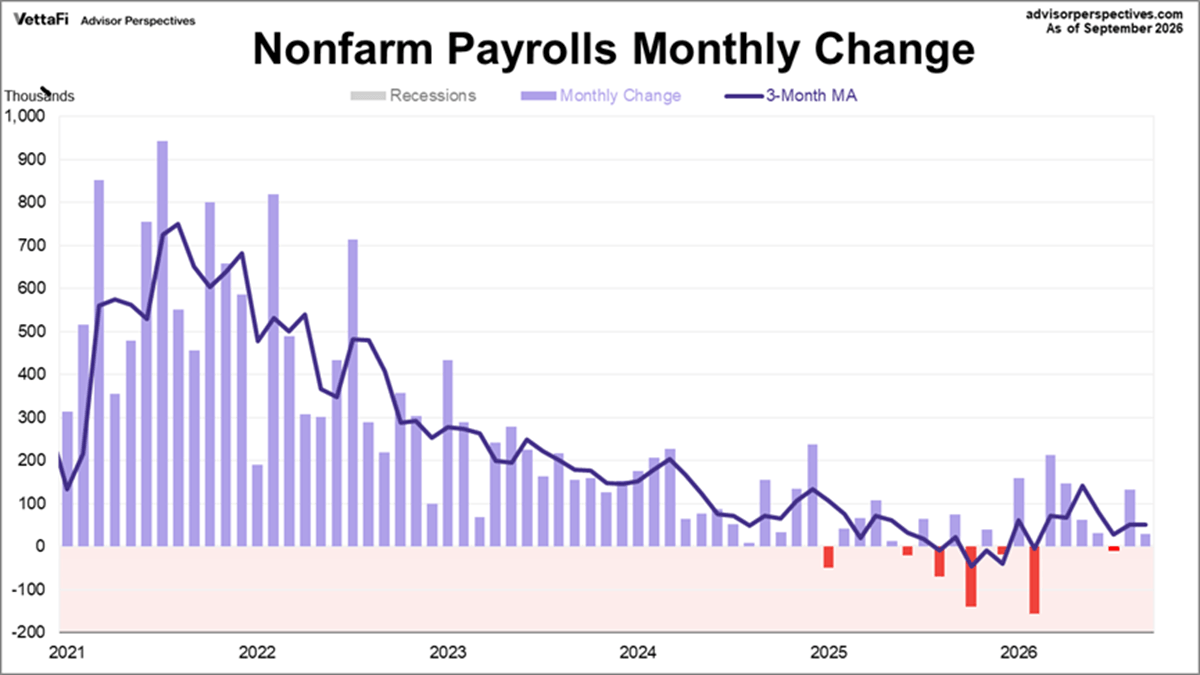
The latest employment report showed that 29,000 jobs were added in September, compared to August's 133,000 gain. This figure was significantly lower than the projected addition of 89,000 jobs. Meanwhile, the unemployment rate increased slightly from 4.1% to 4.2%.
Join VettaFi and Procure ETFs for an educational webcast with insights on how to evaluate companies driving this growth — and how to position space in client portfolios.
How much one needs for retirement is both a mathematical and emotional equation to solve. For both my clients and myself, enough is never enough because we fear a stock market plunge, inflation, or both (stagflation). But these four practical uses of TIPS provide near certainty of having enough to enjoy the rest of one’s life. Rarely do math and emotion each arrive at the same solution.
Today, TINA logic is less compelling. Risk-free five-year and longer Treasury notes and bonds yield over 5%, and investment-grade corporate bonds yield even more. At the same time, stock valuations sit near record levels, implying weak forward returns. The acronym that best describes today's market is TIGA (there is a good alternative).
Financial planners are used to reviewing their executive clients’ financial plans when a major life event occurs, whether it is a promotion, a significant salary increase, retirement, or a liquidity event. But what happens when the client stays in the exact same seat while the organization around them changes fundamentally?
Wall Street has spent weeks trying to make peace with the great bond selloff. Friday offered some short-lived relief — along with a warning about the damage from stubbornly high yields across investment strategies of all stripes.
The dollar neared its strongest levels this year as fiscal strains and renewed political uncertainty in Europe boosted its haven appeal, even as its run of gains stoked concerns the rally is becoming overstretched.
Larger asset managers including Goldman Sachs Group Inc. have been looking to snap up CLO management businesses as they hunt for lucrative fee streams in the $1 trillion US market.
Oil fluctuated in jittery trading, as Saudi Arabia cut prices of its benchmark grade to Asia, the kingdom’s state producer warned about the risk of low stockpiles and as fighting in Yemen intensified.
Remember when near-zero interest rates squeezed retirees on fixed incomes and left pensions with huge shortfalls? I suspect they’re happy to see US interest rates returning to normal.
VettaFi has experienced strong growth as a differentiated index provider in 2026. This momentum continues with today’s acquisition of The SPADE® Defense Index. The deal adds a popular, high-conviction thematic sector strategy to a global platform. More than $260 billion in index-based assets is tied to VettaFi.
The bond market took center stage through September with inflation, oil supply chains and the Federal Reserve performing as an ensemble.
Neither a borrower nor a lender be,” wrote William Shakespeare, who was one of history’s greatest authors but obviously ill-versed in economics. Without lending or borrowing, our modern economic society wouldn’t grow very much, AI or not.
For a quarter of a century, the hyperscalers have been some of the most profitable and technologically innovative businesses ever created. The reason was clear: their marginal cost per additional customer was almost zero. Costs were fixed and scale was effectively unlimited, which meant margins widened as volume grew.
T. Rowe Price has announced the launch of the T. Rowe Price Dynamic Emerging Markets Bond ETF (TDEM) on the Nasdaq today, the company said.
Recent bond market repricing has pushed municipal yields to levels not seen in decades and improved the potential risk-reward profile for fixed income. Here, we examine why municipals stand out, how supportive credit fundamentals shape the opportunity and why investors may benefit from extending maturities to lock in attractive tax-exempt income.
The Fed’s latest 25 basis point hike might represent a recalibration rather than tightening. Instead of focusing on the next hike, investors should watch broader financial conditions and the long-term trajectory for interest rates.
Few investors would naturally put artificial intelligence data centers and US shale oil in the same frame. One is built on advanced semiconductors and software; the other on rock, steel and drilling rigs. But the economic pattern is familiar. A breakthrough changes what is possible, demand outruns supply, attractive profit pools emerge and capital floods in.
Investors who have owned securities for many years can accumulate significant unrealized gains. Selling those investments to reposition a portfolio can trigger capital gains taxes.
Market participants have been conditioned to expect clear Forward Guidance from Fed Chairs. Chairman Warsh has made it clear that Forward Guidance will be less under his leadership, but he has offered a very important qualifier that many have yet to grasp.
Today, we’re going to look at a lot of various data points and analysis, that when taken together give us a much clearer picture of the total world.
This week gave us another glimpse of our AI-powered future. AI personal agents are becoming a thing you need to understand, if not use.
Emerging markets have significantly evolved in recent years and offer a more compelling risk/reward setup than in the past. From deeper local markets to world-leading companies, Emerging markets presents a stronger opportunity than geopolitical volatility suggests.
Softer U.S. inflation and labor data as well as more cautious comments from Federal Reserve officials shifted the rates outlook this week.
Municipal bond asset managers are finding opportunities in the rout that tore through markets this month, with cheaper valuations and the highest yields in years drawing investors.
In September, Vanguard ETFs overall recorded a mix of steady market performance, some volatility, and significant dividend distributions, with investors pouring substantial capital into its funds.
Broadcom Inc.’s Wall Street syndicate is starting to gather $60 billion of fresh AI chip financing to benefit Anthropic PBC and other companies, according to people with knowledge of the matter.
With Microsoft Corp.’s best quarter for decades in the books, Wall Street is betting the stock can keep rallying as the tech giant’s standing in the artificial intelligence landscape continues to improve.
Tesla Inc. shares have tumbled in 2026, but Wall Street analysts are increasingly reluctant to tell investors to sell.
Head over to Polymarket’s US website and you’ll be greeted with a panoply of crystal-ball trades on everything from the midterm elections to the likelihood of a fully reopened Strait of Hormuz. Try that in France, where I live, and you’ll see something very different.
An important decision in special needs planning isn’t necessarily one that can be found in textbooks, determined by a formula in a spreadsheet, or governed by laws or regulations. It’s the choice of the people who will surround your loved one when you can no longer.
Chuck Carnevale explains the Rule of 72 and shows how earnings growth can compound over time. Using FAST Graphs and real stock examples, he explores how growth and valuation affect long-term returns.
Fixed-income investors are being paid more to take risk than they have been in years, but not all opportunities are created equal. Higher yield levels, heightened volatility and growing differences across countries, sectors, industries and issuers are expanding the opportunity set. Dispersion is the raw material from which active returns are generated. Below are four ways investors can capitalize on it.
Midterm elections are increasingly taking over the headlines, and that includes coverage of markets. While inflation, rates, and geopolitics probably have more outright impact on portfolios, investors and market watchers still look to midterm elections as a major event.
Franklin Equity’s Grant Bowers discusses why a higher cost of capital does not change the capital expenditure outlook.
The sell-off in U.S. Treasury (UST) yields has continued pretty much in an unabated fashion In fact, multi-year high watermarks are being achieved throughout the fixed coupon maturity curve. The most widely followed development was the UST 10-year yield rising to its highest level since 2007.
Markets await a possible Fed rate hike as Congress weighs Trump's dividend proposal, a limited fall session, and a Senate vote on crypto regulation.
The takeaway from Q3 isn't that the IPO recovery is dead, it's that it has entered a far more tactical phase. The appetite to register is undeniably present, but the window to price comfortably has narrowed. For big names like OpenAI and Oura, taking extra time to clear safety, governance, or market noise is a luxury of strength, not desperation.
Yesterday’s cooler-than-expected PCE print finally gave the bond market a breather, pulling Treasury yields down from their brief 5.3% peak. For financial advisors, this recent whiplash brings fixed income duration conversations back to center stage — specifically, balancing the hunt for long-term yield with the safety of ultra-short cash alternatives.
You can’t spot it on the field or in the stadium. You can’t correct it in training. Or cure it with a dose from the team doctor. But it’s a malady an overwhelming number of professional athletes will face.
AI could be a transformative force for the Fed’s policy framework. Elevated investment demand – now coupled with positive wealth effects that are necessitating tighter financial conditions – could eventually give way to a positive supply impact from higher productivity growth that could allow for easier financial conditions without inflationary implications.
Munis can fund local power, grid, water and wastewater infrastructure; most AI campus capital will be financed in non-municipal markets.