For months investors have faced a dilemma — pay through the nose for technology giants trading at eye-watering multiples, or wait for a cheaper entry point and risk missing out on the year’s biggest bull run.
The Federal Reserve is being challenged with one of our most important tenets: levels versus momentum.
Take the market narrative with a grain of salt and look at the fundamentals in determining your outlook for the economy and financial markets. We ultimately believe this soft patch of data will prove to a be a ‘growth scare,’ not a ‘recession reality.’
Rotation - The Earth's axis has an inclination of 23.5 degrees relative to its orbital plane around the sun.
Friday’s weaker-than-expected jobs report has sparked a robust debate about whether the economy is sliding into recession or whether the rise in the unemployment rate in July was due to a continuing post-pandemic normalization of the labor market.
The softening trends in both inflation and labor data are sending a message that monetary policy is too restrictive.
During each speculative run-up in asset prices – whether the dot-com bubble, the housing bubble, or more recently the rapid rise (and fall) of the stocks of electric vehicle companies – there’s typically a moment when Wall Street strategists, analysts, and investors go all-in on that theme.
Recent macroeconomic and geopolitical developments, along with shifting AI sentiment, have raised concerns over whether strong headline returns, low volatility, and persistent mega cap tech leadership can continue as we look ahead.
On the latest edition of Market Week in Review, Investment Strategist BeiChen Lin and ESG and Active Ownership Analyst Zoe Warganz discussed key takeaways from recent central bank meetings. They also provided an update on how U.S. small cap companies are performing during second-quarter earnings season.
The relative weakness in July’s nonfarm payroll employment number and the increase in the rate of unemployment from 4.1% in June to 4.3% in July, triggering the Sahm Rule is a reminder of the difficult tasks ahead for the Federal Reserve.
The strong currency is neither a blessing nor a curse.
Never before in my history studying the Federal Reserve (Fed) has the Fed’s policy come into question immediately following the Fed decision.
As Milton Friedman taught us many decades ago, monetary policy works with long and variable lags. Recent economic reports suggest that the long and variable lags on the tightening of monetary policy in 2022-23 are starting to come to an end.
A recent mid-year strategist pulse check from Natixis revealed where strategists believe the top opportunities exist across markets.
Dollar cost averaging involves committing money to the stock market gradually, rather than all at once. This time spent out of the market leads to lower returns, but also to commensurately lower risk.
In my opinion, the primary reason that yields are too high is a pronounced fear from the Fed and bond investors of another round of inflation. The Fed runs an extraordinarily tight monetary policy to ensure it doesn’t reoccur.
De Leus and Gijsels, both originating in the world of institutional brokerage identify the five principal trends affecting investments in the near future. The two take turns writing chapters so that the book is a straight man/funnyman show, with the straight man providing mostly sound, conventional analysis and the funnyman interviewing dead economists and Fed chairmen not yet born.
Global bonds rallied as traders bet the Federal Reserve and fellow central banks will turn more aggressive in cutting interest rates amid mounting concern that economic growth is faltering at a faster pace than expected just weeks ago.
With stock markets plunging around the world, traders are talking up the prospect of an emergency interest-rate cut from the Federal Reserve after the US central bank passed up the opportunity to ease policy last week. Not only is this highly unlikely, it would be counterproductive.
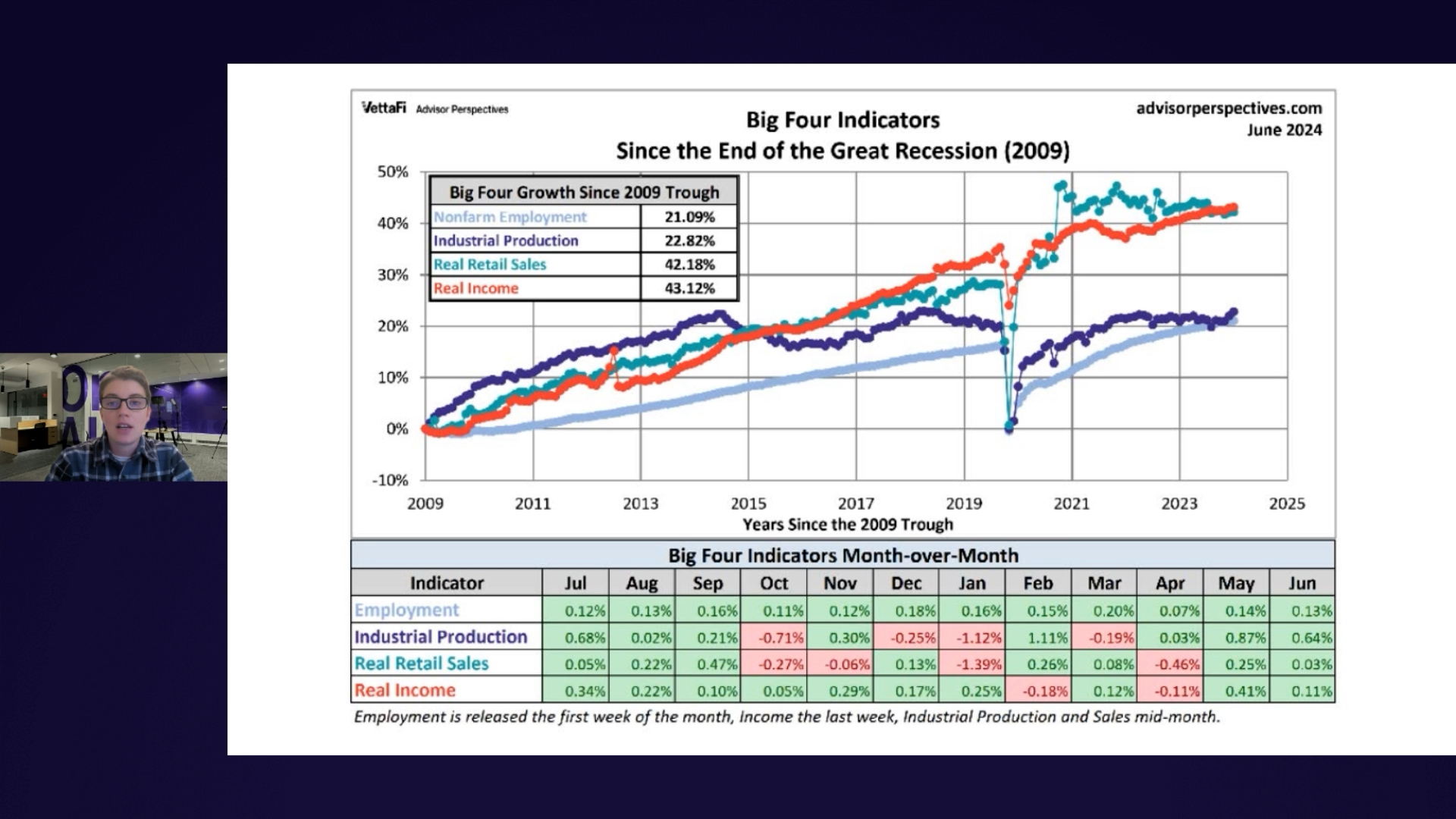
Economic indicators are released every week to provide insight into the overall health and performance of an economy.
The Federal Reserve is between the Rock of Gibraltar and the Rocky Mountains. The data they use to explain their policy choices is in apparent transition. A self-aware analyst, seeing the conflicting data, knows that the right policy choice will only be understood in hindsight.
When growth slows and rates fall, what will happen to an asset class with long-dated cash flows that are not very economically sensitive? Well, it is likely to strongly outperform. Ergo the short-term outlook for growth relative to value/small caps appear to be rosy.
On July 31, the U.S. Treasury released its most recent Quarterly Refunding Announcement which revealed its financing strategy, presenting both positive and restrictive elements for global liquidity.
The members of the Bank of England’s Monetary Policy Committee (MPC) are probably not intimately familiar with Taylor Swift’s back catalogue. If they were, Swift’s hit “Cruel Summer” may have been ringing in their ears when cutting rates today for the first time since March 2020.
Once again, the Fed kept rates unchanged at the July FOMC meeting. As a result, the Fed Funds trading range remains in the 5.25%–5.50% band that was introduced exactly a year ago and still resides at a more than 20-year high watermark.
While election news dominated July's headlines, small-cap stocks had their best monthly performance relative to large-cap stocks since December 2000.
We have been talking about resiliency-driven inflation for the past several weeks. As the US and its Western allies realign supply chains to strengthen economic resiliency, the cost of certain goods and commodities will go up.
Cassandras seldom get opportunities to be right about two disasters. Even the original Cassandra scored no notable victories after predicting the fall of Troy. But when a seer who successfully called one catastrophe warns of another coming, you might want to listen.
The bond-market rally escalated Friday after a report showed that job growth slowed sharply last month, further stoking speculation that the Federal Reserve will start aggressively cutting interest rates to keep the economy from stalling.
The violent rotation from Big Tech plunged the Nasdaq 100 Index into correction territory, wiping out more than $2 trillion in value in just over three weeks, as traders unwound bets that had been minting money for over a year.
The central bank’s latest policy statement and Chair Jerome Powell’s remarks suggest that an initial interest rate cut could come as soon as September.
The Federal Reserve noted that inflation is moving closer to its 2% target after electing to hold rates steady at its July FOMC meeting.
The Northern Trust Economics team shares its outlook for growth, inflation and interest rates in major markets.
Coming into this earnings season, one of the most intriguing questions was how well the consumer-facing companies would be able to maintain their pricing power. The new algorithm for success is a bit more complicated than “raise prices by x.”
In this article, Russ Koesterich discusses factors behind gold’s impressive performance year to date.
Economists Stephen Miran and Nouriel Roubini are making waves by suggesting in a paper published last week that the Treasury Department has actively engineered easier financial conditions by increasing the issuance of short-term bills and, consequently, reducing the share of longer-term notes and bonds, thereby keeping yields lower than they would otherwise be.
The Federal Reserve kept its policy rate unchanged at the July meeting, but left the door open to rate cuts later this year.
Federal Reserve Chair Jerome Powell signaled central bank officials are on course to cut interest rates in September unless inflation progress stalls, citing risks of further labor-market weakening.
Nvidia Corp.’s wild ride this week is headed for the record books.
Demand growth is cooling, but evidence suggests that overall fundamentals are still sound.
Could this be the last Fed meeting before rate cuts begin? With inflation moderating and job growth weakening, the Fed prepared markets for a more eventful meeting in September while not committing to anything just yet.
Jeff and Ron discuss the state of the economy, inflation, the bond and stock markets, and they outline, in broad terms, their current investments.
Official recession calls are the responsibility of the NBER Business Cycle Dating Committee, which is understandably vague about the specific indicators on which they base their decisions. This committee statement is about as close as they get to identifying their method.
Which financial assets a central bank should buy and sell is hardly a novel question. Historically, the US Federal Reserve has focused on shorter-term Treasury securities, but quantitative easing had the Fed buying mortgage securities and quality commercial paper in significant quantities. More generally, central banks often hold gold and foreign currencies.
The US Treasury left its quarterly issuance of longer-term debt unchanged for the second straight time, and maintained its guidance that it doesn’t expect to need increasing issuance of notes and bonds for “several quarters.”
Value — defined by stocks with a low book-to-market ratio — handily beat growth by a minimum of 4% on average annually over the period 1927-2014, although surprisingly with a higher standard deviation. In today’s world, think Verizon versus the Magnificent Seven decades forward.
We are approaching a turning point in policy decisions as the FOMC attempts to walk the fine line of hitting their inflation targets while maintaining a healthy labor market.
The economic data is coming in very good for markets. Starting with GDP, we observed a modest growth rate of around 2% in the first half of the year. While not spectacular, it’s far from recessionary conditions. This level of growth, with slight inventory accumulation, suggests a stable economic backdrop.
I chaired an international economics conference in Canada earlier this month. Delegates from all over the world attended to discuss the issues of the day. Following is an abridged version of the meeting summary that I offered during the closing session.
Overly optimistic investor expectations of market returns may be a problem.