As we write this, stocks have bounced back as Trump retreated from electronic tariffs from China. Nevertheless, this was a remarkable week for markets with Trump’s tariff policy taking center stage for market stress across stocks, bonds and currencies.
The reciprocal reprieve does not alter the tectonic shift in the trade outlook.
Markets have had a wild ride these past couple of weeks, alongside chaotic tariff-related news, with volatility (and its policy triggers) most elevated in the bond market.
US equities extended a rebound into a third session Tuesday as traders weighed the ongoing global trade war against a slew of positive earnings reports from Wall Street banks.
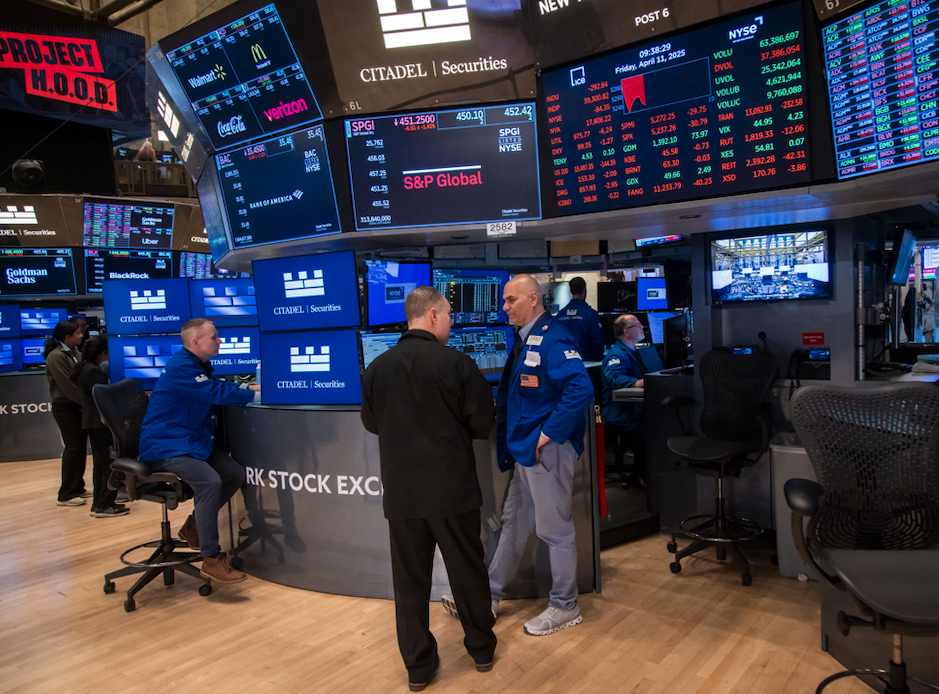
Wall Street on Monday finally caught a respite from the deep selloffs and unusually sharp swings that have raced through markets ever since President Donald Trump unleashed his global trade war.
The American consumer is tapped out. The savings buffer is gone, wage growth is declining, and credit costs are rising. Corporate America is already adjusting to this new reality, with companies issuing cautious guidance for 2025.
On Monday, April 7, the S&P 500 dropped as much as 4.7% at the session low before whiplashing higher on reports of a potential tariff delay—closing the day up 3.4% from Friday’s close.
Swap spreads measure the difference between the interest rate on a swap and the yield on a Treasury bond with the same maturity.
In a tumultuous environment, investors increasingly turned to actively managed bond ETFs this year according to JPMAM research.
Yield spreads are critical to understanding market sentiment and predicting potential stock market downturns. While yield spreads have widened, they remain well below the long-term averages. However, if recession risks increase due to tariffs, sentiment, or illiquidity, those yield spreads will widen further.
Last week’s data can be summarized by a volatile market reacting to tariff news and a backwards-looking inflation reprieve.
After sparking the steepest plunge in financial markets since the global pandemic five years ago, President Donald Trump’s administration made another dramatic pivot in its trade war strategy on April 9: It paused for 90 days the “reciprocal” tariffs that had been in effect for less than 24 hours.
After starting the year on a high note with the S&P 500 index of U.S. Large Cap stocks posting an all-time high on February 19th, equities retreated during the second half of the quarter, officially falling into correction territory (down 10 percent) on March 13.
Another period of heightened volatility in the markets reminds us why tax management can be such an essential part of fixed income investing.
It was a wild week on Wall Street after President Donald Trump announced a broad new tariff policy that went beyond what most analysts had anticipated, spurring a plunge in both stock and bond markets.
Bonds have gained as investors sought shelter amid growing fears around a tariff-driven global economic slowdown.
Earnings season begins with companies adjusting on the fly to tariffs. This could give investors insight into strategies firms are taking and how businesses might be affected.
On 2 April, the Trump administration announced sweeping tariffs that were more aggressive than many had expected. Then on 9 April, the administration announced a 90-day pause on most of the new country-specific “reciprocal tariffs.”
Concerns about a trade war have rattled markets so far in 2025, but we believe fixed income investors need to be patient, stay defensive, and see how things evolve before making any big decisions.
Last week President Trump announced tariffs on nearly all US trading partners, a move that far exceeded the most pessimistic expectations of market participants.
Given the abundance of market uncertainty, it may be best to adhere to Treasuries, or for additional yield, to municipal bonds.
With the financial markets still wrestling with the tariff announcements from last week, one thing is still certain: uncertainty remains an integral part of the investment landscape.
Shorter-term Treasuries gained after an unexpected ebb in US inflation last month calmed bond traders shaken by President Donald Trump’s evolving trade policy.
In an era when a select group of tech behemoths has dominated market returns, investors are growing increasingly wary of the concentration risk it poses.
Callable bonds make up a large share of the bond market—and introduce one more variable into the bond-investing process.
VettaFi addresses common questions on midstream/MLPs, oil prices, recessions, and tariffs following last week’s equity sell-off.
With a number of factors at play, the short-term pullback in gold will likely meet resistance to the long-term, unchanged fundamentals,
Market valuation indicators are used by investors and analysts to gauge whether markets are overvalued, undervalued, or fairly valued relative to historical norms. Here is a summary of the four market valuation indicators we update monthly.
Treasury Secretary Scott Bessent played down a selloff in US Treasuries, saying that there was nothing systemic at play, and also served warning against China not to attempt to devalue its exchange rate in retaliation for American tariff hikes.
An enduring image from 2024 will be the capture of the SpaceX booster rocket by the Mechazilla robot arms on its return to Earth.
While there are no absolute winners in a trade war, there may be relative winners in the global stock market for investors to consider.
At the start of last week, the S&P 500 rallied three days in a row, with investors believing that the tariffs announced on Wednesday would be targeted.
Tariff Turbulence. The President’s long-anticipated tariff announcement on April 2 has come and gone. Our hopes for some clarity, so the uncertainty weighing on confidence and the equity market could subside, were dashed after we heard the breadth and magnitude of the administration’s tariff plan.
US Treasuries tentatively resumed their gains on Tuesday after the wildest day for bond traders since the height of the pandemic in March 2020.
President Donald Trump’s bombshell Liberation Day tariff announcement was greeted with one of the worst two-day US stock market routs on record. Whatever you think of Trump’s tariff policies, they are a huge gamble, and no one knows how things will play out.
As investors are uncomfortably aware of, global equity markets have been in freefall since U.S. President Donald Trump’s announcement of “reciprocal tariffs” on April 2.
Moving forward, investors may want to keep investment-grade options close with a few from Vanguard to consider.
Chinese shares plunged and sovereign yields neared an all-time low as investors braced themselves for the fall-out of a spiraling trade conflict between the world’s two largest economies.
Last week's economic landscape was dramatically reshaped by President Trump's announcement of sweeping tariff policies on what he declared "Liberation Day." His announcement triggered a historic sell-off in the stock market.
Global markets are in freefall in response to President Donald Trump’s universal 10% tariff on all goods being imported into the U.S., with as many as 60 countries facing “reciprocal” tariffs on top of that.
The incremental tariffs were bolder than market expectations and ushered in new uncertainty.
The tariff chaos continues … but the economy remains intact. For now.
On the latest edition of Market Week in Review, Director and Senior Investment Strategist Alex Cousley discussed the details of the Trump administration’s tariff plan and the market’s reaction.
U.S. stocks underperformed in the first quarter of 2025, hit by a double whammy from intensifying policy uncertainty and a U-turn in select mega cap stocks.
In the report, Fixed Income Portfolio Managers John Lloyd and Greg Wilensky discuss how fixed income markets are responding to Trump’s sweeping tariffs and the implications for investors.
U.S. indexes suffered their worst day since the pandemic, hurt by Trump's massive tariffs that sparked recession fears. Almost every sector fell, with retailers and tech hard hit.
In the report, Fixed income portfolio managers Brent Olson and Tim Winstone reflect on the initial credit market response to President Trump’s tariffs.
Traders boosted their bets on Federal Reserve interest-rate cuts this year and US Treasuries rallied as a solid report on American jobs failed to calm markets.
The combination of slowing economic growth and stubborn inflation, combined with uncertainty about U.S. tariff policy, is keeping investors cautious.
Adam Hetts, Global Head of Multi-Asset & Portfolio Manager, and Oliver Blackbourn, Portfolio Manager, give their thoughts on how US President Trump’s ‘Liberation Day’ tariffs have reshaped global trade dynamics, emphasising the benefits of diversification at a time of heightened uncertainty about the prospects for growth.