President Donald Trump’s bombshell Liberation Day tariff announcement was greeted with one of the worst two-day US stock market routs on record. Whatever you think of Trump’s tariff policies, they are a huge gamble, and no one knows how things will play out. What we do know, however, is that uncertainty makes the stock market more volatile.
So it was after Trump’s sweeping tariff announcement. The S&P 500 Index tumbled 10.5% last Thursday and Friday, a two-day drawdown rarely surpassed over the past 100 years and, then too, almost exclusively during the Great Depression, the infamous 1987 crash and the 2008 financial crisis. Understandably, I received many calls and texts from concerned friends and investors wondering if we are facing a fresh crisis. My answer was no — at least not yet.
What makes this selloff so jarring is its speed. But speed is not severity. The S&P 500 is down 17% from its Feb. 19 peak through Friday, less than the 20% drop that marks the start of a bear market. And the headline number overstates the impact. A good chunk of the S&P 500’s decline is attributable to the technology giants that dominate the index. The S&P 500 Equal Weight Index, by contrast, is down a more modest 14% over the same time.
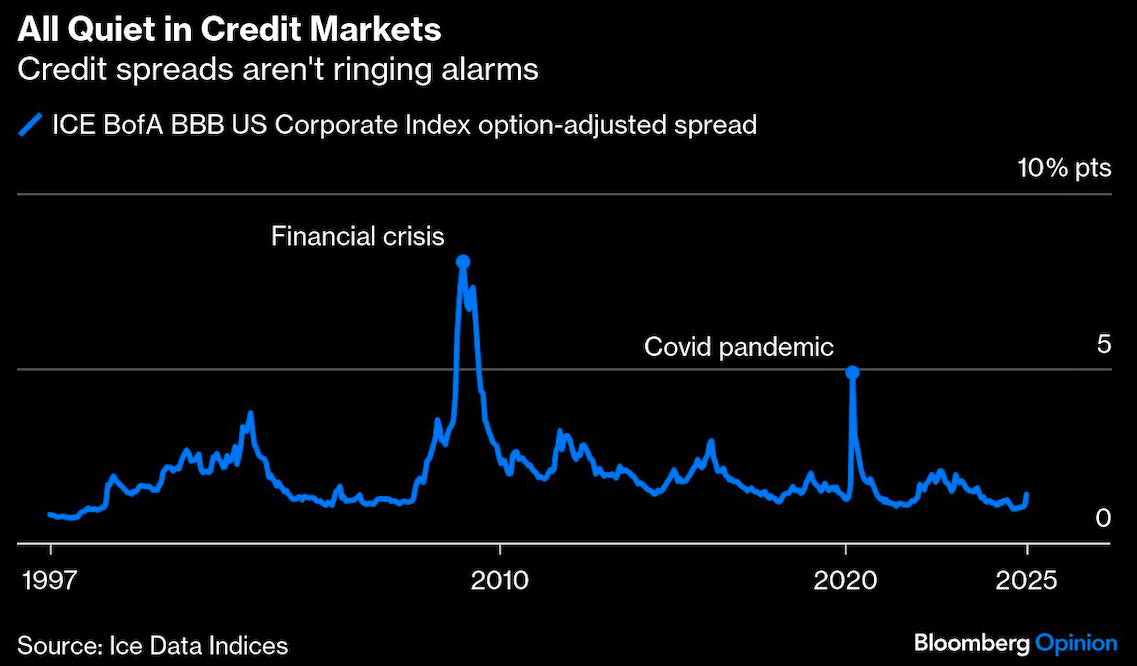
Other market gauges show little concern so far, if at all. Notably, credit spreads — the difference in yield between corporate bonds and Treasuries — reliably spike during crises. Spreads for high quality borrowers surged to nearly 8 percentage points during the financial crisis, signaling that a growing number of companies were struggling to pay their debts. Today, those same credit spreads are barely above a percentage point. Even credit spreads for troubled borrowers, while higher last week, remain close to historic lows.

None of that resembles a crisis, but there are signs the economy is slowing. The 10-year Treasury yield is down sharply since the beginning of the year. The two-year Treasury yield is lower, too, signaling that the Federal Reserve will cut short-term interest rates by about 0.5 to 0.75 percentage point this year. Those moves in Treasury markets accelerated after the White House’s tariff announcement last week. They are also echoed by the Atlanta Fed’s estimate that real gross domestic product contracted at an annual rate of 2.8% in the first quarter.
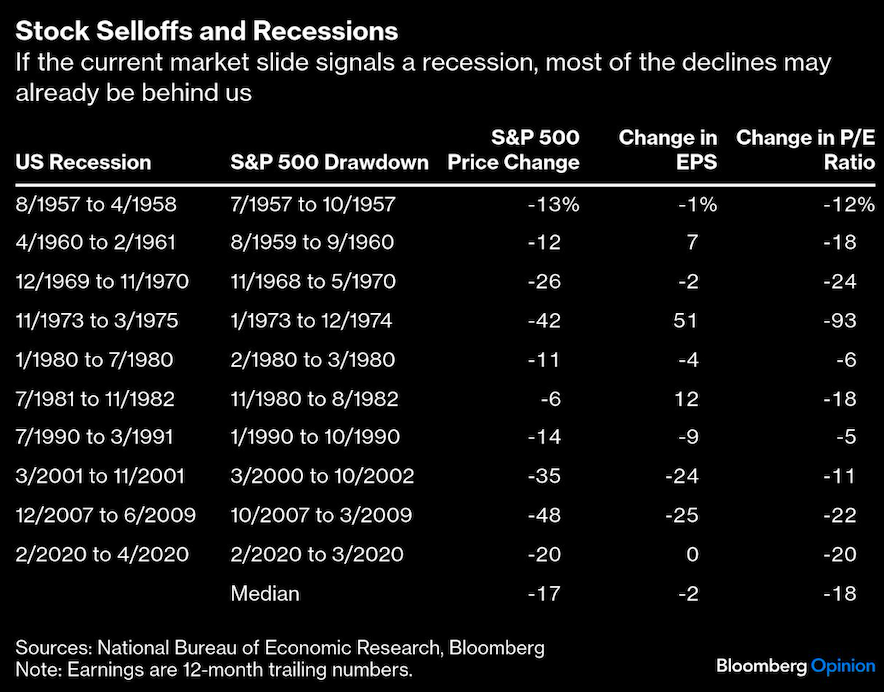
The question investors should be asking, then, is what to expect if the economy tips into recession. For guidance, I looked at how the S&P 500 performed during each of the past 10 recessions, a period that stretches back to the mid-1950s. Specifically, I calculated the index’s peak-to-trough decline corresponding with each recession using month-end prices.
The first thing that jumped out was that the market typically sold off in advance of recessions. That may be what it is doing now, perhaps informed by warnings from a number of highly regarded economists about the impact of the tariffs being contemplated. I was also strangely reassured by the severity of past drawdowns. The median decline during the 10 episodes I looked at was 17%, matching the S&P 500’s drop so far. In that light, it’s entirely plausible that the worst of the selloff is already behind us.
Also reassuring is that the three scariest episodes in the data are easily distinguishable from the current moment. Two of them followed historic stock bubbles: the Nifty Fifty mania of the early 1970s (-42%) and the dot-com craze of the late 1990s (-35%). The market wasn’t cheap before this selloff began, but it was no bubble. The third and deepest slide resulted from the global financial crisis (-48%). This is not that.
This selloff does resemble previous recession-adjacent drawdowns in that it seems to be driven more by sentiment than fundamentals. The speed of the selling suggests investors aren’t waiting around to see how companies navigate the apparent economic slowdown — or the tariffs. The data suggests it’s not unusual for investors to sell first and ask questions later. The S&P 500’s valuation, as measured by its 12-month trailing price-earnings ratio, contracted in every one of the 10 selloffs I looked at. Earnings, by comparison, declined on only six of those occasions. The declines were also predominantly attributable to lower valuations: The median valuation contraction was 18%, whereas the median decline in 12-month trailing earnings was just 2%.
To me, all of this — the fact that the selling so far seems to be motivated by emotion more than calculation, and that the market is already down a good portion of the amount one would expect in anticipation of recession — is good reason not to join in the selling.
Here’s another: A lower market doesn’t guarantee a recession. Economist Paul Samuelson once quipped that “the stock market has predicted nine out of the last five recessions.” Indeed, there have been 37 bear markets or corrections since the mid-1950s, well more than the 10 recessions in that time.
It’s a reminder that the market isn’t the economy — sometimes stocks sag for reasons all their own. And sometimes market moves in anticipation of recession, such as lower interest rates or lower energy prices, bolster a slowing economy and help it avoid recession. And, of course, sometimes the market just gets it wrong. The collective wisdom of markets is the best gauge we have, but it’s not infallible.
None of this means that a tariff induced crisis is off the table. Markets are moving fast, and things could look meaningfully different in a few days. If the stock market selloff accelerates, P/E ratios dip into the low teens or lower, credit spreads spike and Treasury yields plunge, those will be signs of a deeper crisis — and a historic buying opportunity.
But we are still far from there, and for now, the best move is probably to sit tight.
A message from Advisor Perspectives and VettaFi: To learn more about this and other topics, check out some of our webcasts.
Bloomberg News provided this article. For more articles like this please visit
bloomberg.com.
Read more articles by Nir Kaissar