If the current slate of proposed U.S. tariffs is implemented, our model estimates a 60-to-80 bps increase in cost structures across most sectors of the global economy.
How will potential trends in inflation, the US dollar and supply deficits across many raw material markets affect the environment for investing in commodities?
At the start of each new year, there are regular predictions that international equity markets will outperform U.S. large-cap ones.
US retail sales slumped in January by the most in nearly two years, indicating an abrupt pullback by consumers after a spending spree in the closing months of 2024.
Apple Inc.’s China business kicked off the Year of the Snake inauspiciously.
Meta Platforms Inc., after pushing into augmented reality and artificial intelligence, has identified its next big bet: AI-powered humanoid robots.
DeepSeek may be that catalyst, forcing investors and technologists alike to question long-held assumptions and reevaluate the competitive landscape in real time.
This article introduces GARP – growth at a reasonable price. As we will detail, by introducing earnings growth expectations into traditional valuation equations, some value stocks may not be quite the gems investors think. Likewise, some growth stocks may be value stocks.
’ll first summarize their projections and note what I think are some shockers. Then I’ll take a look at how accurate their past forecasts have been. Finally, I’ll conclude with what I’m changing in my own portfolio...
A hedge fund startup that uses artificial intelligence to do work typically handled by analysts has outperformed the global stock market in its first six months while slashing research costs.
Treasury yields dropped to weekly lows Friday after weak January retail sales data prompted traders to restore bets that the Federal Reserve will cut interest rates by September.
As we enter Valentine’s Day weekend, financial infidelity isn’t exactly a topic that exudes romance. But lovebirds who don’t make the discussion a foundational piece of their relationship risk adding avoidable strain on their union.
Markets always look their very best at the top - that's increasingly the case with gold as it nears $3,000 a troy ounce. It's behaving like a Veblen good, an item for which, contrary to the laws of economics, demand increases with price.
For four years, Indians sensed that the US was terrified of the word “trade.” Joint statements after summits buried trade such issues somewhere near the end; officials avoided the question at press conferences, preferring to focus instead on relatively esoteric concerns such as cooperation in space.
President Donald Trump ordered his administration to consider imposing reciprocal tariffs on numerous trading partners, raising the prospect of a wider campaign against a global system he complains is tilted against the US.
It is not just tariffs that might affect inflation and growth but also trade uncertainty and the effects of the ambitious Trump policy agenda.
It’s mid-February and earnings season is in full swing. All I really want to know is if Mr. Market is going to be my Valentine… or not. Earnings data hits, political comments are made, and investors react. The CNN Fear & Greed Index is at dead neutral.
The January Employment Situation Report reaffirmed the resilience of the U.S. labor market, with nonfarm payrolls rising by 143,000 and the unemployment rate ticking down to 4.0%.
Building a bond portfolio these days isn’t easy. Interest rates have been volatile. Credit spreads are tight. And sweeping change in US fiscal, trade, and regulatory policy is underway. We think securitized assets deserve a closer look.
At the same time, the Fed has mostly ignored the impact of easy financial conditions—the combination of stock, bond, and credit conditions—offsetting increases in interest rates by bolstering wealth and confidence.
2025 is beginning in much the same manner as 2024, with investors focused on whether the Chinese government is going to implement new stimulus measures.
Cash flow and income sometimes get commingled, potentially creating confusion. Cash flow and yield typically represent two different components that can be used to accomplish different objectives.
We are observing a significant shift in global supply chains away from China, presenting a substantial investment opportunity. What are the reasons behind this shift?
The investment teams at Man Group and KraneShares have developed a liquid alternative that attempts to solve issues with conventional private equity funds by bringing PE-return drivers to a public equity ETF. Join them for an educational webcast exploring liquid private equity, return drivers, and how to use ETFs to gain exposure to liquid private equity.
Federal Reserve Chair Jerome Powell said the latest consumer price data show that while the central bank has made substantial progress toward taming inflation, there is still more work to do.
Elon Musk praised his upcoming Grok 3 chatbot as an AI model outperforming everything else that’s been released thus far, and said the world would get to see it in a matter of weeks.
Investors in America’s biggest company are increasingly focused on China, where Apple Inc. is striving to win over a crucial customer base while also facing tariff-related risks.
Microsoft Corp. is bigger than most countries’ whole stock markets and its bond rating would be the envy of many nations.
Jeremy Grantham’s Boston-based investment firm is tapping into popular demand on Wall Street for emerging-market strategies that avoid China altogether, as investors prep for fresh disruptions across global supply chains on the back of Donald Trump’s combative trade posture.
US wholesale prices rose in January by more than forecast on higher food and energy costs, highlighting only limited progress on inflation ahead of tariffs imposed by the Trump administration.
Recent developments may just offer advisors and investors fresh pathways with which to attain higher yield in 2025.
A closer look at the broader landscape reveals why the United States remains positioned to pursue a strategy of tariffs.
The article introduces CC CAPE, a modified version of Shiller CAPE, which corrects index biases for improved forecasting. While both measure market valuations for long-term return forecasting, the CAPE Spread helps gauge sentiment for medium-term predictions.
Perhaps US efforts to cut off China’s access to advanced semiconductors will be more successful than analogous restrictions on tech exports to France in the 1960s. But we now have at least one data point – DeepSeek – that suggests otherwise.
Michael Contopoulos breaks down why CLOs offer attractive relative value, why short-duration positioning may help manage interest rate uncertainty, and the importance of an active approach for this year in particular.
The Federal Reserve’s record of forecasting has frequently led it to respond too late to changes in economic and financial conditions. In the most recent FOMC meeting, the Federal Reserve changed its statement to support a pause in the current interest rate-cutting cycle.
For 2025 tax planning, our Bill Cass shares income tax planning strategies that can help manage current tax bills and prepare for future changes. Here are the highlights.
Managers are cognizant of potential risks to portfolios, identifying dominant Chinese component manufacturers, North American automotive supply chains, and smaller cap industrial cyclicals as market segments worth monitoring.
Could the U.S. dollar lose its place as the world's reserve currency? Despite a long-term trend toward currency diversification, we don't see the dollar losing dominance anytime soon.
Market valuation indicators are used by investors and analysts to gauge whether markets are overvalued, undervalued, or fairly valued relative to historical norms. Tune in for a summary of the four market valuation indicators we update monthly.
You’ve set your 2025 budgets, and now you’re working with them – but is your marketing budget supporting the firm’s growth goal?
Let’s explore how to strike the right balance to keep your client meetings engaging, relevant, and impactful.
President Donald Trump called for lower interest rates, seeking to raise pressure on the Federal Reserve as he moves to implement a second-term economic agenda high on tariffs and expanding tax breaks.
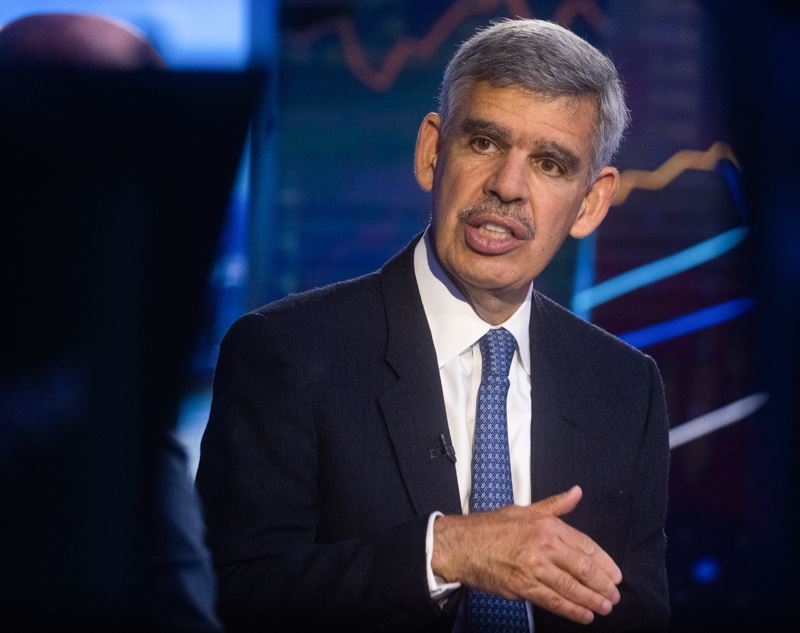
The Federal Reserve is set to refrain from cutting interest rates for “quite a while,” following a hotter-than-expected inflation report, according to Mohamed El-Erian.
Private equity firms are facing early tests to the theory that Donald Trump’s return to the White House is a net win for America’s dealmakers.
Nvidia Corp. investors have typically rushed to buy the stock on any dips. But the mood since the DeepSeek-driven rout has been different, signaling that fears of a slowdown in AI spending aren’t going away.
The AI flight is taking off, and DeepSeek is the final call for India to show up at the boarding gate. Since its private sector is too risk averse to back research projects with uncertain payoffs, the state will have to step up.
Join the experts at ROBO Global for a free educational webcast and set yourself up for a deeper understanding of AI and Robotics.
Billionaire investor David Tepper has certainly made up his mind. He doubled down on his bet on Chinese stocks last quarter, adding positions in e-commerce platforms Alibaba Group Holding Ltd. and JD.com Inc., as well as index funds that track some of the country’s biggest companies.
It’s not easy when someone doesn’t want to look at their own culpability in relationships. But you can only control what’s controllable, and we don’t control others, much as we endeavor to do so.