In this article, we will explore the performance and characteristics of key ETFs representing the semiconductor and technology categories, respectively, using advanced data analytics tools provided by LOGICLY.
Municipal bonds posted positive absolute and relative performance in June. Modest primary and secondary supply was outpaced by improved demand. While July has historically been a top-performing month, we maintain some near-term caution.
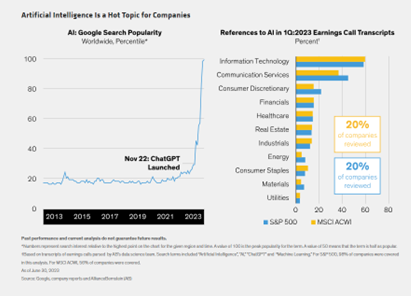
Artificial intelligence has quickly become a hot topic around dinner tables and in corporate boardrooms. But delivering business benefits from AI will take time. Investors should proceed with caution.
Chief Economist Eugenio Alemán and Economist Giampiero Fuentes note that while it is taking longer to bring inflation down, the Fed will continue to conduct monetary policy to reach its target rate.
Against the backdrop of the funds' goal of long-term capital appreciation, we aim to generate excellent financial performance that is fueled in part by the strategic sustainability focus of the companies in which we invest.
In his latest paper, James Montier lays out a framework for spotting what he terms “slow burn Minsky moments,” or the economic vulnerabilities associated with the build-up of private sector debt.
Formed in 2017, the firm is headed by ETF visionaries Bruce Bond and John Southard, founders of PowerShares ETFs, one of the largest ETF providers in the world.
Drawing on data from LOGICLY, this article will dive into the Treasury ETFs that boast the highest YTD inflows, shedding light on some of their standout features and key characteristics.
Tech giant Microsoft is on a mission to use technology to solve some of the world’s most pressing problems.
Factor investing can help drill through broad sector labels to help investors better understand past performance and expected returns.
Prior to 2008, when the Federal Reserve ran a “scarce reserve” monetary policy, just about every bank in the US had a federal funds trading desk. These trading desks lent and borrowed federal funds (reserves) amongst each other.
Chief Economist Eugenio J. Alemán discusses current economic conditions.
An upturn in residential activity may be the next inflation challenge.
Global equity markets have had a very strong first half of the year, but it’s a pretty unusual time because, on the one hand, equities are contending with a pretty difficult macro backdrop.
Led by the Federal Reserve’s campaign of increasingly large hikes, interest rates have risen meaningfully year-to-date. Conventional wisdom would guide investors to sell fixed income — a reflection of one of the most fundamental relationships in the investment world: as rates go up, their investments go down.
Economic indicators are released every week to help provide insight into the overall health of the U.S. economy. In this article, we cover three of the most important economic releases from the past week: the BLS employment report, job openings, and labor turnover (JOLTS), and the ADP employment report.
Higher expected corporate earnings mask broad pressure under the surface. We see more earnings pain ahead and look for opportunities at the sector level.
The tech sector was the MVP of the first half. Tech is likely to maintain All-Star status in the second half.
We’re tactically cautious on developed-market equities with a broadly risk-off stance, but we have a relative preference for emerging-market (EM) stocks over a 6- to 12-month horizon.
Income-driven repayment will ease the burden of resuming student loan payments.
The recent collection of labor data has painted a mixed jobs picture, but underlying wage strength and still-strong payroll growth will likely keep the Fed in a hawkish position.
VettaFi’s coming Fixed Income Symposium is timed to go live just days before the next FOMC meeting. The Symposium goes live on the 24th and the next FOMC meeting is scheduled for July 25th – July 26th.
In his latest memo, Howard Marks discusses five market calls he’s made during his career. He argues that investors seeking to know the market’s likely direction should focus on taking its psychological temperature and understanding the nature of cycles. Just as importantly, they should learn to control their own emotions and have the humility to know when not to make a call.
Shifting the risk-reward ratio in your favor.
Following a strong start to 2023, CIO Larry Adam and his team share their outlook for the remainder of the year.
Several ETFs offer targeted exposure to the burgeoning Indian economy. In this article, we will dive into four top-performing India ETFs, exploring their key characteristics.
Low commodity prices are containing inflation in emerging markets.
Given attractive yields and strong credit conditions, we have a positive view on the municipal bond market for the second half of the year.
We believe that avoiding whole sectors or business models introduces portfolio risk and should be done only with careful consideration and a strategic, holistic plan.
Diversity, equity, and inclusion (DEI) practices drive growth and groundbreaking innovation. As business change accelerates, deploying intentional DEI actions develops diverse thinking and new ideas that can break new ground and build business resiliency.
Debt-financed fiscal policy is driving much of today’s high inflation, but as pandemic-era measures fade, central banks will likely return to their key role in managing price levels.
Steadfast global resilience to recession highlighted the quarter, although the outlook hasn’t necessarily improved. But with labor markets tight and wages keeping pace with inflation, consumers are navigating the economy’s rough patches. Still, we expect growth to slow in time.
One of the hardest parts of economic forecasting is separating what we expect from what we want.
The second half of 2023 has officially begun, meaning it’s time for us to reflect on the commodities market so far this year. Lithium increased by 10.81%, making it the best-performing commodity and one of only two that recorded a positive return, the other being gold.
The ARCS strategy is a currency management strategy that gives a diversified exposure to three factors: Carry, Value and Trend.
For over a decade, emerging markets (EMs) have been full of promise—and disappointment. Year after year, investors have waited for the powerful growth trends of the past that drove developing markets from Mexico to Malaysia to reassert themselves.
A summer real estate market should help heat up the sector amid relatively high-interest rates. If the real estate market is indeed in recovery mode, that’s just what it needs for bullish momentum.
Amgen sells its products to healthcare providers, including physicians or their clinics, dialysis centers, hospitals, and pharmacies in over 100 countries but primarily in the US.
This week the VettaFi Voices discuss what lies ahead for the U.S. economy and U.S. markets. Consumer confidence ticked up significantly from 102.5 in May to 109.7 in June.
Throughout 2022, high levels of volatility across all major asset classes created a difficult environment.
There is renewed anxiety among central bankers in the face of sticky inflation.
This article will take an in-depth look at a trio of top-performing Bitcoin-related ETFs.
Going viral entered a whole new dimension with the introduction of ChatGPT late last year. In just six weeks, the artificial intelligence (AI) tool gained 100 million users — and a great deal of media attention.
Small business owners without workplace retirement plans now may take advantage of expanded tax credits if they establish one, according to John Kutz, National Retirement Plan Strategist at Franklin Templeton. He outlines recent regulatory and legal developments.
Surf’s up! Elevated yields and negative correlations are good news for bond investors. We share strategies for making the most of today’s opportunities.
In 2022, the funded status of $20 billion club members reached its highest level since 2007 due to steep rises in discount rates.
Better than expected first quarter earnings, decelerating inflation and growing optimism about a soft, non-recessionary landing have driven the market's positive 2023 start.
Ashmore is a specialist Emerging Markets investment manager with over thirty years' experience in these markets. Today we continue to innovate, offering new strategies that provide an opportunity for investors to participate in Emerging Markets.
In this article, we take a deeper look at some of the most important economic releases from the past week: personal consumption expenditures (PCE), gross domestic product (GDP), and consumer confidence and sentiment.
As the world continues to be rocked by inflation and financial instability, four precious metals “megatrends” have emerged largely undetected by the mainstream – central bank gold buying, rapidly expanding silver uses, a platinum supply breakdown, and capital control schemes.