In the two years since ChatGPT burst onto the scene, artificial intelligence has come to dominate investor consciousness more than any other technological breakthrough in the past two decades.
SpaceX and its investors have agreed to purchase as much as $1.25 billion of insider shares in a transaction valuing Elon Musk’s rocket and satellite maker at about $350 billion, according to an internal email seen by Bloomberg.
Republicans have lashed out at the Inflation Reduction Act (IRA), a landmark package of incentives for clean energy, since it was passed two years ago.
Inflation optimists were riding high at the start of 2024. Price pressures seemed to be cooling quickly, and market pricing suggested that the Federal Reserve might lower policy rates by a whopping 1.75 percentage points this year.
Our outlook on the 11 S&P 500 equity sectors.
To maximize tax benefits from year-end charitable giving, you may want to use strategies like lumping contributions, making qualified charitable distributions from IRAs, and gifting appreciated assets.
An enduring image from 2024 will be the capture of the SpaceX booster rocket by the Mechazilla robot arms on its return to Earth. This achievement served as a powerful metaphor for the year: the improbable not only became possible but redefined expectations.
To improve potential returns and mitigate risks, investors should choose from the widest range of opportunities.
Better than expected economic data in November appears to be thwarting the FOMC's efforts to engineer lower short-term interest rates.
Riverfront's stock selection team performs analysis on individual equities that provides useful insights into how we position our portfolios.
Here are six key areas where AI can make a transformative impact on financial advisory practice.
US consumer prices rose at a firm pace in November that was in line with expectations, solidifying expectations for the Federal Reserve to cut interest rates next week.
US Treasuries gained and traders boosted their bets on a Federal Reserve interest-rate reduction next week after a report showed consumer prices last month accelerated in line with expectations.
What is there to say with Bitcoin at $100,000 for those of us who thought $10,000 looked nuts.
ByteDance Ltd.’s options for TikTok in the US are looking increasingly desolate, as the tech war between Washington and Beijing boils over.
Google debuted a new version of its flagship artificial intelligence model that it said is twice as fast as its previous version and will power virtual agents that assist users.
China’s economic ascent over the past four decades has been a remarkable story of growth, driven by several factors.
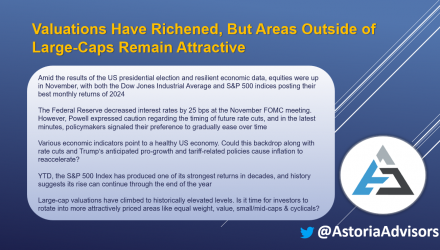
There are not many attractive opportunities in the US large-cap space. History suggests the market is overdue for a correction.
For a twist on this week’s column, I will share some stress management techniques I often teach to help mitigate the overwhelming feeling of “I can’t do this all!” and to find ways to enjoy the December rush.
Effective listening can help convert more prospects into clients. Your ability to listen effectively can be the deciding factor in whether they choose to work with you.
The U.S. economy and stock market are entering 2025 from a position of strength, but risks of volatility—especially pertaining to policy—are much higher compared to last year.
We examine how a potentially complex bond market in 2025 could still offer opportunities in high-yield bonds, municipal bonds, and inflation-protected securities.
The Santa Claus rally that started a few weeks back continued as the market logged its 53rd record high for 2024. While the Scrooges bemoaned inflation and tariffs, other investors embraced the strong economic data and loaded their sleds with market returns.
The surprise nomination of Robert F. Kennedy Jr. to head healthcare policy in the U.S. caused substantial volatility in November. But despite heightened uncertainty, the sector’s long-term outlook appears intact, say Portfolio Managers Andy Acker and Dan Lyons – giving investors a potential opportunity to invest at attractive valuations.
BlackRock’s Rachel Aguirre highlights several of the year’s biggest ETF trends and explains how the firm has positioned itself around them. VettaFi’s Cinthia Murphy discusses the recently launched FIRE ETFs and LifeX ETFs.
Financial advisors are in a prime position to help clients adopt preventive measures against tax-related identity theft. Effective protection involves a mix of robust security practices, ongoing fraud prevention education, and tools for monitoring client accounts.
We decided to see which companies saw the greatest spillover effects from these two revolutionary technologies.
Waiting until 67 or 70 may not feel like the best choice in the moment. Yet the extra income could mean more freedom from financial stress and more ability to enjoy your later years with peace of mind.
India’s institutional strength used to be reflected in the reliability of its national accounts.
December is a big month for stock buybacks, and by month’s end, companies are expected to spend more money repurchasing shares this year than ever before.
Alphabet Inc.’s Google is investing in mega energy parks that will generate renewable power as the company races to fuel its data centers.
Strong 2024 performance may be tough to replicate given tight credit spreads, but we still have a favorable view on corporate bond investments given the strong economy.
On the latest edition of Market Week in Review, Investment Strategist BeiChen Lin discussed the ouster of France’s prime minister and the potential market implications. He also provided an update on the health of the U.S. economy.
When the ECB’s rate-cutting cycle ends, should the neutral rate be far higher than pre-pandemic? Not in our view.
Why hasn’t tighter monetary policy caused a recession? One reason: federal budget deficits have been huge.
Last week we processed robust economic data and growing clarity on Federal Reserve policy, instilling a consensus view for a strong market that is now well reflected in positioning.
Join the experts at Invesco and VettaFi for a deep dive on what investors need to consider going into the new year. Jason Bloom will join us in the second half to discuss the outlooks for Fixed Income
Amid concerns about the impact of rising deficits on U.S. Treasuries, it helps to differentiate bond investments by maturity, credit rating, and global relative value.
Might another market liquidity event be on the horizon? While there is generally good liquidity in the financial system, there are some nascent signs that problems could arise.
On this episode of the “ETF of the Week” podcast, VettaFi’s Head of Research Todd Rosenbluth discussed the Neuberger Berman Short Duration Income ETF (NBSD) with Chuck Jaffe of Money Life. The pair discussed several topics related to the fund to give investors a deeper understanding of the ETF overall.
'The past is not necessarily prologue,' said VettaFi’s Head of Research Todd Rosenbluth, in advance of tomorrow’s Market Outlook Symposium.
he economic-policy consensus that prevails in the US is right about one thing.
I am (mostly) bullish on crypto and (usually) skeptical of higher taxes, especially on capital gains.
We believe municipal bonds currently offer a compelling balance of risk and reward for investors in higher tax brackets.
Whether you want to buy or rent, finding an affordable, comfortable home can be extremely difficult, if not impossible.
Just a few short years (months?) ago, few would have believed it possible. But it happened: Bitcoin has traded above $100,000 for the first time ever.
U.S. policies are set for a major reshaping as full Republican control takes hold in 2025.
CEO Ali Dibadj highlights the three macro drivers that investors must navigate in 2025 and beyond, as well as the importance of actively positioning for a brighter investment future.
Five of Franklin Templeton’s specialist investment managers provide their annual outlooks for the global economy and key asset classes, including global equities; global fixed income; global infrastructure; the macro fixed income environment; municipal bond market; high yield bond market; small cap equities; U.S. dollar; U.S. economy; and U.S. equities.
Getting a stay of execution doesn’t mean you’re no longer on death row.