Gold steadied near $4,000 an ounce as traders weighed a US-China trade truce that failed to quash concerns about long-term competition between the world’s two largest economies.
As transition consultants, we read a lot of press releases announcing financial advisors moving to new broker-dealers. You probably don’t torture yourself by doing that, but it’s part of our job.
The federal government shutdown shut off the steady stream of economic reports relied on by investors to gauge the health of the economy and financial markets. However, the much-anticipated September Consumer Price Index (CPI) report was released last week, as it was needed to determine cost-of-living adjustments for Social Security payments.
The Federal Reserve lowered its policy interest rate by 25 basis points, as widely expected. However, dissenting votes may cloud the path forward.
We see the global economy as undergoing a period of “global rewiring” on a number of fronts—evolving patterns and relationships that we anticipate affecting certain economies and markets for some time to come. Such rewiring could cover relationships between countries or developments within particular regions or economies.
China’s ability to sustain fairly robust economic growth despite a massive property sector downturn is now facing new tests as global trade barriers rise, and domestic demand shows fresh signs of weakness.
JPMorgan Chase & Co. is leading a group that’s investing about $90 million in a second round of financing for the Texas Stock Exchange, giving a boost to the Dallas-based upstart as it angles for a piece of a market dominated by Nasdaq and the New York Stock Exchange.
Tucked into President Donald Trump’s trade deals formalizing higher tariffs on goods from Asia this week are provisions for a global economic frontier the US wants to stay free of protectionism: digital commerce.
Stock valuation answers a deceptively simple question: What is a business truly worth? Price is what you pay; value is what you get.
Global electricity demand is accelerating as AI data centers, electrification, and economic growth drive an unprecedented need for reliable energy. Nuclear power is uniquely positioned to meet this challenge, delivering clean, zero-emission baseload electricity with the highest capacity factor of any major energy source.
Novo Nordisk A/S made an unsolicited bid for US biotech firm Metsera Inc., sparking a heated battle with Pfizer Inc. to get their hands on weight-loss treatments that both drugmakers want in order to regain lost ground in the booming market.
Last week’s economic narrative centered around the Federal Reserve's latest rate cut, a decision complicated by the government shutdown and lack of economic data.
Over nearly every meaningful time frame, Bitcoin has dramatically outperformed traditional asset classes. In the last 3 years, it has returned an astonishing 79.2% annualized, compared to 18% for the S&P 500, 24.4% for gold, and just 2.6% for the Bloomberg U.S. Aggregate Bond Index.
Rather than toil over the construction of an ideal fixed income portfolio for a client, advisors can simply apply a template primed for success using Vanguard’s model portfolios. On that note, Vanguard just introduced two new dynamic asset allocation fixed income model portfolios that can suit various investor profiles.
Effectively reading the Federal Reserve's Beige Book can help investors spot economic, industry, and consumer trends that could potentially impact investment portfolios.
One of the most fundamental decisions facing fixed-income investors is determining the optimal maturity for their Treasury holdings.
We continue to hold gold across all strategies, viewing it as a strategic asset. Central banks remain steady buyers, underscoring gold’s role as both a store of value and an inflation hedge.
The three themes we laid out will take a few years to play out, if at all. Our portfolio positioning reflects our belief in the economic strength and momentum of the US Tech / AI trade, and we would want to see more policy clarity and earnings confirmation before we make any large shifts into international.
US stocks are hovering near all-time highs, buoyed by the prospect of cooling trade tensions between the US and China as corporate America largely brushes off tariff pressures. But that doesn’t mean that Wall Street professionals will be sleeping easy this Halloween.
Long-dated bonds are looking more attractive as governments and central banks take steps to curb the glut in that segment of the market, according to JPMorgan Asset Management.
Amazon.com Inc.’s cloud unit posted the strongest growth rate in almost three years, reassuring investors who were concerned that the largest seller of rented computing power was losing ground to rivals. The shares surged.
Meta Platforms Inc. found record-shattering demand for its bond sale on Thursday even as its shares plunged, in a sign that bond investors are looking past any concerns about its artificial-intelligence spending plans.
Euro-area inflation eased slightly but stayed above 2%, backing the European Central Bank’s decision to keep borrowing costs where they are.
There’s no official read on how fast the US economy grew last quarter, thanks to the government shutdown. But almost everyone reckons it was a healthy pace — and that’s largely thanks to AI.
This bull market has been on quite a run. The S&P 500 is up 35% since its April 8, 2025 year-to-date low, and up over 92% since it began on October 12, 2022, excluding dividends.
The Federal Reserve’s October rate cut, to 3.75%–4%, signals a continued “risk management” approach, with December’s policy path tilting toward another cut.
The Federal Reserve on Wednesday announced a widely anticipated 25-basis-point (bp) rate cut, bringing the federal funds target range to 3.75%–4.00%. With markets priced for this move and the Fed operating in a data vacuum due to the U.S. government shutdown, the rate cut and modest statement changes were largely uneventful.
The consumer sector was in sharpest focus during the conference. That wasn’t surprising, given the negative headlines surrounding fraud allegations at subprime auto financer Tricolor Auto Acceptance and its subsequent bankruptcy filing.
The politics of the government shutdown are about to get trickier. Today is Day 28 of the government shutdown. The Senate will be in session this week, but the House of Representatives remains in recess.
While many lessons have evolved over time, one maxim has never changed for children: look both ways before crossing the street. I reinforced with my children to then look again. We might not see everything on a quick glance, and traffic can change quickly.
The Multi-Sector Credit Team share perspectives on the fixed income market and their quarterly asset allocation ranking. They highlight a timely chart to watch, explore relative value opportunities, and provide insight on their latest asset allocation scores by fixed income sub-sector.
It lacks the effervescence of copper and the geopolitical allure of rare earths – yet aluminum is the metal of the moment. Key to modern life and everywhere in the global economy, it’s entering a make-or-break phase: Either the world is sleepwalking into a supply crisis or further into the hands of China. Or, more worryingly, both.
Regulatory changes and productivity gains could push growth to move even faster in the years ahead. But we are also still dealing with the uncomfortable process of moving away from government stimulus and massive deficit spending that have boosted growth numbers in the post-COVID era but were unsustainable.
As widely expected, the U.S. Federal Reserve cut the federal funds rate by 25 basis points for a second time this year. This gives fixed income investors an opportunity to reposition their portfolios with intermediate bonds or reconsider active exposure if they don’t have it already.
Doug Drabik discusses fixed income market conditions and offers insight for bond investors.
The Powell put is on. The Federal Reserve chairman tried to sound like a hawk, but the central bank’s actions were those of a dove.
The Federal Funds Rate (FFR) is the interest rate banks charge each other to borrow money overnight. It's set by the FOMC and is one of the Federal Reserve's primary tools to implement monetary policy and is a key driver of economic activity. This video examines the Federal Funds Rate and reviews the Fed's interest rate meeting on October 29, 2025.
Join the experts at WisdomTree for an educational webcast that explores the current realities of the market, looks at where equity opportunities could emerge, and unpacks how to position fixed income portfolios as rates change.
Markets move fast, and in the ETF corner of the world, sometimes it feels like it’s practically impossible to keep up. Product development and proliferation have been so intense in recent months. New tickers are coming at us faster than ever.
US President Donald Trump emerged from his meeting with Chinese leader Xi Jinping beaming, labeling the conversation “truly great.”
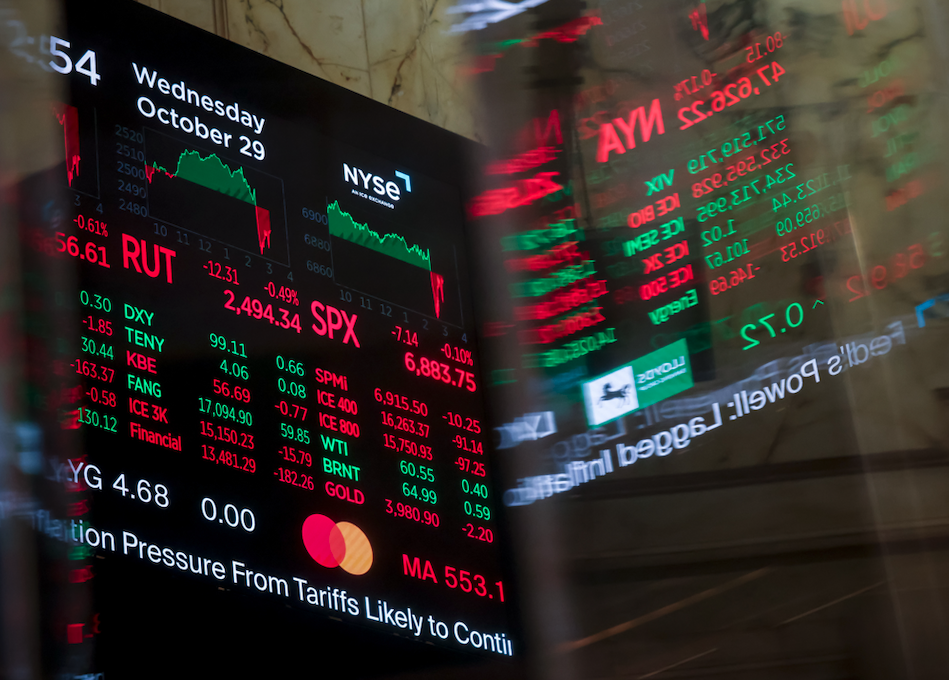
Treasuries fell the most in nearly five months after Federal Reserve Chair Jerome Powell cast doubt on a December interest-rate cut, even as a sagging labor market prompted policymakers to bring down borrowing costs Wednesday.
Nvidia CEO Jensen Huang’s insistence this week that he did not “believe we’re in an AI bubble” is all well and good when you’re the man selling the finest shovels for the artificial-intelligence boom. But what of the companies that are expected to turn all that AI building into gold?
It’s important to remember that QT, at least in the current context, was never really a proactive policy. Rather, it’s the undoing of a policy — quantitative easing — that the Fed used to support markets and the economy during the Covid-19 pandemic.
Evan Harp sat down Axon’s Brady Lochte to talk about his practice, the Exchange conference, and the challenges facing advisors and their clients today.
The headline annual CPI came in at 3 percent, according to BLS data. That was up from 2.9 percent in August and 2.7 percent in July. It was the highest print since January, and up from a low of 2.4 percent in March.
Still-healthy demand and disciplined cost control are central themes for earnings, which continue to suggest a mostly resilient economy in light of government data darkness.
Two weeks ago, the International Monetary Fund (IMF) issued an updated World Economic Outlook. In it, the IMF edged up its global growth forecast for 2025, suggesting that U.S. tariffs haven’t turned out to be as damaging as the Fund anticipated in April.
Over the last 56 years, I’ve spent a lot of time making suggestions to clients regarding their investment processes and portfolios, and I’ve been on the client side as a member of various investment committees. But seldom have I been able to bridge the two, serving as an active participant in clients’ investment processes.
Lazard Asset Management is betting the newfound appetite for emerging-market assets is only just starting, launching its first-ever exchange-traded fund focused on the region as investors look for ways to ride a rebound in international markets.
Part of the reason behind Japanese stocks’ discount to the U.S. is the profitability gap; the U.S. has a Return on Equity (ROE) of 18.3%, while Japan’s broad market has yet to break above 10% on that measure (though some forecasters believe Japan will get its act together).