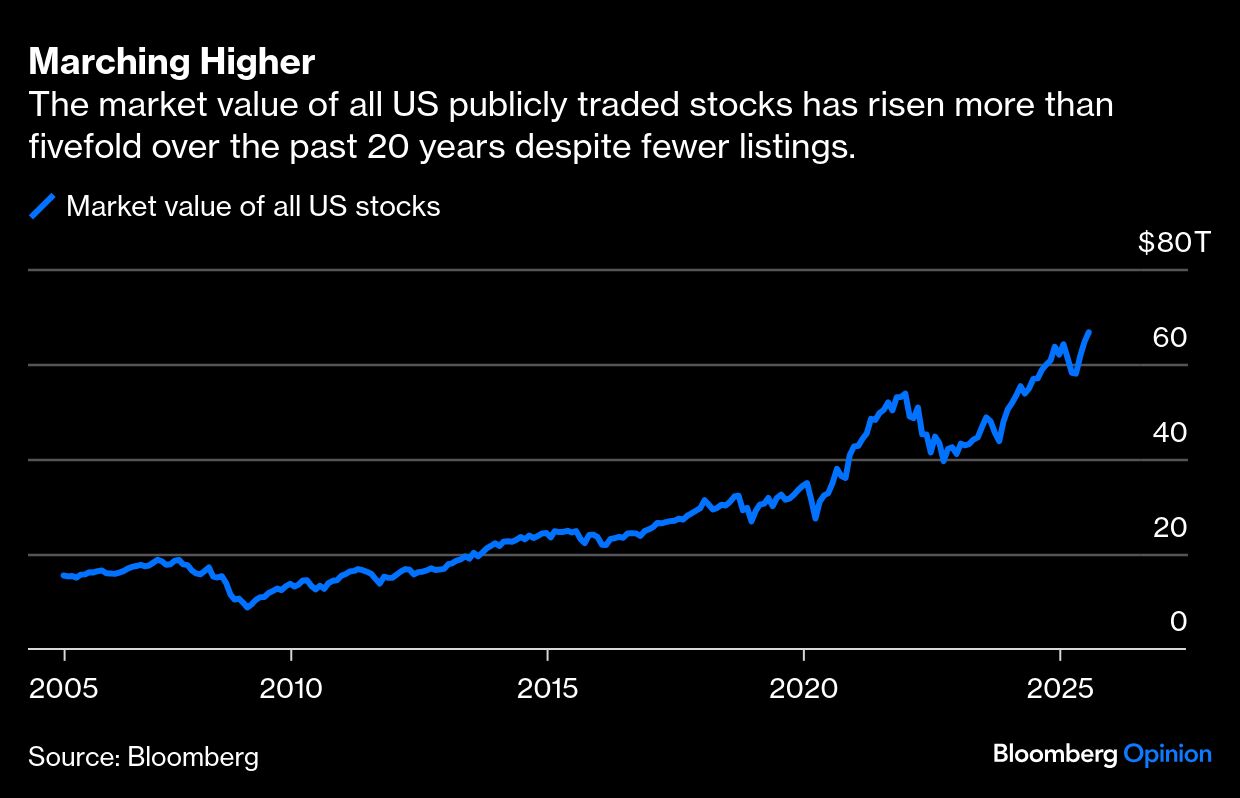
We are entering a Golden Age of big business. Or, depending on how you look at it, a Dark Age for small business. Economic concentration is rising almost everywhere, from Main Street to Wall Street, where Microsoft Corp. this week became the second company to reach a $4 trillion market capitalization after Nvidia Corp. In fact, nine of the 10 of the world’s largest companies are based in the US and all are worth at least $1 trillion. And despite the efforts of anti-trusters, this trend will only continue.
Why? For all the handwringing about market power and concentration from both the left and the right of the political spectrum, lawmakers continue to enact policies that benefit big businesses at the expense of their smaller competitors.
Sure, big businesses have always made up a large share of employment. But its dominance over American industry in all its forms has only grown the last 30 years. This is about more than a few big firms leading the S&P 500 Index. Fewer small companies are able to go public these days, and those who do sell at a discount . The number of listed companies in the US had shrunk to some 4,000 right before the pandemic from about 7,000 in 1996.

Think about it: Most consumers doing work around the house these days will head to their local Home Depot first instead of the local mom-and-pop hardware store – if any are still around. And the home you may be renting? There’s a good chance it is owned by a Wall Street private-equity firm and not a local landlord. What about those tariffs the Trump administration is imposing on imports? Unlike smaller firms, big business is in a better position to absorb the extra costs rather than pass them on to their customers.
Greater concentration is presumed to be a problem. The thinking is that small, fast-growing businesses are where most new jobs were created historically. And such businesses are an important source of innovation, helping to keep the economy dynamic and competitive. And yet, it’s not clear whether concentration has been bad for the average American.
Yes, consumers face less choice at the national level, but there are still options when it comes to shopping or employment. Have you ever noticed that where there’s a Home Depot a Lowe’s is bound to be nearby? And while there was some evidence of mark-ups, the prices of many consumer goods and services fell as industries became more concentrated, helping to contain inflation.
The costs to workers and consumers may not be large because concentration might just reflect a changing economy that favors bigness and rewards scale. Some even argue a tech driven world is better for economies of scope , or the ability to leverage lots of proprietary data, while delivering more efficient logistics that allow businesses to quickly scale. This may be one reason why smaller innovative companies are bought by bigger companies rather than go public.
Though there is something lost in a more concentrated economy. Innovation and growth have no doubt traditionally come from small business. Often, this is because big companies become too bureaucratic and slow to change. And even for entrepreneurs who operate on a small scale and keep hiring to a minimum, business ownership is an important source of wealth generation and mobility. There’s a clear risk from less diversification. It’s possible that if something goes wrong for the few large tech firms that dominate the S&P 500, the whole market could tank along with them, damaging savings and retirement plans and raising the costs of capital for all businesses.
I am less concerned about concentration that reflects a changing economy than I am to the extent it reflects policies that create a subsidy for big business and penalize smaller ones – which have become more prevalent. Our growing regulatory state puts small business at a disadvantage, with the number of pages in the Federal Register that contains all federal rules and regulations growing to more than 87,000 pages in 2020 from a little less than 54,000 in 1990.
Coming from the left, policies that require business to provide more benefits and pay a higher minimum wage make it harder for smaller businesses, which operate on thinner margins, to stay profitable. Other policies such as the resurgence of rent control, or any price control for that matter, favor big landlords who have more properties and can offset their losses on apartments that might not adequately cover their costs.
Coming from the right, tariffs will likely squeeze small businesses, which operate under less flexible supply chains. These firms can’t absorb the added costs of tariffs like their larger competitors and will need to try and pass more of them on to consumers.
There is some hope. Artificial intelligence will democratize marketing, legal services and many other tasks that are now mostly handled by large staffs. This may counteract some of the economic forces that favor big business. But to fully restore competition, policymakers will need to get out of the way. The instinct from both parties is to do more anti-trust and break up firms based purely on their bigness. But that won’t help small businesses that face bigger costs from the policies we have chosen.
A message from Advisor Perspectives and VettaFi: To learn more about this and other topics, check out some of our webcasts.
Bloomberg News provided this article. For more articles like this please visit
bloomberg.com.
Read more articles by Allison Schrager