Thanks to AI, cloud computing, and renewable energy reshaping the global economy, one under-the-radar sector surging to the forefront is utilities. Long considered a sleepier, more defensive, “old economy” play, utilities stocks and ETFs are quickly becoming the backbone of the digital and green revolution. Utilities are powering AI data centers, enabling cloud infrastructure, and driving the energy transition.
Last year, Citigroup projected that data centers could account for up to 11% of U.S. electricity demand by 2030, a significant jump from the current 4.5%. To keep up with surging power needs, utilities companies are pouring billions into grid upgrades and capacity expansions. Such spending also gives utilities grounds to seek regulatory approval for customer rate hikes. When regulators approve these rate increases, earnings and dividend forecasts rise, providing a boost to stock prices.
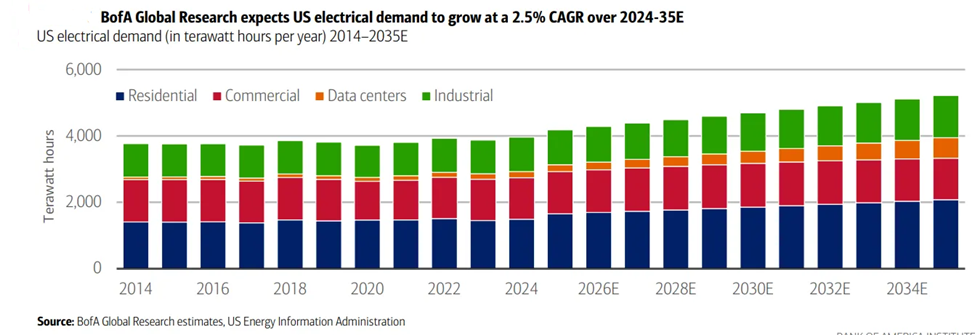
Electric utilities are projected to invest more than $1.1 trillion by 2030 to meet growing energy demand, according to Utility Dive. Bank of America Institute predicts a CAGR growth rate of 2.5% for U.S. electrical demand over the next decade. That includes what has been the historical annual growth of about 0.5%, with another 1% coming from building electrification and the rest stemming from data centers, industrial growth, and EVs. It’s clear the AI explosion has ushered in a new era of growth and prompted an inflection point after lackluster growth over the last several years.

Here’s why utilities are electrifying portfolios like never before.
Safety & Growth Fueling the Utilities Surge
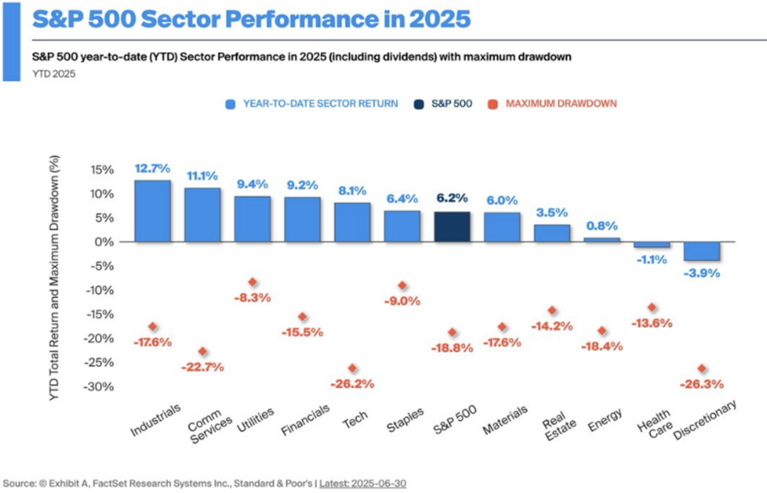
The sector has been a standout performer in 2025, defying broader market volatility with steady gains. Not only are utilities the third best-performing S&P 500 sector this year — up 12% compared to the broader benchmark’s 8% gain — they have also matched the total return of the market for the past 25 years. Compared to the broader market, utilities have also ridden an underlying trend of higher highs and higher lows since late 2023. And it’s also the best-performing sector with the least drawdowns.
Utilities stocks are now breaking out beyond old highs hit last November. prompting a handful of ETFs to do the same. The Vanguard Utilities ETF (VPU) just struck a new 52-week high. The $7 billion fund is up 13% year-to-date, rallying 20% from its 52-week trough, and enjoying positive net inflows. VPU tracks an index comprising large, midsize and small U.S. companies, many of which are trading at a considerable discount. Top holdings include Edison, PG&E, and Eversource Energy.
Technical Strength
The sector also looks strong on a technical basis. Roughly 90% of utilities stocks are trading above their 50- and 200-day moving averages. That compares to just 73% of constituents trading above their 50-day moving averages in the S&P 500 and just 64% above their 200-day moving average.
Likewise, the Utilities Select Sector SPDR Fund (XLU) — the largest and most liquid in the utilities universe — is also hovering near 52-week highs. The $20 billion fund has topped the flow charts, with a haul of $2.5 billion. It’s up 13% on a NAV basis. Unlike VPU, the fund invests in a narrower universe of 34 large-cap names, including dividend-paying giants like NextEra Energy and Duke Energy. This week, State Street also just rolled out a new enhanced income version of this ETF, the Utilities Select Sector SPDR Premium Income Fund (XLUI), which uses covered calls to generate extra income.
Similarly, the iShares Global Infrastructure ETF (IGF) has seen dominant inflows — nearly $2 billion. The $8 billion fund, which provides targeted exposure on a global scale — investing in companies tied to water, transportation, and electricity services — has rallied 16% so far in 2025. Meanwhile, the cheapest utilities ETF on the market is the Fidelity MSCI Utilities Index ETF (FUTY), which has risen 13% and seen positive net inflows. Charging an expense ratio of just 0.08%, the roughly $2 billion fund is competitively priced against its peers and has more than 60 holdings, including a smattering of small-caps.
Emerging Critical Growth Engine
These ETFs overall tend to attract more conservative, income-focused investors seeking steady dividends and long-term growth potential. Investors are increasingly drawn to the sector’s unique combination of defensive stability, structural growth opportunities, and policy tailwinds. Looming rate cuts from the Federal Reserve further fuel the appeal of dividend-paying consistency. After real estate, utilities is the second-most rate-sensitive sector.
Bottom line: Utilities are thriving in 2025 due to their rare “safety and growth” appeal. They offer defensive earnings in an uncertain economy while benefiting from structural demand growth and policy support. With soaring electricity demand and shifting policy tailwinds, this once-staid sector is emerging as a critical growth engine.
For more news, information, and analysis, visit VettaFi | ETFDB.
A message from Advisor Perspectives and VettaFi: To learn more about this and other topics, check out some of our webcasts.
Read more commentaries by VettaFi