Observing the latest developments of the largest corporate defined benefit (DB) plans in the U.S. offers a glimpse into the DB industry, and perhaps a foreshadowing of things to come. After two of the strongest years ever for pension contributions, the coming year may feature the weakest seen in a generation.
The Tweedy, Browne Global Value Fund (TBGVX) has an exceptional track record, outperforming its benchmark and peer-group average by over 300 basis points annually since its inception 25 years ago. I interviewed the members of Tweedy, Browne’s investment committee.
Earlier this month, I penned an article asking if we “really shouldn’t worry about the Fed’s balance sheet?” The question arose from a specific statement made by previous New York Federal Reserve President Bill Dudley...
The sharp rebound in equities seems to be in contrast to the deterioration in data, which could lead to near-term volatility.
After MSCI decided today to boost the allocation to Chinese onshore stocks in its emerging-market indices, global investors are likely to pump more money into the market. But watch out for crowds. Flows into China are concentrated in a small group of large-cap stocks.
This isn't the time in the cycle to take excessive risk. The easy money has already been made. Astoria's 2019 playbook is as follows: late cycle economic forces + desynchronized global growth + a deteriorating earnings cycle = the need for more defensive posturing across stocks and bonds.
What investors should expect from upcoming elections in Thailand, Indonesia, India and the Philippines.
As MSCI considers boosting the allocation to Chinese onshore stocks in its emerging-market indices, global investors are pumping money into the market. But watch out for crowds. Flows into China are concentrated in a small group of large-cap stocks.
Quick review of what drove equity markets in Q4 2018, why it was all noise and then a discussion on where equity investors should focus their thinking as it relates to future equity market performance.
Fed Chairman Jerome “Jay” Powell will deliver his semiannual monetary policy testimony to Congress on Tuesday and Wednesday. In past decades, this testimony was a huge deal for the financial markets. These days, not so much. The Fed is a lot more forthcoming.
The euro area faces another challenging year, but we see a continuation of recent soft growth as much more likely than recession. The European Central Bank (ECB) is, nonetheless, now likely to delay its first rate hike to 2020, and could also implement fresh credit-easing measures.
A couple of weeks ago, I introduced you to an exciting new company called GoldSpot Discoveries,conceived and headed by mining visionary Denis Laviolette. GoldSpot is the world’s first exploration company to use artificial intelligence (AI) and machine learning in the discovery process for precious metals and other natural resources.
Studies have shown over the years that most economic rate projections are terribly inaccurate with forecasts bunched together from crowd behavior. So what to do? Run multiple scenarios, assign probabilities and spit out the most likely base case at that point in time.
A new paper analyzed global multi-asset factor premiums over an unprecedented sample of 217 years. The findings carry important implications for quantitative asset management.
A powerful alternative to the ubiquitous style grid is to organize managers by the investment strategy that a fund pursues. Once constructed, these statistically valid peer groups provide a comprehensive framework for portfolio construction, manager evaluation, fund selection, benchmarking and, quite surprisingly, stock selection and managing market exposure.
While EM has lagged overall in 2018, some EM factors did outperform.
GSE reform is in sight, China’s stimulus falls short, and bank mergers are back.
The European parliamentary elections may cause near-term market jitters, but we do not think the outcome will be a game-changer.
A popular song and a recent article in The Wall Street Journal reminded us of Edmund Burke’s quote and how important history is to the long-term success of common stock ownership.
We have a normal economic calendar, and 1/3 of S&P 500 companies have not yet reported Q418 earnings. Corporate earnings are not confirming those who thought the market was signaling a recession. Both the economy and earnings remain in the background. Daily market moves, even small ones, and the often-erroneous explanations dominate the financial news.
Here are some authentic questions and topics to integrate into meetings to initiate a substantive conversation with your clients and their heirs.
This book tells a story about planning that is intuitive, easy to follow and checklist driven, making the seemingly impossible achievable.
I use Gilligan’s Island as a means of illustrating productivity and its importance for the health of an economy and the prosperity of its people.
In the next few weeks, economic reports that were delayed due to the partial government shutdown will continue to trickle in, helping to piece together the fourth quarter picture. That’s fine but investors are more interested in the future.
Today’s capitalism has a contradiction that is increasingly hard to ignore: lack of competition in key markets. That’s a problem because competition incentivizes producers to get more efficient and reduce prices for consumers. Without competition, you end up with bloated monopolies that may be highly profitable for the owners, but don’t serve the greater cause of economic growth.
RBA’s unique Pactive® investing approach has made us one of the largest and fastest growing ETF model managers in the United States. But we don’t choose our ETFs at face value. Instead, we treat each ETF as a portfolio before making our selections. Learn why our ETF “x-ray” approach is critical for our investment process.
The Economics team explores a smooth economic slowdown, elevated consumer confidence, and troubles in Italy.
If you haven’t heard about Modern Monetary Theory, or “MMT” for short, by now, you will soon. It is highly likely that MMT will be increasingly touted by economists and politicians from both sides of the aisle, as the economic prescription, even panacea, to cure our economic ills.
While investors should be cognizant of the complexities and risks around Brexit, they should be just as aware of the opportunities in select U.K.-based businesses.
In his post-FOMC press conference on December 19, Fed Chairman Powell said that low inflation would allow the Fed to be more patient in adjusting rates. The stock market fell. He said essential the same thing in his January 30 press conference.
Today we’ll look at what we should expect from our investing. In case you haven’t noticed, financial markets are really a giant expectations game. A company can report great quarterly results and still get crushed if earnings are less than analysts expected.
It’s difficult to get good footing in a market that has so many mixed messages bombarding it. We recommend patience, discipline and diversification as expect continued bouts of volatility. The U.S. government shutdown is over, for now…and the Fed is in pause mode, for now…but confidence in government is low and monetary policy is likely to persist. In the near term we believe the most important needle-mover will be the result of trade negotiations between the United States and China. The problem is the inability to gauge the likely outcome.
Matthews Asia Portfolio Strategist David Dali discusses the new drivers of growth in emerging markets.
The fourth quarter of 2018 proved to be one of the most negative quarters for financial risk assets since the current bull market began in March of 2009. The S&P 500 finished down 13.5% and commodities were down an even worse 22.6%. As one might expect, safe haven assets performed well.
Rick Rieder and Russ Brownback argue that an evolving policy stance at the Fed is altering the risk/reward calculus for investors this year, although left-tail risks remain.
A 1997 dark comedy starring Dustin Hoffman and Robert DeNiro, “Wag the Dog” was a film in which a Hollywood director and a spin-doctor collude to fabricate a war in order to distract voters from a presidential sex-scandal. Hilarity ensues. Of course, the irony was that the movie was released just two months before an actual sex-scandal erupted.
"Time is Archimedes’ Lever in Investing - Archimedes is often quoted as saying, 'Give me a lever long enough and I can move the earth.' In investing, that lever is time. The length of time investments will be held, the period of time over which investment results will be measured and judged, is the single most powerful factor in any investment program.
Over the past few years, we have noted steady changes in American views toward China, and vice versa, that will likely lead to superpower competition and the potential for conflict. In Part I of this report, we will discuss the American and Chinese viewpoints.
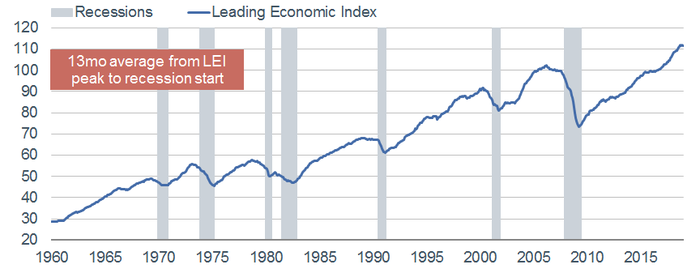
The Conference Board’s release of December’s Leading Economic Index was notable for its continued trend deterioration; and the second decline in three months.
Although most investors hate bearish stock market activity, value investors – like yours truly -relish them. Moreover, bearish market activity becomes especially welcome after extended periods of high valuation like we have been experiencing since calendar year 2014. High valuations make it very difficult for value investors to find attractive common stock investments.
We expect market volatility to continue in 2019, creating opportunities for the Income Fund.
This article examines the Federal Reserve’s monetary policy objectives and their stated inflation goals to better appreciate the role they play in rising wealth and income inequality gaps.
Central banks face a difficult year. Eurozone economies are slowing. And the U.S. government shutdown can’t be ignored.
It makes little difference to our portfolios whether recession strikes in 2019 or 2020. The benchmarks will drop between 40 and 50%—some more, some less. To the extent that you are exposed to stocks and other financial markets, your portfolio is going to take a hit.
Will emerging markets stocks rebound in 2019? Attractive valuations, strong forecast earnings growth, structural reforms, and an abating dollar headwind suggest they will.
The fourth quarter of 2018 saw U.S. equities decline materially, with especially steep falls in December. During the fourth quarter the equity market as measured by the S&P 500 generated a total return of -13.5%, bringing full year S&P returns to -4.4%. While disappointing, these results need to be seen in the context of a broader and much more severe downturn in global equity markets.
The process of creating The Ten Surprises begins in the summer when I organize four lunches in the Hamptons for serious investors. About 100 people attend including hedge fund managers, private equity titans and even some academics. One of the benefits of this is that it gives me some clarity on where the consensus is, and that is essential before the Surprises can be determined.
Our January Sinology explains that China’s economy did not slow sharply in 4Q18. Growth rates of household consumption and private investment actually accelerated.
Normally, the end of January sees the government's first estimate of real GDP growth for the fourth quarter. But with no end in sight for the shutdown, which has already seen numerous other data releases postponed – including figures on retail sales, international trade, inventories, construction, and durable goods - it's very unlikely the GDP report will arrive on time.
Today, I’m going to introduce you to an economist I have read for years. His name is Richard F. Moody. He is the Chief Economist at Regions Financial Corporation (Regions Bank) headquartered in Birmingham, Alabama. Regions is the largest bank in the South with almost 1,500 branches spread across the southeastern US and the Midwest.