Bond markets continue to adjust to a more hawkish policy environment following the Federal Reserve’s recent 25-basis-point rate hike.
Financial markets continue to grapple with a fundamental question: If inflation remains above target after years of restrictive monetary policy, is interest-rate policy still aimed at the right problem?
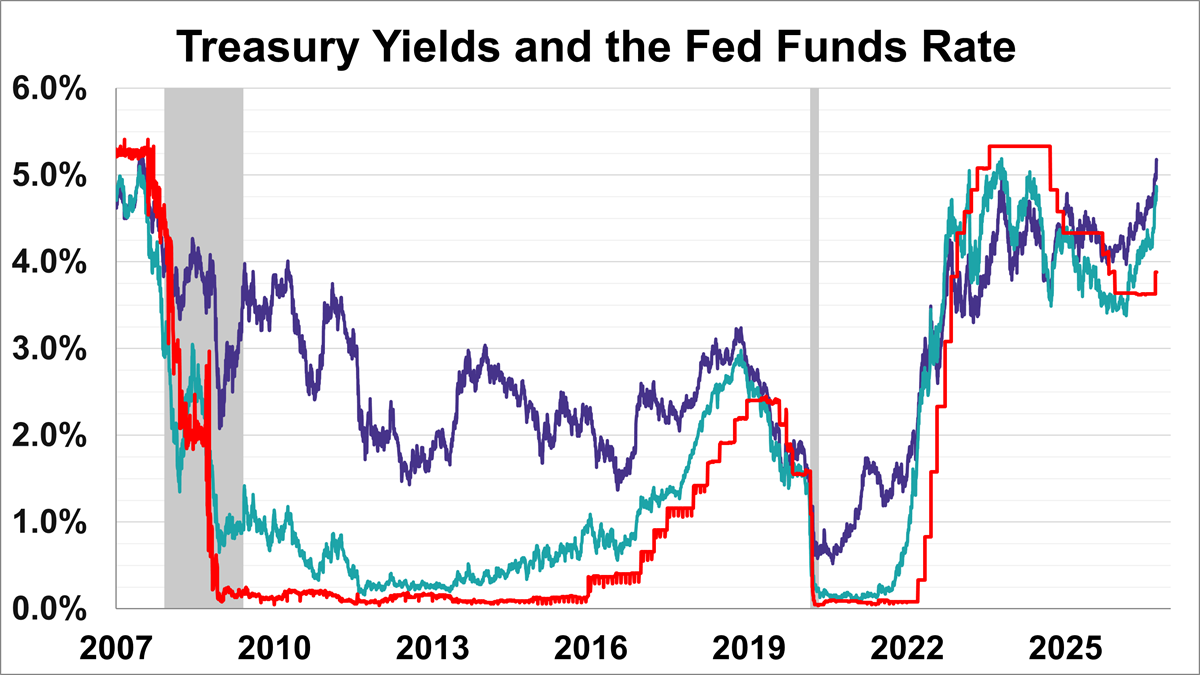
There is more than one reason the 10-year Treasury yield is 5.23% today. Most importantly, the Fed has stopped anchoring interest rates at artificially low levels. Fear of inflation is likely another. However, both of those are related to the massive government debt the US has created.
A recent VettaFi webcast explored advice on navigating retirees' behavioral tendencies in decumulating assets in retirement.
In his latest insight, Richard Bernstein, Global Head of Macro & Customized Investing, examines why the Fed’s actions tend to lag the economic cycle, how deglobalization may limit its flexibility, and what a potentially longer period of tighter monetary policy could mean for investors.
Only 30% of Americans believe they’ll be able to retire comfortably — an amount retirement plan participants now estimate is $1.2 million, a recent survey by Schroders found. 33% of plan participants said that their credit card debt was higher than their retirement savings.
As bond yields have risen, mortgage rates are again facing upward pressure, extending the U.S. housing market's post-pandemic affordability challenges. Beyond mortgage rates, trends in wage growth, taxes, and insurance costs also continue to shape the affordability outlook.
Chris Galipeau discusses high-conviction insights that go beyond media headlines.
In the first quarter of this year, as the Strait of Hormuz closed and oil prices exploded, Berkshire Hathaway made a couple of moves that might have flown under people’s radars.It cut its stake in Chevron by roughly a third. Then it bought an airline.
Understanding why investor optimism wins over a full market cycle is one of the most underrated edges an investor can own, and it has almost nothing to do with waving pom-poms.
I’m talking about the cash I have sitting here that I desperately want to get into the market. Earlier this year, I got a chunk of money from selling a house. I have no desire to own another home (that’s a story for another time.) Instead, I used some of the money to pay off some debt. The rest is just sitting in my savings account earning absolutely nothing.
A snowball effect of asset values can similarly empower wealth effects: the tendency for consumers to spend more as the value of their investments rises. Wealth effects are surprising at first glance: household investments may be illiquid and tend not to produce substantial cash flow. However, a rising net worth builds a consumer’s confidence in their ability to afford purchases.
"Funflation" is on the rise, and it could bode quite well for the retail sector if the trend remains persistent.
Brendan Greeley’s “The Almighty Dollar” is unlike any other book on the U.S. dollar ever written. If you want to take a really deep dive into financial history and — more specifically — the history of currency, this is the book for you.
I propose that the question of whether now is an especially auspicious time to buy in general — or more incisively, whether properly allocated investors should have more, less, or the same TIPS exposure when rates are relatively high — is more nuanced.
Japan can thank its high debt loads and aging demographics for the inflation restraint. But the cost paid in stagnant growth and diminished prosperity for its citizens has been dear. We do not fear an inflationary spike in the U.S.; instead, we are concerned that the economic doldrum that has infected Japan for over 25 years will slowly work its way here.
Among the world’s top fuel-consuming nations, Japan is the most energy insecure. Its import-dependency ratios are scary: It buys overseas 99.9% of the oil it needs; 99.7% of the coal; and 97.8% of the natural gas.
The U.S. economy remains resilient despite headwinds including sticky inflation, trade instability and rising geopolitical tensions. State and local government tax revenues have followed suit and have posted solid growth, aided by robust equity market returns.
In September 2024 and June 2025, I wrote memos that were critical of governments’ attempts to override the laws of economics, based on my conviction that trying to do so is likely to prove ineffective and potentially harmful.
This week, there are a few things that we need to pay attention to: the large move in interest rates and what it means (and more importantly, what it doesn’t mean!); and the constant barrage of doom and gloom on energy and AI. Let’s jump in.
Last week we looked at the Federal Reserve’s inflation problem. This week, let’s look at the other half of its mandate: maximum employment.
The yield on the 10-year note finished September 25, 2026 at 5.17% while the 2-year note ended at 4.81%.
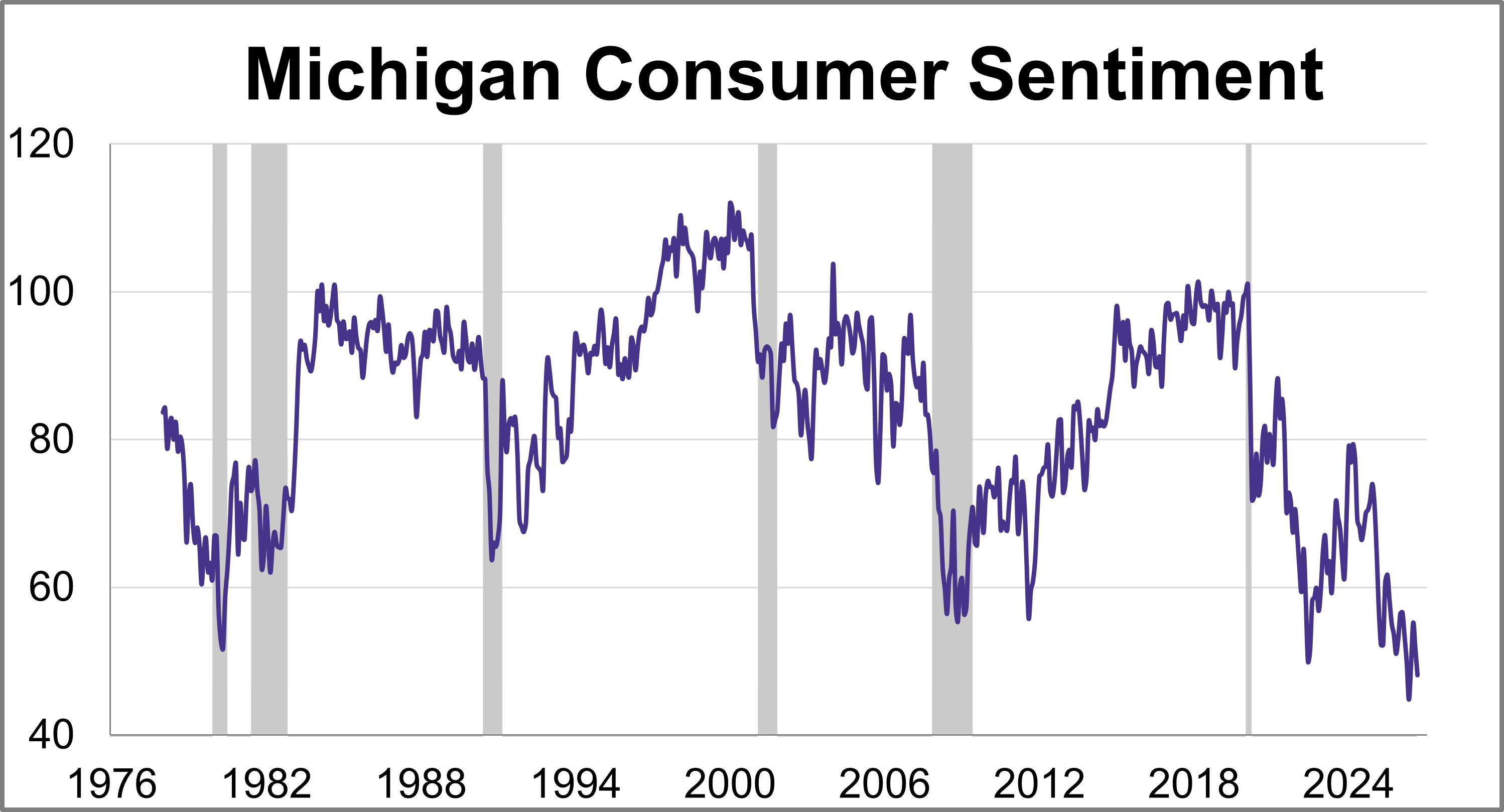
Consumer sentiment falls in September for two consecutive months. The final September reading for the University of Michigan Consumer Sentiment Index came in at 48.1. This marks a 7.0% (3.6 points) decrease from August.
US stocks climbed as oil and Treasury yields pulled back from the recent surges ahead of data on inflation expectations.
Now the US is in a higher-interest-rate environment, and once again there is a lot of redefining going on. One change is that it’s finally good to be a saver again. The catch is that saving isn’t quite as safe as it used to be.
The tectonic plates of the global economy have shifted. Across the world, yields on long government bonds — keystone of the entire financial system — have climbed to their highest in decades. A trend that had been clear ever since the brief post-pandemic boom turned into resurgent inflation and higher rates has suddenly accelerated.
The US housing market has been stuck in neutral for nearly four years, with sales of new and existing homes plodding along at a historically slow pace. One explanation is that the average rate on a 30-year fixed-rate mortgage in the US passed 6% four years ago and has stayed above that ever since, creeping past 7% this week.
Since ChatGPT was first released in 2022, the artificial intelligence (AI) trade has dominated US equity markets. Gains have been driven by three interrelated forces: enthusiasm for artificial intelligence, growing concentration in the largest technology companies and strong price momentum.
This year has presented no shortage of challenges for investors. Geopolitical conflict, trade tensions, rising energy prices, shifting interest rate expectations and an increasingly active political backdrop have each taken turns dominating the headlines. Yet despite these obstacles, the economy has continued to expand, corporate profits have marched higher and markets have climbed one wall of worry after another.
Confluence Investment Management offers various asset allocation products, which are managed based on “top down,” or macro, analysis. We publish asset allocation thoughts on a bi-weekly basis, updating the report every other Monday, along with an accompanying podcast.
Doshi said gold holding $4,000 during the correction and later rallying to $4,700 before last week's Fed rate hike strengthened his conviction that the broader gold bull market remains intact despite continued headwinds from the Iran war oil shock.
The Federal Reserve hiked rates, and we expect there are more to come. With a hawkish Fed and a resilient economy, long-term yields may stay elevated.
The U.S. economy has traveled farther than most forecasters expected. Strong household spending, healthy labor markets and continued business investment have kept the expansion on course.
The rise in Treasury yields has prompted a familiar set of explanations. Some investors have pointed to government borrowing and persistent inflation, while others have focused on the possibility that artificial intelligence will lift economic growth and interest rates.
Yields on the US’s longest-dated bonds climbed to the highest level in more than two decades, the latest milestone in a global selloff driven by inflation fears and concern about government debt burdens.
The rush for the exits by wealthy investors in private credit funds is far from done. But even as the rich run away from direct lending, they aren’t abandoning alternative assets. Instead, they look to be chasing the next hot thing: infrastructure finance.
Looking ahead, markets are priced for additional hikes. And our base case is that the FOMC will likely deliver one or two more 25-bp rate hikes through this year and into early next. However, looking further out, anticipating appropriate Fed policy through a financial-conditions-targeting framework has its own limitations. Hence, a neutral rate anchor is still useful.
LPL Research analyzes S&P 500 margin expansion, assessing how much is structural versus cyclical and what that means for future earnings forecasts.
It’s really starting to feel like autumn now. August PPI, CPI, and Retail Sales are in the books, the September FOMC meeting is out of the way, and we can now look forward to Jobs Week on Wall Street. Football is in full swing, and earnings season begins before you know it, with Pepsi (PEP) posting results on Thursday, October 8, followed the next morning by Delta (DAL).
Global growth remains resilient but uneven. In the United States, expansion is supported by private demand, a stable labor market and AI investment, while Europe and Japan continue to show surprising strength despite ongoing risks.
Artificial intelligence (AI) technologies are developing faster than investors anticipated just a few years ago, fueling a popular narrative that AI will trigger widespread job cuts. Yet there’s little evidence to back this view. Instead, we find that AI is changing hiring patterns, altering skill requirements and shifting the mix of work performed within firms.
Major US equity indices finished the week mixed. The NASDAQ gained 0.7 per cent while the Dow and S&P 500 slipped. The divergence reflected a tug-of-war between fears of slower AI development early in the week and a rebound in AI-linked shares by Friday.
Markets have dealt with serious whiplash from the Federal Reserve’s dramatic policy pivot this year. In just six months, the Fed funds futures market went from pricing in two rate cuts totaling 50 basis points to now pricing in two rate hikes in 2026.
Facts are facts, so let’s just state it plainly: Howard Buffett is a nepo baby. And this is one of the rare cases where I think we should be OK with it.
The US deficit has reached $1.97 trillion and is on track to pass 6% of gross domestic product this fiscal year, the latest milestone in a remarkable deterioration of the federal budget.
Federal Reserve (Fed) chair Kevin Warsh has established his hawkish credentials. Franklin Templeton CIO, Sonal Desai sees scope for further yield curve steepening and a range of selective opportunities, based on capturing income and focusing on quality rather than counting on lower rates or tighter spreads.
It wasn’t that long ago that Kevin Warsh’s leading critics were saying his biggest problem was that he wasn’t “independent” from President Trump, that if Trump told him to “jump” he’d ask “how high?” Or, in this particular situation, “how low should interest rates go?”
The Federal Reserve delivered the 25-basis-point increase the markets had largely anticipated, but the overall message was somewhat more hawkish than expected. The decision was unanimous, and the new dot plot points to another rate increase this year. Four participants apparently see the possibility of raising rates at each remaining meeting, so there is clearly a meaningful hawkish contingent on the FOMC.
The week began with calls for a potential slowdown in AI spending amid growing safety concerns and included a midweek Fed rate hike for the first time since 2023. The S&P 500 finished slightly lower for the second week in a row despite continuing signs that economic growth is strong. Shorter-term bond yields pushed higher as investors priced in the potential for additional rate hikes, both in the U.S. and abroad.
Some economists and market participants view inflation as one of the most important economic indicators. Market participants spend a lot of time worrying about a lot of things, but inflation is pretty close to the top of the list most of the time.