TIPS Yields at 3% Are Awesome! But Fundamental Principles Don’t Change
Membership required
Membership is now required to use this feature. To learn more:
View Membership Benefits Advisor Perspectives welcomes guest contributions. The views presented here do not necessarily represent those of Advisor Perspectives.
Edward F. McQuarrie and William J. Bernstein published “Long TIPS Yield 3%. Time to Buy?"1 here on Advisor Perspectives on August 13. It's a personal favorite topic by a team I respect, and a highly engaging read . . . so here I am engaging!
Because hearty approbation requires little more than “What they said!” while critique demands framing and nuance, the volume-weighted balance of my comments below will appear varying degrees of critical. This is unfortunate, because I wouldn't expend this much effort reviewing a cockamamie article or one with authorship I respected less. So, to restore some balance, let me say this up front: McQuarrie and Bernstein have written an excellent article, and I hope many people read it. In fact, you should probably read it before reading this response.
Let’s Say It Again: Long TIPS Yield 3%!
I must first echo the notability of the historically anomalous long-term TIPS rates available at present. They are particularly interesting given that (A) the recent spike in all interest rates seems to be partly driven by elevated inflation pressures, yet (B) the breakeven inflation rate remains pinned below 2.5% for the long term and even the intermediate term.
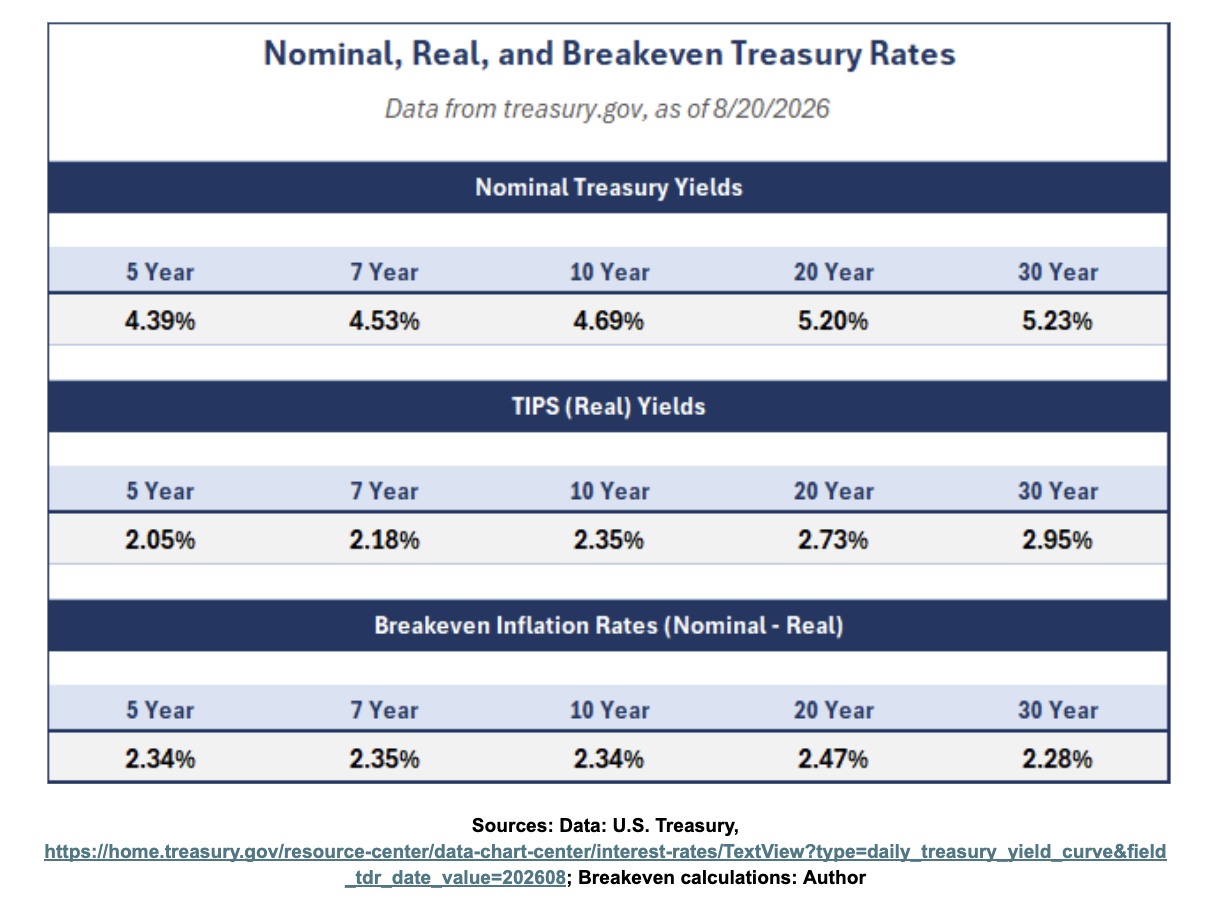
Is Now the Right Time to Buy TIPS? Is “Now” Ever the Wrong Time?
The narrative that current long-term TIPS yields are historically attractive is indisputable. To the extent investors who could benefit from long-horizon safety have been ignoring the asset that provides that safety, the McQuarrie and Bernstein article’s (henceforth “the authors” and “the article”) clarion call to purchase the goods at historic bargain prices is an economic and social good.
I propose that the question of whether now is an especially auspicious time to buy in general — or more incisively, whether properly allocated investors should have more, less, or the same TIPS exposure when rates are relatively high — is more nuanced.
For one thing, I strongly concur with the authors that the highest and best use case for TIPS is the immunization of future real spending needs, e.g., through real income laddering. But if we assume that the magnitude of an investor’s requirements for safe, inflation-protected cash flow is largely independent of real interest rates, then the proper dollar amount of TIPS required for immunization is in fact less when rates are high, not more.
This is a good thing! It increases spare capacity for pursuing other goals with other financial tools. Rearranging this observation for maximum impact: Today’s historically high TIPS yields are attractive in part because they plausibly enable you to buy more stuff that isn’t TIPS!
A possible counterargument might be that the division of future spending goals into “inflexible” needs, for which TIPS are an excellent tool, and “flexible” wants that are best covered by other tools — a division the authors and I both employ — is in fact an oversimplification of what is really a spectrum of flexibility.
Perhaps an investor would want to cover more of the spectrum with safe cash flow when that cash flow can be purchased for less. But the general observation remains that lower costs for instruments of safety will increase, not decrease, the capacity to allocate more of your dollars to risk assets.
Stocks Are Always Risky
Relatedly, I would emphasize that the horizon-matched TIPS rate is the risk-free real rate at each horizon, as set by the market. This is always true, not just when TIPS rates are high. As such, if market pricing is at all rational,2 then assets such as stocks that offer a sizable risk premium in expectation must surely carry a significant, non-negligible risk of underperforming TIPS at all horizons.
This statement is both so eminently defensible and so vital to proper long-term investment planning (including for retirement), that I began my five-installment “Long-Horizon Investing” manifesto, also here on Advisor Perspectives, with not one but two articles on the riskiness of stocks in the long run. (I won’t repeat most of the arguments here; you can find 6,000+ words on the topic there.)
Consequently, my greatest disappointment with the “Long TIPS” article is that the authors3 would apparently adopt the same law-of-small-numbers methodology4 that plagues so much long-horizon “fake arbitrage” reasoning (to borrow Zvi Bodie’s terminology) in the investment world. Even stretching back to Alexander Hamilton's time, there are only seven independent 30-year observations, and in that time, the United States has experienced the greatest two centuries of economic growth of any nation in the history of humankind. It is unwise to conclude from such statistically weak evidence that an investor with “a truly long-term horizon of 30 years or longer need not be tempted by enticing 3.0% yields on TIPS.” No magic investment fairy endows the stock market with a risk-free risk-premium on long horizons, as this would really just mean two different risk-free rates were offered by the same market.
If the authors are truly convinced of this, then following Bodie, I would ask how willing they would be to offer to make whole any investors who, convinced by their arguments, follow their advice for 30 years and come up short of the risk-free real rate? To ensure their follow-through, they would need to put in escrow a long-term at-the-money-forward5 total return put option. . . which will cost them about 40 cents for every dollar of investors' stocks.6
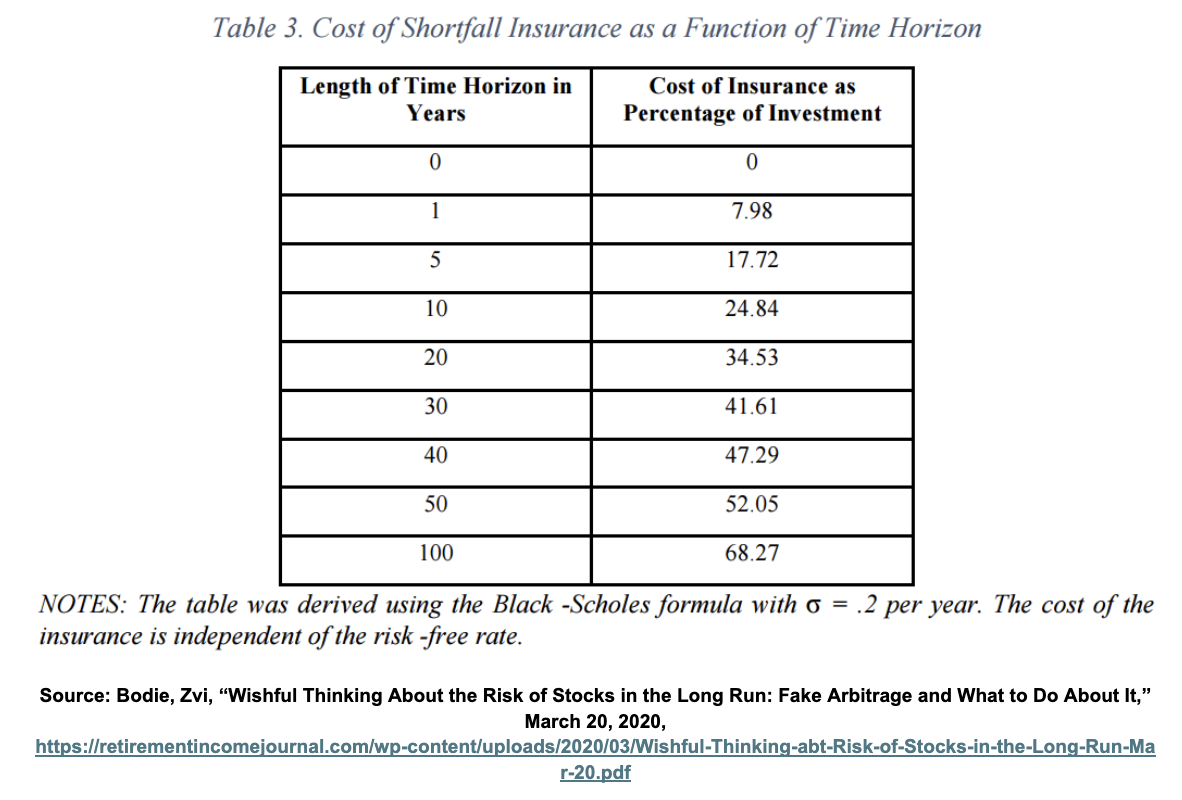
Putting it simply, the market thinks the market is risky on long horizons. And if there is ever a period where the risk of the stock market underperforming horizon-matched TIPS (or nominal Treasury) is truly zero or negligible, then that risk-free equity premium can be captured as an immediate arbitrage through the derivatives markets.7 There’s no need to wait 30 years!
Risk Capacity, Not Horizon
If someone has the capacity and the tolerance for risk, I certainly agree with the authors’ statement that accepting the risk to reach for equities’ potentially much greater return is a rational choice. But I would extend this to goals both nearer and farther than the intermediate horizon to which they apply it. I sometimes illustrate risk capacity this way:
- If someone professes a willingness to risk spending their last 10 years of life eating cat food8 in exchange for a shot at generational wealth, I’m going to try to talk them out of it.
- But if someone is willing to risk a staycation in exchange for a decent shot at Aruba, I’m not going to try to convince them to lock in Branson, Missouri, instead.
This is true whether the vacation is in one year, five years, or twenty years. What may shrink is someone’s willingness to be flexible with their vacation plans as the horizon shortens, but that’s the risk capacity of the goal changing, not a demonstration that stocks are riskier in the short run.
Conversely, while I would typically agree with the authors that a young saver should invest 100% in stocks, that is because a young person usually has both greater retirement planning flexibility and a much higher ratio of human capital to financial capital. It does not mean I believe stocks become safe in the long run.
A conceptual demonstration: We have enough independent one-year observations to conclude that in a horrific, first percentile-ish negative outcome, the stock market might underperform the one-year TIPS rate by as much as 50%. This is what most people have in mind when they think of the short-term riskiness of the stock market, and because we have so many one-year observations, a 1-in-100 outcome is easy for investors to visualize.
Meanwhile, Aizhan Anarkulova and Scott Cedarburg calculated a 12% probability that a diversified stock portfolio could fall short of inflation over a 30-year period. In doing so, they used the same block bootstrap methodology by which they more famously and controversially concluded that someone should hold 100% stocks throughout their lifetime (in no small measure because their methodology excluded long-term-safe assets such as TIPS ladders).
Merely keeping pace with inflation, a stock portfolio would underperform a 3% TIPS yield by 142% over 30 years. That’s nearly three times the 50% one-year shortfall and perhaps more than 10 times as likely. It also costs you 30 years of your investing lifetime instead of just one. Quantitatively this is all very back-of-the-envelope, but please take the concept of long-run stock risk seriously!9
On the other hand, my insistence that risk/return never becomes *wink-wink*/return must not be mistaken for bearishness. (It’s not risk/*nothing* either!) The authors are right to emphasize just how extraordinary the upside can be with equities, in the more probable case that the risk premium manifests itself. That’s why it’s rational for someone who has the risk capacity to invest in the stock market.
Risk Free! . . . ish?
I've used “risk free” repeatedly based on the idea that anything with a higher expected return may also perform significantly worse than horizon-matched TIPS. In their article, the authors propose a semi-conspiratorial confiscatory argument about nominal bonds (“a device for slow and steady expropriation”).10 Given that, perhaps we must also entertain the possibility that the reason breakeven inflation rates remain so low — i.e., the reason TIPS yields are relatively high — is that the market is pricing in a non-negligible probability of politically motivated CPI sandbagging by the BLS.11
Although equally conspiratorial, this potential scenario also suggests a mechanism for extending “slow and steady expropriation” to TIPS.12For anyone who might see a path here to explaining stocks’ risk-free risk premium, don't kid yourselves for the following reasons. 1. It also implies such a thoroughgoing breach of the government’s social contract that the propensity for effective or direct expropriation could extend to all asset classes. 2. This would indicate that TIPS may be carrying an expected risk premium, too.
Yeesh. I shudder and move on.
A Hodgepodge of Thoughts in Lieu of a Conclusion
- One form of market irrationality Bernstein has avowed elsewhere — the occasional price bubble13 — is in fact inadmissible if surefire long-term outperformance is to be believed. There is only one aggregate market price at a time, and if that price is always low enough to irrationally guarantee long-term outperformance, then it can never be high enough to imply an irrationally negative short-term risk premium.
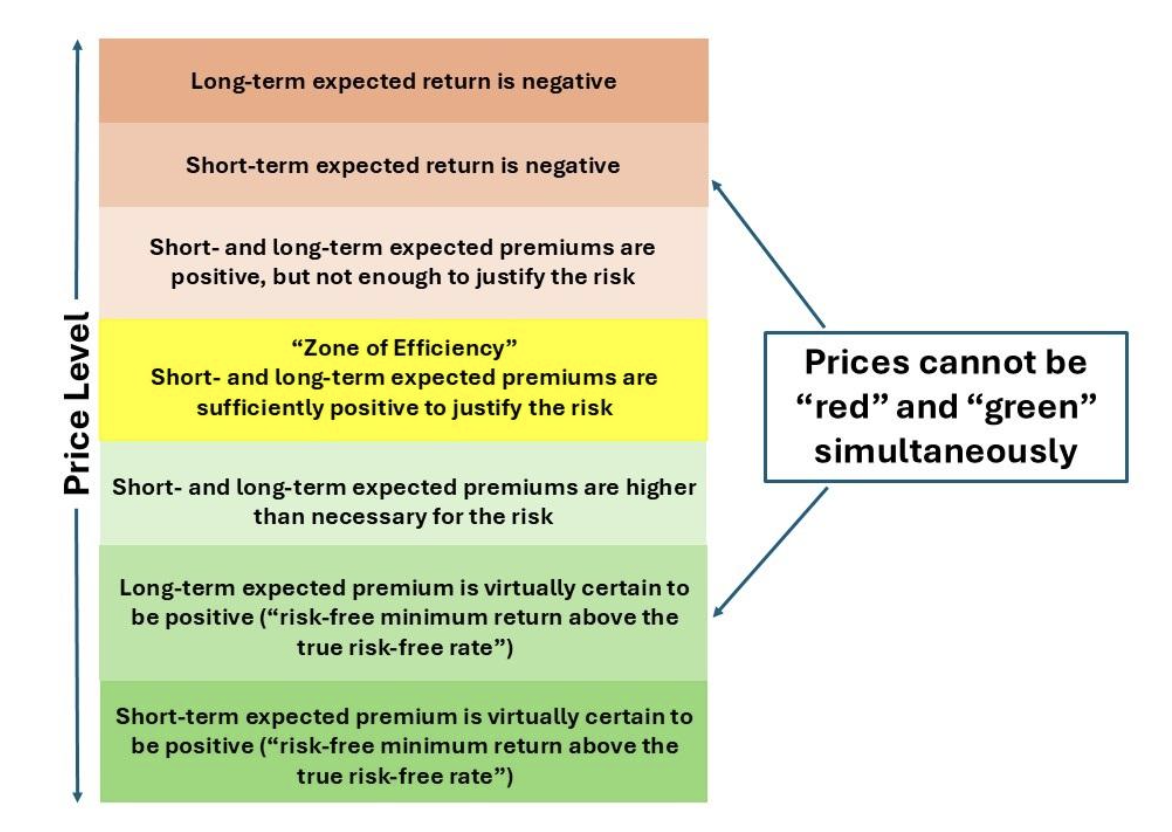
- As to the article’s assertion, “Stocks can do well over the very long term because you have to assume so much risk over the short term,” aside from the applicability of the above arbitrage arguments, the short-term volatility of long-term bonds, including long-term TIPS, is in fact much 𝘩𝘪𝘨𝘩𝘦𝘳 than that of stocks.14
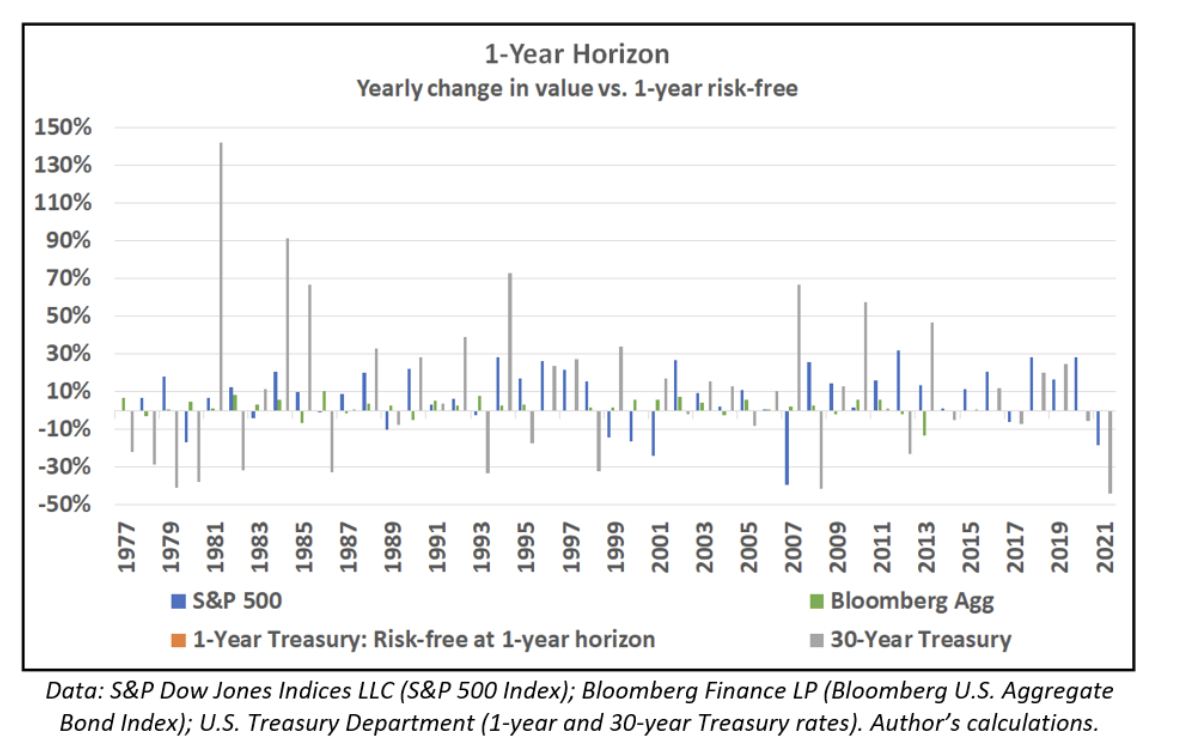
- The above and below images are taken from the third installment of my “Long-Horizon Investing” series, wherein I pointed out the extreme consequences of duration mismatch — a risk with no corresponding return premium — as horizons grow. The riskiness of short-term bonds or cash in the long run essentially mirrors that of long-term bonds in the short run.15 Consequently, I would shout from the rooftops the “Long TIPS” article’s pronouncement that “the true conservative choice is a 30-year TIPS ladder — not a 30/70 blend using those [uh . . . bad]16 nominal bonds that we condemned earlier . . .”
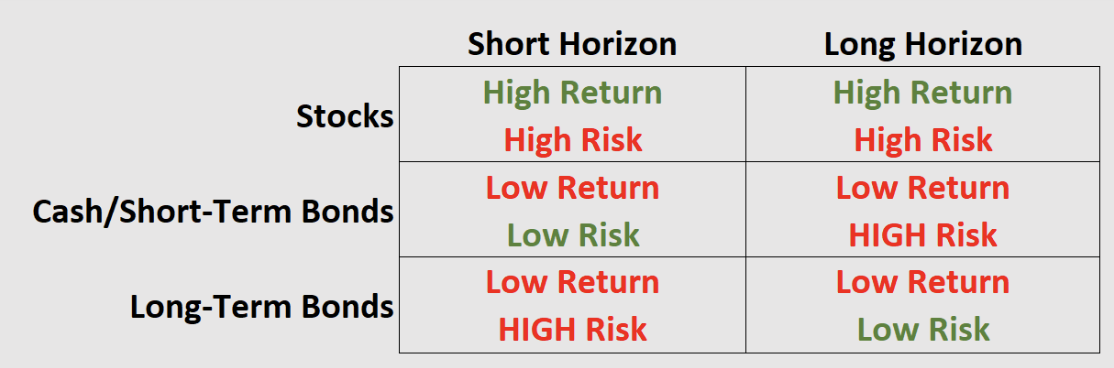
The specific blend in the article’s crosshairs is a typical 30/70 glidepath terminus in a target-date mutual fund series. While I would assert that the one-size-fits-none nature of such funds is necessarily problematic, I want to emphasize a point that the article only waved at in the sentence quoted above: Such a glidepath is not necessarily wrong for holding 70% bonds, but it is wrong for holding 70% of the wrong bonds. And while the nominal-ness of the bonds is indeed wrong if safe real income is the goal, the duration mismatch of a short-term bond portfolio for long-term income is even more dangerous.17
- The arguments above collectively suggest that the article’s proposed strategy of replacing stocks and bonds with TIPS for inflexible retirement expenses is the right call, whether TIPS yields will outpace the “4% Rule” or not. In other words, the sentence about “the conservative choice” is spot on, but it could have dispensed with the conditional opener, “[at] current yields.”18
Incidentally, I laud McQuarrie’s work in “The 4-Percent Rule Was Never Failproof.” I have repeatedly beaten the same drum myself.
1. I offer a nerdy nod to the authors for their defiance of Betteridge.
2. William Bernstein has espoused an assemblage of jargon whereby “efficiency” and “rationality” are orthogonal vectors, such that the market can be efficient and irrational simultaneously. I’ve always adopted a more traditional nested terminological topology, wherein irrationality is even less efficient than mere inefficiency. I think Paul Samuelson’s proposed “micro efficient”/“macro inefficient” divide is the more helpful terminology to cover what Bernstein was describing.
3. McQuarrie even wrote a research paper titled “Stocks for the Long Run? Sometimes Yes, Sometimes No."
4. I’m going to violate both my promise not to block quote and my promise not to repeat my arguments, but I’m confining the violation to an endnote. This point is too important:
The probability of a shortfall declines as the horizon increases, but the magnitude of the worst shortfalls grows larger. Thus, as the horizon increases, stock risk increasingly looks like ‘tail risk.’ This implies that as the timeframe grows, the amount of independent data required increases — i.e., to establish whether negative outlier events occur less frequently than they should — but the amount of independent data available decreases.
This is also why the mere probability of a shortfall, without regard to potential magnitude, is insufficient to describe the full nature of long-run stock risk.
5. Whereas “at-the-money-spot” refers to a strike price equal to the current price level of the underlying (e.g., a total return stock index), “at-the-money-forward” means you set the strike price equal the current price multiplied by a value equal to the end-to-end return of the risk-free asset. This locks in insurance against stock returns underperforming risk-free asset returns. It is also the strike price at which a call option and a put option must have the same price, per put-call parity.
6. The “about” in my sentence must be seen as implying generous bands, as the precise cost will vary with implied volatility, liquidity, Treasury rates, etc. But the general point remains that securing a guarantee from the market against the risk of stocks underperforming the horizon-matched risk-free rate grows more expensive with horizon. This is true in theory and in practice, and while Bodie used the Black-Scholes formula to generate precise cost estimates, nothing more complex or controversial than the Law of One Price, as manifested through put-call parity, is required to prove the qualitative point.
7. For example, you can instead sell that 40-cents-per-dollar put option and spend the proceeds, secure in the certainty that your short obligation will expire worthless.
8. Is cat food really that much cheaper than people food? I dunno. Clearly, we’re not talking about the premium stuff.
9. As I mention elsewhere, I suspect stock market expected returns are higher when the risk-free rate is higher, which implies the odds of a negative real return are probably lower when TIPS rates are high. Then again, my example didn’t even discuss the fact that the 12% tail would include many observations with far worse outcomes!
10. The authors’ seeming certainty about this is singularly dismissive of market efficiency, given the bond market's freedom to price in such risks if it sees them. “Governments have learned that the investor frog placed in a warm bond pot rarely bestirs himself in time.” I mean, maybe? There are certainly historical examples that fit this conclusion. But as with the tech bubble (see endnote 13), there are plausible alternative explanations, and in proffering investment advice, I tend to lean toward DATMIS: don’t assume the market is stupid. In this case, that would look like an assertion that a diversified bond portfolio very likely has higher expected returns than TIPS of the same maturity, in exchange for bearing both credit and inflation risk that an investor may very sensibly not wish to bear.
11. Note that a proposition that breakeven inflation rates are reduced due to the market pricing in CPI suppression risk at some probability, is compatible with market efficiency.
12. This “expropriation extension” could be viewed as TIPS joining the inefficient markets story in endnote 10, or it could be viewed as a story that both nominal and real rates have risen in part because of inflation/expropriation risk of a kind that TIPS will not in the end fully hedge.
13. I don’t entirely discount the possibility of market bubbles either. Market efficiency likely makes a better floor than ceiling, thanks to limits to arbitrage. But I also think it can be much harder than people think to prove the presence of a bubble, during or even after the event: https://www.linkedin.com/posts/nathan-dutzmann_stocks-bubble-share-7391613572474261505-4sqz/
14. Why on earth am I spending so much time on this topic?! Fair question. It’s for the same reason that I found it necessary to start the five-article series aimed at developing a goals-based framework for retirement investing with two articles on this same topic: If stocks are magic money machines in the long term, then long-term investing is comically simple: Put the money in stocks! But if they are not magic money machines, then the comically simple advice that so often gets dispensed is potentially quite dangerous.
15. I often tell clients, “You can have safe cash value or safe income, but not both.” This is an important expectation to set for anyone who builds a TIPS ladder, since the volatility of the ladder will be extreme in the early years, not despite but because of the income safety.
Side note to this endnote: Annuities with income riders are an arguable* exception, but at present annuity income guarantees are not available in an inflation-protected form.
*Footnote to side note to endnote: “Arguable” because most annuities will in fact impose “market valuation adjustments” — manifestations of the short-term volatility of long-term guarantees — on anyone who tries to turn the low-volatility “cash value” into actual liquid cash in the early years of a policy.
16. Priggish? Me? Okay, maybe. (Or maybe I did that to trick you into reading McQuarrie and Bernstein’s article so you could see the fairly mild word they actually employed.)
17. For what it’s worth, DFA’s target-date income funds are the only target-date series I’m aware of that gets this right. However, I wonder in practice how well an unguided retiree will be able to handle the year-to-year price volatility that is a necessary corollary to safe income from the funds’ duration-matched bond portfolio.
18. Another highly plausible way of viewing this is that the expected return for equities, and thus the probability of success for the 4% Rule, likely varies with real interest rates, since the expected equity-risk premium is a risk-derived addition above the risk-free rate, whatever that may be. Consequently, the “N%-Rule” is such that the N available from a TIPS ladder, which varies substantially over time, must always be higher than any meaningfully “safe” N (if there even is such a thing) from a risk asset portfolio.
In his roles as chief investment officer for Round Table Investment Strategies and portfolio manager for Torren Management, Nathan Dutzmann is responsible for applying financial science and investment research to the process of constructing portfolios tailored to the individual needs and goals of clients nationwide. Nathan was previously an investment strategist with Dimensional Fund Advisors and a partner and chief investment officer with Aspen Partners. He is also a member of the investment industry advisory council for The American College of Financial Services. He holds an MBA from Harvard Business School and a master’s degree in international political economy and a bachelor’s degree in mathematical and computer sciences from the Colorado School of Mines.
A message from Advisor Perspectives and VettaFi: Discover something new! Click here to register for our upcoming webcasts.
Membership required
Membership is now required to use this feature. To learn more:
View Membership Benefits