Ask any Federal Reserve chair how far the policy rate sits from neutral and you’d normally get a number, or at least a range. Asked exactly that on 16 September, current Chair Kevin Warsh provided neither. He said the comparison is “useful academically … a discussion to help us think about policy,” but that it carried no “operational effect” on what the Federal Open Market Committee (FOMC) decided that day.
Warsh’s messaging is a notable departure from recent norms in how the Fed describes its policy stance. The real neutral interest rate has been a core component of FOMC communication since Janet Yellen was chair from 2014–2018 (read her 2015 speech). Before Yellen, Chair Ben Bernanke leaned on the same idea: implicitly attributing the drop in the neutral rate after the 2008–2009 global financial crisis (GFC) to economic scarring and the balance sheet repair that followed, packaged publicly as “headwinds” (see his 2012 speech).
However, since being appointed chair this year, Warsh has framed the discussion differently. At Jackson Hole and again in September, he said he’d “be hard-pressed to describe broad financial conditions as restrictive” – a view he said is “widely shared by the committee.” This framing relates the stance of monetary policy and, more specifically, changes in the Fed’s policy rate to how those changes affect broader asset market prices and spreads – credit spreads, equity valuations, and borrowing costs across the economy – rather than the gap between the policy rate and a model-implied neutral rate.
The distinction matters and has near-term implications for Fed policy. Several (but not all) FOMC participants have described policy this year as somewhere between neutral and mildly restrictive – a stance that is at least theoretically positioned to mitigate temporary inflationary pressures.
At the same time, broad financial conditions in the U.S. have been remarkably stable despite energy market disruptions. Higher real rates – which by themselves should tend to restrain economic activity – have coincided with robust equity returns. The S&P 500 sits roughly 13% above where it started the year, supporting consumption through the wealth channel.
Viewed through this lens, September’s Fed rate hike may have been aimed at helping prevent financial conditions from easing further; such easing would potentially add to demand-side inflation pressure. Ahead of the September meeting, markets were pricing an elevated chance of a 25-basis-point (bp) hike. As a result, holding the policy rate steady would have been a notable surprise.
See more: Fed Hikes: What's Next for Treasury Yields?
Looking ahead, markets are priced for additional hikes. And our base case is that the FOMC will likely deliver one or two more 25-bp rate hikes through this year and into early next. However, looking further out, anticipating appropriate Fed policy through a financial-conditions-targeting framework has its own limitations. Hence, a neutral rate anchor is still useful.
Ultimately, our outlook is for the Fed to recalibrate its policy stance to position for the risk that inflation doesn’t dissipate. However, as the temporary factors that have been supporting inflation fade – tariffs, energy, and AI-related computing equipment price adjustments – and the FOMC gains more confidence that inflation isn’t persistent, further adjustments beyond that may not be necessary.
The real neutral rate: theory and practice
Traditionally, the real neutral (or natural) rate – what economists call r* – is defined as the real interest rate that neither stimulates nor restrains. It is the rate that would prevail with the economy growing at potential and inflation stable at target.
It is useful as a theoretical anchor in that it provides a benchmark for how much monetary policy is supporting or restricting activity. However, in practice, r* has limitations. It shifts as structural forces change, it cannot be observed, and the methods used to estimate it produce uncertain and inconsistent results.
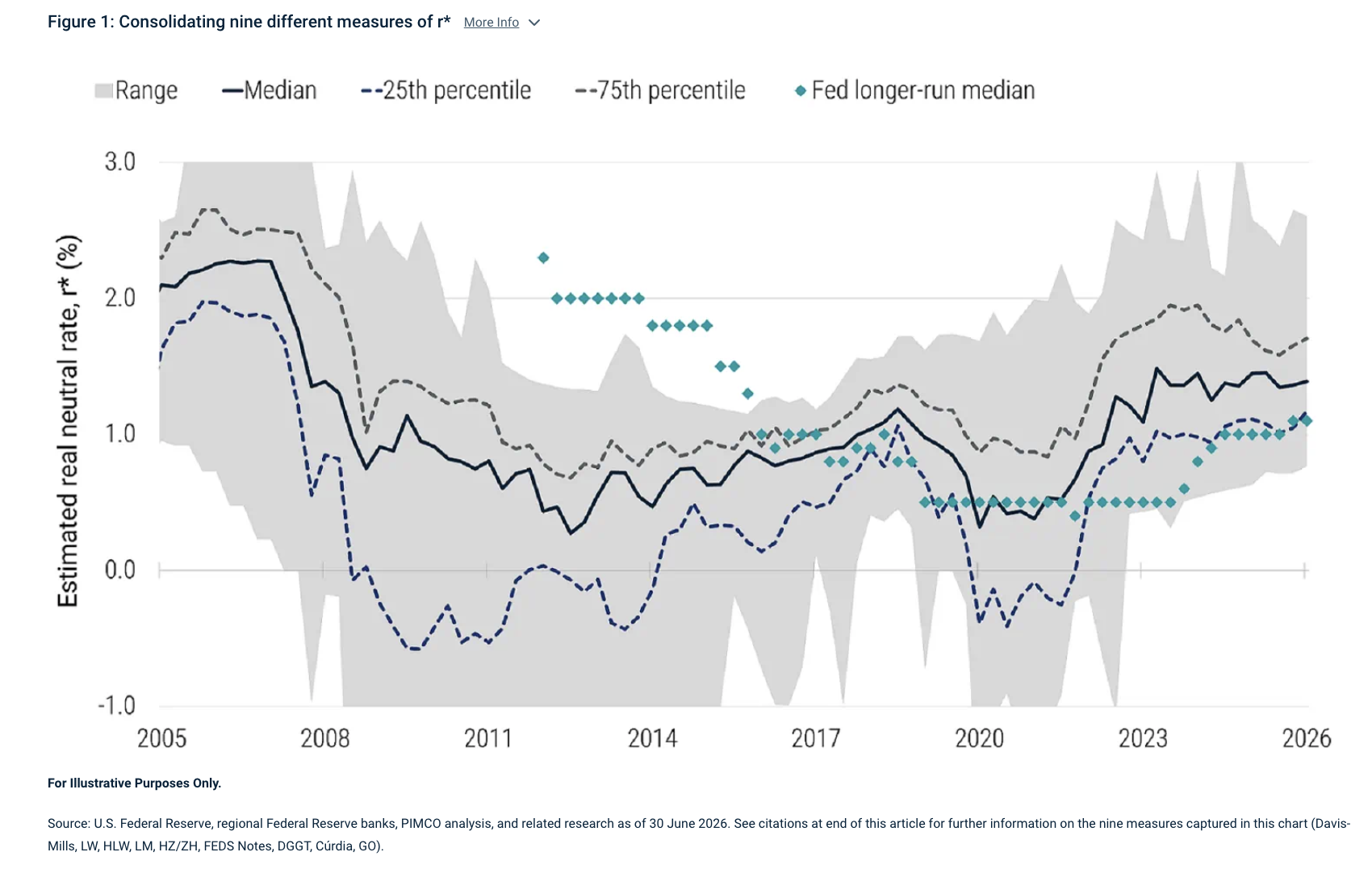
Alongside Laubach-Williams (2003) and the later Holston-Laubach-Williams models, many of the regional banks within the Federal Reserve System now publish their own estimates of r*. Surveying them puts current point estimates roughly between 0.8% and 2.6% in real terms, with a median near 1.4% (see Figure 1). This isn’t far from the roughly 1.2% implied by the median point estimate of the FOMC’s longer-run projections. However, the 1.8-percentage-point range of plausible estimates is wide, and on the extremes has very different practical implications for current policy. Also, the various estimates of r* are not just different from one another; each is imprecise, and increasingly so. Model-implied 90% confidence bands suggest the true level of r* could sit some 1.7 percentage points above or below the point estimate – that’s a vast range in the world of interest rates.
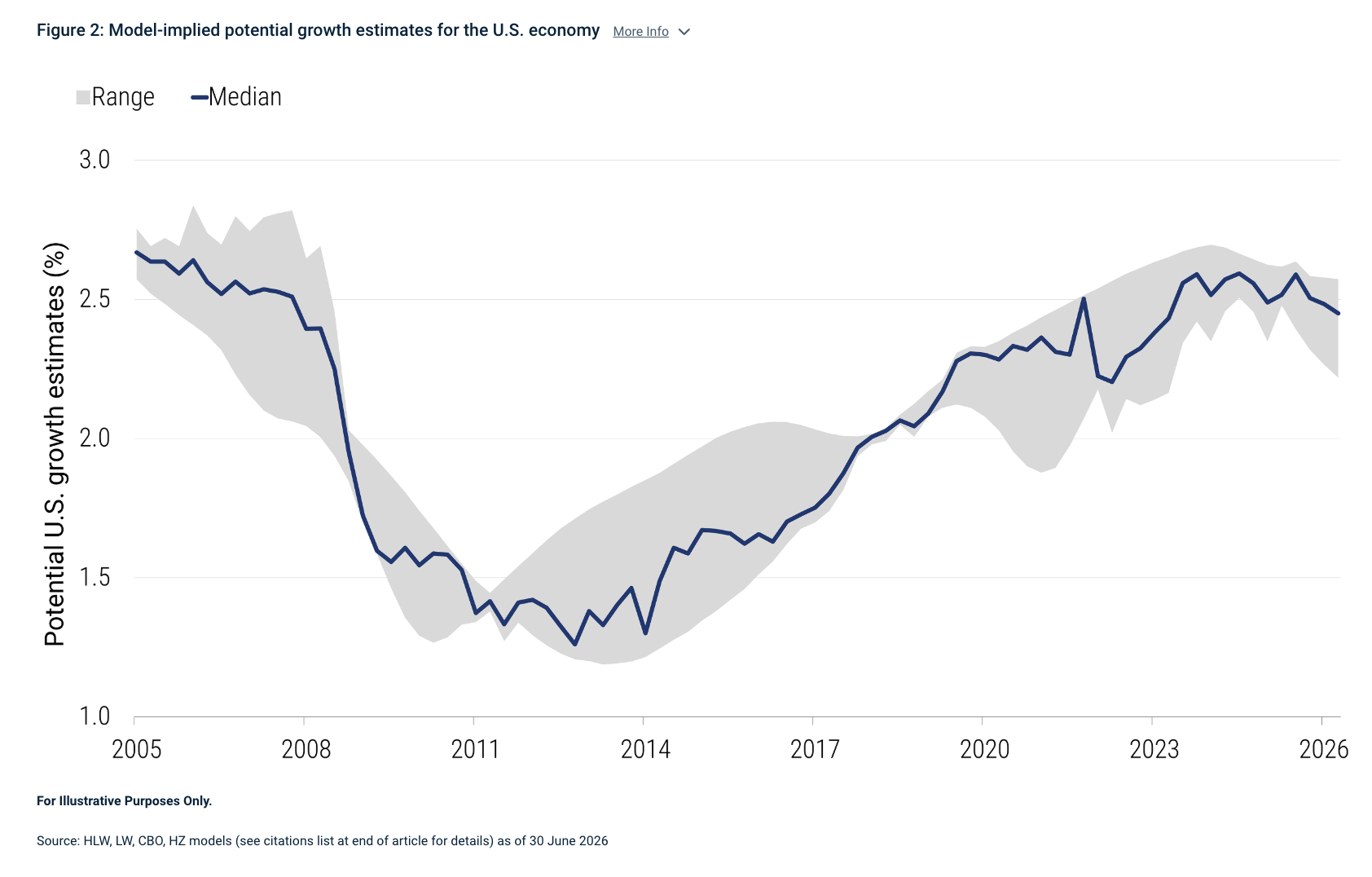
A further complicating factor is that r* estimates are time-varying as structural forces in the economy change. After falling for the better part of three decades, model estimates of r* have risen about 100 bps post-pandemic, from roughly 0.5% to 1.5%. Although the factors driving r* are widely believed to be related to the evolution of potential growth and savings and investment preferences, the main driver recently appears to be higher potential growth, which the models that publish it have marked up from about 1.8% to 2.5% (see Figure 2). According to U.S. Commerce Department data, U.S. labor productivity growth – a key component of potential growth – shifted higher post-pandemic even before any widespread AI implementation and adoption could reasonably be expected to show up in the statistics.
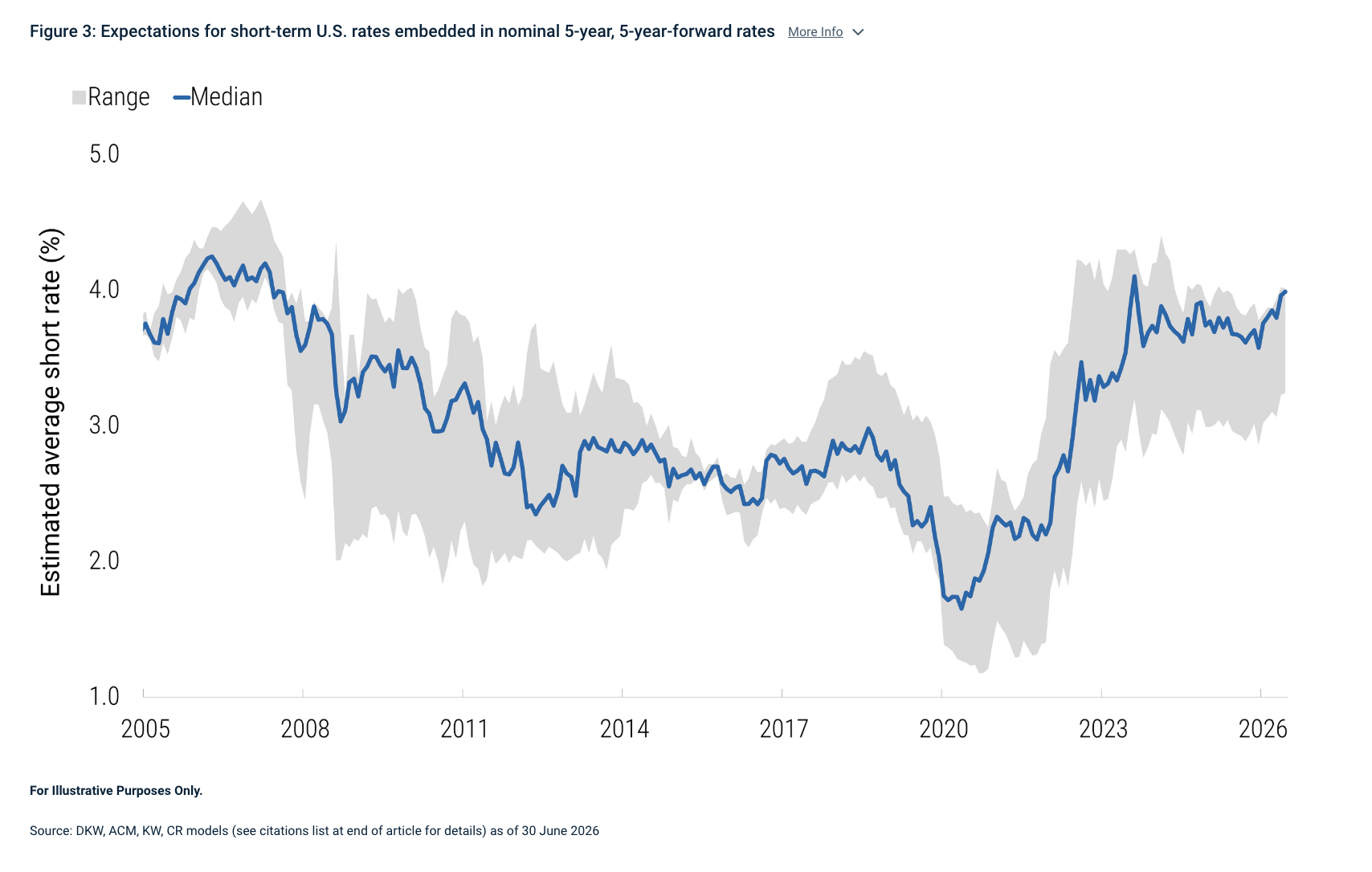
The U.S. interest rate curve has repriced accordingly: Term-structure estimates of the expected average short rate embedded in the 5-year, 5-year-forward rate have also risen roughly 100 bps over the same period (see Figure 3).
Whether r* rises further still is another key question. The structural forces behind the original decline aren’t easily reversed, but AI is likely to be a powerful force that fundamentally reshapes the economy. A widely cited analysis is by Rachel and Smith (2015), who documented a roughly 450-bp fall in global long-term real rates over the preceding three decades. The trend was common to developed and emerging economies alike, pointing to a shift in the global neutral rate rather than country-specific factors.
Notably, trend growth – the channel doing most of the work in today’s U.S. growth estimates – explained little of the pre-GFC decline in Rachel and Smith’s analysis. Global growth was fairly steady through those decades, and it was the crisis itself that triggered a broader reassessment of growth prospects. Most of the move, therefore, came from saving and investment preferences: Longer lifespans and rising inequality pushed desired saving up, while desired investment fell with the declining relative price of capital and lower public investment.
Fast-forward to today: If AI delivers sustained productivity gains, it should push r* up, as should higher desired investment. But the societal uncertainty AI creates could also lift precautionary saving. In prior analysis we’ve found no evidence yet in U.S. Treasury yield behavior that AI model releases are moving market-based r* estimates, although that doesn’t necessarily mean AI won’t affect r*. (See a related discussion in the 1 July edition of Macro Signposts.)
Financial conditions targeting has its own limitations
If r* estimates are this uncertain – and the current policy rate sits comfortably inside the range of reasonable ones – and the path forward for r* is equally uncertain given the technological and structural changes happening in the global economy, then broad financial conditions might indeed be a better guide for monetary policymakers, at least in the near term, for the simple reason that they are observed rather than estimated.
Financial conditions have stayed stable even as the U.S. interest rate market has priced a higher policy path. So while the forces driving inflation still don’t appear persistent, it’s possible that the FOMC – at least until it gains more confidence in hitting its inflation target – would rather not risk compounding inflationary pressures by effectively easing conditions through failing to deliver what markets have already priced in.
Looking further out, overreliance on financial conditions also has practical limitations. Financial conditions react to many things the Fed doesn’t control. Investor risk tolerance can reset abruptly on a geopolitical shock, a growth scare, or a fiscal surprise. Currently, financial conditions are being supported by AI optimism and an outlook for productivity growth. However, that could also change. It doesn’t take an AI bust to cool the pace of investment growth – the acceleration in the pace of investment just needs to slow. A central bank steering only by conditions could be forced to overreact to temporary swings and could end up a long way from any plausible neutral rate for reasons unrelated to the underlying economy.
Implications
Our base case is one or two more 25-bp policy rate hikes in the next few Fed meetings, broadly consistent with market pricing. By early 2027, the non-labor cost pressures that kept inflation elevated in 2026 – tariffs, energy, computer equipment – should be fading, limiting the need for further adjustment.
While Fed hikes in the very near term may be aimed at managing broader financial conditions and not adding to inflationary pressures, we see practical limitations to financial conditions targeting. Financial conditions can exhibit stability until they don’t. Understanding underlying fundamentals and how they are changing, even if the data and outlook are uncertain, still has a role in anchoring monetary policy.
Citations for the models discussed above:
-
Davis-Mills (PIMCO / National Bureau of Economic Research (NBER)) – Josh Davis, Cristian Fuenzalida, Leon Huetsch, Benjamin Mills, and Alan M. Taylor. “Global Natural Rates in the Long Run: Postwar Macro Trends and the Market-Implied r* in 10 Advanced Economies.” Journal of International Economics 149 (2024): 103919. Working paper (WP) version: NBER Working Paper No. 31787, October 2023.
-
LW (Federal Reserve Bank of New York) – Thomas Laubach and John C. Williams. “Measuring the Natural Rate of Interest.” Review of Economics and Statistics 85, no. 4 (November 2003): 1063–70. WP version: FEDS 2001-56, Board of Governors.
-
HLW (Federal Reserve Bank of New York) – Kathryn Holston, Thomas Laubach, and John C. Williams. “Measuring the Natural Rate of Interest after COVID-19.” FRBNY Staff Reports, no. 1063, June 2023.
-
HLW (original) – Kathryn Holston, Thomas Laubach, and John C. Williams. “Measuring the Natural Rate of Interest: International Trends and Determinants.” Journal of International Economics 108, supp. 1 (2017): S59–S75.
-
LM (Federal Reserve Bank of Richmond) – Thomas A. Lubik and Christian Matthes. “Calculating the Natural Rate of Interest: A Comparison of Two Alternative Approaches.” FRB Richmond Economic Brief 15-10, October 2015.
-
LM (update) – Thomas A. Lubik and Christian Matthes. “The Stars Our Destination: An Update for Our R* Model.” FRB Richmond Economic Brief 23-32, September 2023.
-
HZ / ZH (Federal Reserve Bank of Cleveland) – Taylor N. Horn and Saeed Zaman. “Neutral Interest Rates and the Monetary Policy Stance.” FRB Cleveland Economic Commentary 2025-08, 9 September 2025.
-
FEDS Notes (Federal Reserve Board of Governors) – Thiago Revil T. Ferreira, Mitch Lott, and Keith Richards. “Real-Time Global Longer-Run Neutral Rates.” FEDS Notes, Board of Governors, 9 April 2025.
-
DGGT (Federal Reserve Bank of New York) – Marco Del Negro, Domenico Giannone, Marc P. Giannoni, and Andrea Tambalotti. “Safety, Liquidity, and the Natural Rate of Interest.” Brookings Papers on Economic Activity 48, no. 1 (Spring 2017): 235–316. WP version: FRBNY Staff Reports, no. 812, May 2017.
-
Cúrdia (Federal Reserve Bank of San Francisco) – Vasco Cúrdia. “Assessing a Medium-Run Natural Rate of Interest.” FRBSF Economic Letter 2026-22, 17 August 2026.
-
Cúrdia (WP) – Vasco Cúrdia. “Monetary Policy and the Medium-Run Natural Rate of Interest.” FRBSF Working Paper 2025-24, May 2026.
-
GO (Federal Reserve Bank of Kansas City) – Andrew Glover and Johnson Oliyide. “Introducing New Monthly Estimates of the Natural Rate of Interest and Natural Unemployment Rate.” FRB Kansas City Economic Bulletin, 2 February 2026.
-
DKW – Stefania D’Amico, Don H. Kim, and Min Wei. “Tips from TIPS: The Informational Content of Treasury Inflation-Protected Security Prices.” Journal of Financial and Quantitative Analysis 53 (1): 395–436. 2018.
-
ACM – Tobias Adrian, Richard K. Crump, and Emanuel Moench. “Pricing the Term Structure with Linear Regressions.” Journal of Financial Economics 110 (1): 110–138. 2013.
-
KW (Federal Reserve Board of Governors) – Don H. Kim and Jonathan H. Wright. “An Arbitrage-Free Three-Factor Term Structure Model and the Recent Behavior of Long-Term Yields and Distant-Horizon Forward Rates.” Finance and Economics Discussion Series 2005-33. Washington: Board of Governors of the Federal Reserve System. 2005.
-
CR – Jens H.E. Christensen, Francis X. Diebold, and Glenn D. Rudebusch. “The Affine Arbitrage-Free Class of Nelson-Siegel Term Structure Models.” Journal of Econometrics 164 (1): 4–20. 2011.
Disclosures
A word about risk: All investments contain risk and may lose value. Investing in the bond market is subject to risks, including market, interest rate, issuer, credit, inflation risk, and liquidity risk. The value of most bonds and bond strategies are impacted by changes in interest rates. Bonds and bond strategies with longer durations tend to be more sensitive and volatile than those with shorter durations; bond prices generally fall as interest rates rise, and low interest rate environments increase this risk. Reductions in bond counterparty capacity may contribute to decreased market liquidity and increased price volatility. Bond investments may be worth more or less than the original cost when redeemed.
Statements concerning financial market trends or portfolio strategies are based on current market conditions, which will fluctuate. There is no guarantee that these investment strategies will work under all market conditions or are appropriate for all investors and each investor should evaluate their ability to invest for the long term, especially during periods of downturn in the market. Outlook and strategies are subject to change without notice.
Forecasts, estimates and certain information contained herein are based upon proprietary research and should not be interpreted as investment advice, as an offer or solicitation, nor as the purchase or sale of any financial instrument.
PIMCO as a general matter provides services to qualified institutions, financial intermediaries and institutional investors. Individual investors should contact their own financial professional to determine the most appropriate investment options for their financial situation. This material contains the opinions of the manager and such opinions are subject to change without notice. This material has been distributed for informational purposes only and should not be considered as investment advice or a recommendation of any particular security, strategy or investment product. Information contained herein has been obtained from sources believed to be reliable, but not guaranteed. No part of this material may be reproduced in any form, or referred to in any other publication, without express written permission. PIMCO is a trademark of Allianz Asset Management of America LLC in the United States and throughout the world.
CMR2026-0923-5954431
A message from Advisor Perspectives and VettaFi: Discover something new! Click here to register for our upcoming webcasts.
© PIMCO
Read more commentaries by PIMCO