The Big One Is Rumbling in the Bond Market
Membership required
Membership is now required to use this feature. To learn more:
View Membership BenefitsThe tectonic plates of the global economy have shifted. Across the world, yields on long government bonds — keystone of the entire financial system — have climbed to their highest in decades. A trend that had been clear ever since the brief post-pandemic boom turned into resurgent inflation and higher rates has suddenly accelerated.
In Japan, 10-year bonds now yield the most in more than three decades. In other major markets, government borrowing costs are their highest since the eve of the Global Financial Crisis 19 years ago, and rising at a pace that hasn’t been seen since long before then: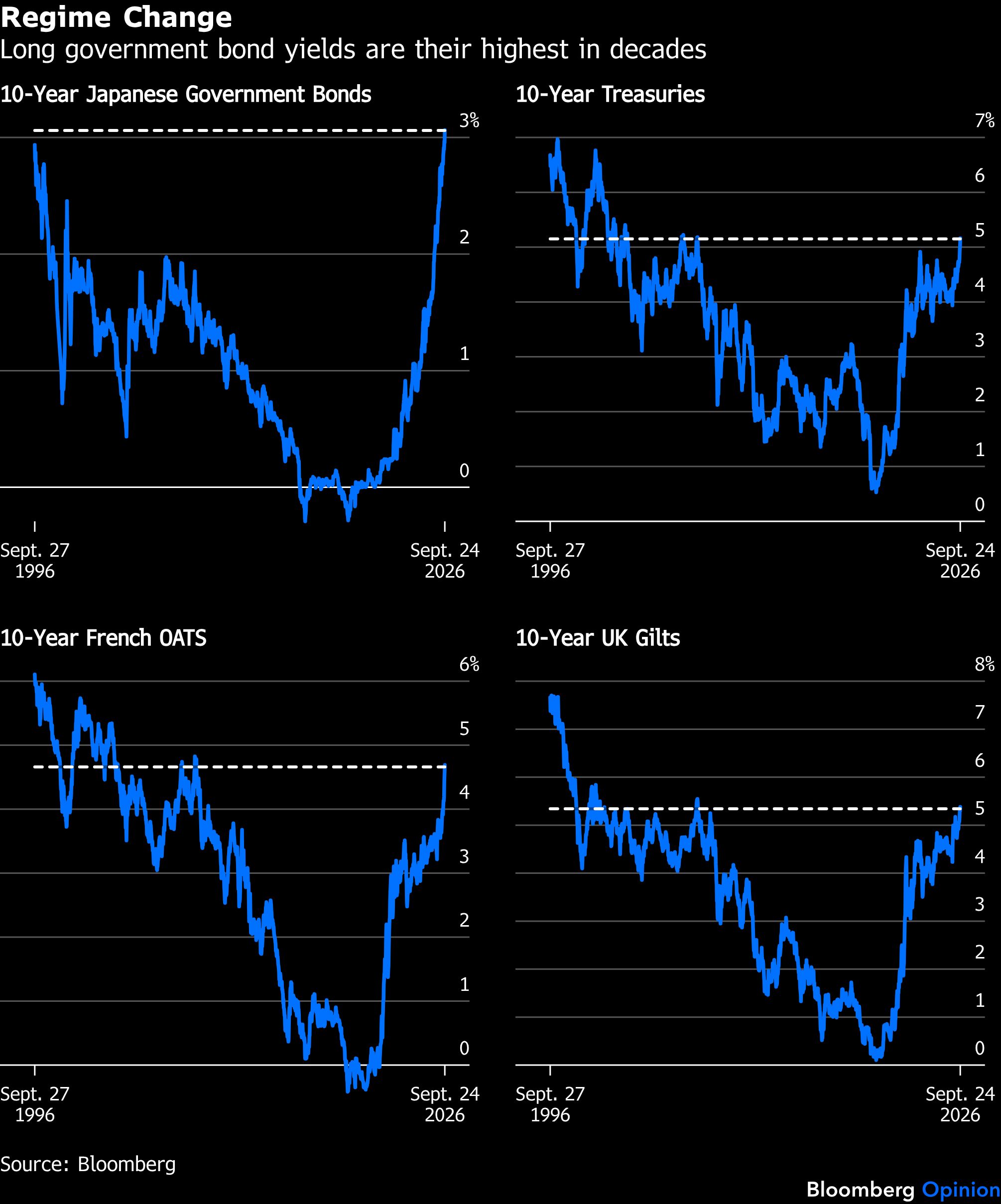
In financial terms, this is truly an earthquake. What is strange, however, is that even though 10-year government bonds are the financial bedrock, setting the risk-free rates from which virtually all transactions are ultimately priced, they are showing little sign of damaging anything else, either in the markets or the real economy. The Nasdaq 100, one of the world’s most widely tracked indexes, hit a new all-time high this week even as yields were tipping upward.
See more: What’s Driving the Rise in Global Bond Yields?
That is ultimately because their rise is still viewed — rightly or wrongly — as benign.
Causes
Many factors drive the bond market, but it’s hard to argue that any of the more alarming ones is responsible for the shift. Among frequently cited problems that don’t appear decisive on closer inspection are:
- Fiscal concerns: Government deficits are rising and reaching frighteningly large numbers — US outstanding debt last month topped $40 trillion for the first time. But inflation has whittled away at the value of outstanding debt. As a proportion of gross domestic product, debt is falling, the Institute of International Finance showed this week. Digging into the entrails of the bond market, the “term premium” — put simply, the extra return bond investors require to be compensated for risks over and above moving interest rates — has barely budged of late. It would be rising fast if there was truly concern about Uncle Sam’s ability to repay debt.
- Crowding out by debt to fund artificial intelligence: Private companies with impeccable credit ratings are borrowing prodigious sums of money to build and equip the data centers AI needs to function. This debt isn’t as safe as the Treasury’s because even the likes of Alphabet Inc. or Amazon.com Inc. can’t print new money to meet their commitments. But it’s tough to find evidence that funds normally allocated to Treasuries are being diverted their way.
- Politics: In Germany, they look particularly parlous, with the hard-right Alternative for Deutschland winning a majority in one recent state election, while chancellor Friedrich Merz’s Christian Democratic Union failed even to reach the 5% threshold in another. But the run on German bunds has been less extreme than most others. In the US, prediction markets have switched to price in a “Blue Wave,” with Democrats taking both the House and the Senate in the midterm elections. They’re generally regarded as market-unfriendly — but over history, bond yields tend to fall in periods of political gridlock, as they restrain the kind of drastic government spending that investors dislike.
- Inflation: Opinion polls show huge discontent with rising living costs. But in the US, at least, most measures of core inflation are still declining. As the Treasury issues bonds whose returns are linked to inflation, it’s possible to get an exact read on investors’ expectations — and they’ve barely moved in several years. Investors are not selling bonds because of any fear that price rises will veer out of control.
- Oil: Energy prices have rebounded as the conflict in Iran intensifies, and growing evidence that it’s the destruction of refining capacity, rather than limits on crude leaving the region, which is having the most serious impact on the economy. Diesel at a record taxes agriculture and manufacturing. Prices have stayed elevated far longer than was anticipated when the US-Iran conflict started in February. Yet markets are still trading on the assumption that these effects will be transitory. Brent crude for delivery next month is now $107 per barrel, but for 12 months it’s at $82. If the situation in the Middle East deteriorates, it implies that a lot of the negative effects have not yet been factored in, but it’s hard to argue that rising oil has driven this.
The most logical explanation for bonds’ upheaval is also one of the most palatable. Economic data have been much stronger than expected of late. In combination with a surprisingly aggressive approach from the new Federal Reserve Chair Kevin Warsh, that has prompted markets to price in overnight US rates of 4.75% a year from now. Before the Iran war, they were expected to fall to 3%.
Consequences (Positive)
It’s difficult to couch a sudden increase in the cost of borrowing money for the long term as good news. But there are some positive implications. If a virtually risk-free investment will now pay a guaranteed 5% for 10 years, that becomes a viable alternative to stocks — or at the very least it allows for more effective risk management. Traditional pension plans, which define benefits for their savers in advance (rather than allowing them to move with the market), fund their guarantees by buying bonds. The higher the yields on offer, the cheaper it is for them to do this. Thus the possibility of a pension crisis, particularly for relatively low-paid public employees where such plans still predominate, is reduced.
There’s also a traditional libertarian argument that a higher cost of money could be exactly the medicine that capitalism needs by forcing companies to spend on projects that have a real chance of generating a return. This follows almost two decades when yields were held unnaturally low by policies such as quantitative easing, or QE, which made it easier to turn a profit just by financial engineering. Ian Harnett of Absolute Strategy Research in London argues:
Higher real yields are a source of capital discipline on both governments and corporates. That need not constrain capex. Higher real yields should lead to more productive capex. Our gripe about QE was that zero rates didn’t boost capex but reduced it, as companies were rewarded by investors for providing yield via dividends and buybacks, rather than investing in new capacity and processes.
He also contends that higher yields will make life harder for the many non-bank financial lenders that have flourished over the last decades. The disquieting analogy here would be with 2007, when the last spike in 10-year Treasury yields above 5% was the catalyst for financiers to retreat from arcane structured-credit products based on sub-prime loans. It’s not clear, however, that the current non-bank lending is as widespread as shadow banking was then. Harnett says that another retreat would further discourage companies from relying on financial engineering rather than productive investments.
Risks
Nevertheless, there are risks in such a sudden shift in the market landscape, particularly if yields keep rising. Fiscal problems don’t appear to have driven yields higher — but rising borrowing costs might push strained government finances to crisis point.
This is not a major issue for the US, which has the advantage of the world’s reserve currency and also starts with a very low tax burden. Higher taxes, particularly for the wealthy, might cause serious problems in the longer term, but in the short term would swiftly assuage any worries about Uncle Sam’s ability to repay debt.
The rise in yields is a global phenomenon, and as the chart above shows, it has been most extreme for countries with obvious fiscal issues — notably Japan, where gross debt is almost 250% of GDP, and France, which as part of the euro zone doesn’t control its own monetary policy. French borrowing costs have not only risen in absolute terms, but they are now 1.1 percentage points above equivalent yields in neighboring Germany. The gap between the two had only been higher for a few months during the worst of the euro-zone’s sovereign debt crisis in 2011 and 2012. This implies that again the market is perceiving France as far riskier than Germany, even though both are bound by the same currency.
Nobody wants a repeat of that crisis. But with France likely to elect as president a far more nationalistic politician next year, while Germany appears to be turning inward and less inclined to help out, there is a growing risk that the shift in the financial tectonic plates could lead to a political earthquake in the euro zone.
But such aftershocks, if they happen, are for the future. For now, despite everything, the ground beneath our feet remains stable.
A message from Advisor Perspectives and VettaFi: Discover something new! Click here to register for our upcoming webcasts.
Bloomberg News provided this article. For more articles like this please visit bloomberg.com.
Membership required
Membership is now required to use this feature. To learn more:
View Membership BenefitsSponsored Content
Upcoming Virtual Events View All