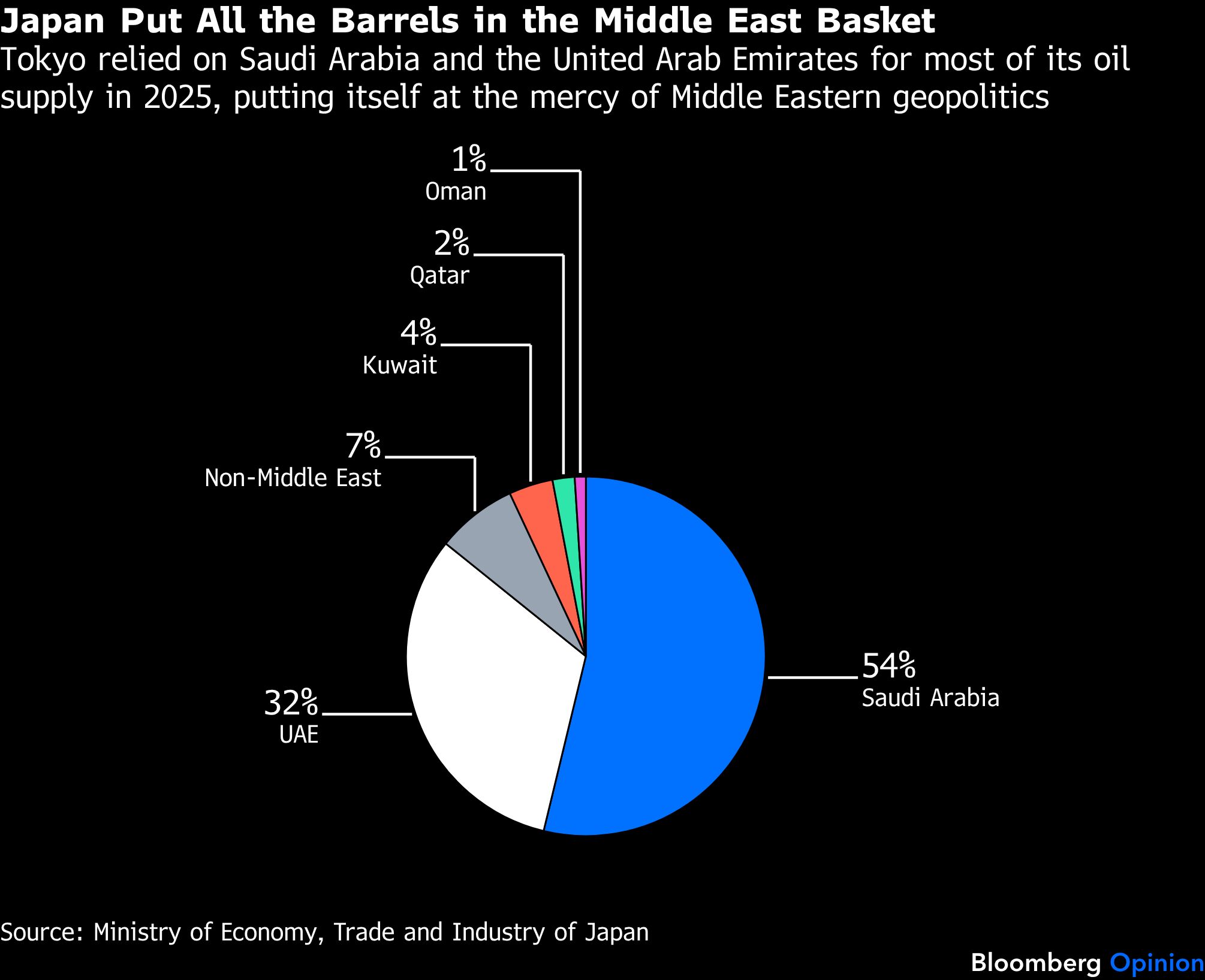
Among the world’s top fuel-consuming nations, Japan is the most energy insecure. Its import-dependency ratios are scary: It buys overseas 99.9% of the oil it needs; 99.7% of the coal; and 97.8% of the natural gas. So Tokyo springs into action after every major energy shock to reassess its supply sources, making it a bellwether of global trends. The direction it’s signaling this time? Run away from the Middle East.
Where Japan goes, others in Asia would too. Indeed, South Korea, another major energy importer, has already announced plans to reduce its reliance on the Middle East. India has been less vocal but was trying to diversify even before the war in Iran.
Beyond creating a major conundrum for Middle Eastern suppliers, the shift goes against geographic, economic and historic reasoning. The Middle East and Far East are relatively close, so it makes commercial sense — particularly when the cost of shipping is high, as it is now — that oil flows from one region to the other. And so it has done for decades.
Despite its deep sense of energy vulnerability after the 1973-74 oil crisis, and again in 1979, Japan trusted the Middle East, buying more than 90% of its crude from the region. With the benefit of hindsight, the policy was — to borrow a phrase from Nobuo Tanaka, a former senior energy official in Japan who later ran the International Energy Agency — a “mistake.”
The official message is, of course, more diplomatic. But read between the lines and it’s obvious that Japanese officials are trying to rectify what they see as a policy failure. The key is “diversifying procurement sources and transport routes,” according to a cabinet document. The goal, while unquantified, is clear: to “break free from a structural vulnerability where recurring energy supply instability and constraints act as a bottleneck for Japan's economic growth.”
To be sure, the documents also talk about supporting construction of new pipelines to bypass the Strait of Hormuz, which would allow it to keep buying crude from, say, the United Arab Emirates and Saudi Arabia without having to worry as much about instability in Iran. But Japan still looks to be headed for a major supply shift.
The Japanese government is discussing the plan, and a formal announcement including import targets and taxpayer money to support it may come before year-end. Seoul, meanwhile, has already set a quota and vows to reduce its oil supply from any region to 50% of the total. Currently, the Middle East accounts for just over 75% of South Korean oil imports.
Japan may not have the numbers sorted, but it isn’t waiting for the end of the war to make changes. In July, according to the latest monthly data available, the US was its main provider of oil, accounting for 37% of total petroleum imports. It’s worth repeating because it reflects the power of the US shale revolution along with the latest upheaval in the global oil market: Washington is today the biggest oil supplier to Tokyo. Mexico and Latin America provided another 3%.
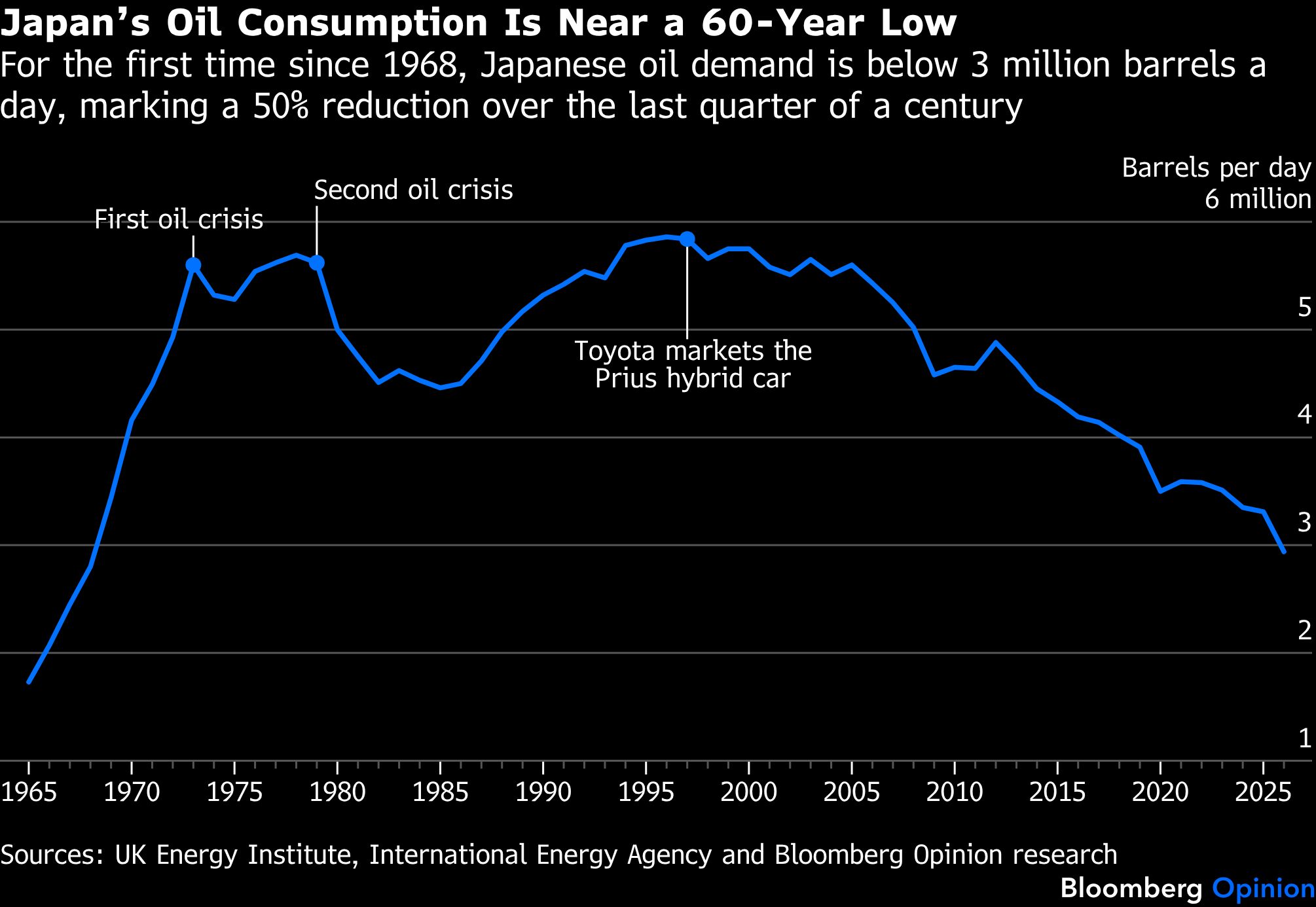
Turning those one-off statistics into sustained flows won’t be easy. But if history serves as any guide, Japan has demonstrated it can shift its oil consumption when it senses its national security is at stake. Back in the late 1970s, the country consumed more than 5.5 million barrels a day, generating more than 60% of its electricity burning crude and fuel-oil. Betting heavily on coal, nuclear and liquefied natural gas, it pushed oil out of its power industry almost entirely. By 2025, Japanese oil consumption had fallen to a 55-year low of less than 3 million barrels a day.
Reducing dependency on the Middle East would be easier if overall Japanese oil demand drops further. The fewer barrels it needs to buy, the easier it is to shift purchases. If the mantra in the 1970s and 1980s was “get oil out of electricity,” the next objective should be more radical: get oil out of transportation.
It was Japan that gave the world the first mass-produced hybrid car, Toyota Motor Corp.’s Prius. Hybrids have made huge inroads since then, helping to reduce gasoline consumption by about half over the last two decades. But Japan, the world’s fourth-largest car market by sales totals, lags in adoption of pure electric vehicles. Having developed hybrids first, its car manufacturers didn’t push nearly as hard as China’s into full electrification.
The result is that today only about 2% of new cars sales in Japan are full EVs, well below the 28% average in Europe, and even trailing the US and Canada. The International Energy Agency believes the high share of the population living in apartments with limited access to private parking, in combination with a limited charging network, are constraining EV sales in Japan. That makes EVs an important lever for reducing oil imports, which would make diversification easier. So alongside its plans to finance pipelines to bypass the Strait of Hormuz, Tokyo should work harder to boost EV sales, with a focus on expanding its EV charging infrastructure.
It also should try to reduce oil usage in heating. Rural Japan relies on kerosene stoves, an oddity among industrialized nations. If Tokyo manages to squeeze down its gasoline and kerosene demand, what would be left is diesel and other petrochemical feedstock. (As the world’s fourth-largest chemicals producer, it imports huge amounts of refined petroleum products used in plastics and other materials.)
The oil market’s algebra, however, is unyieldingly zero-sum. If Japan succeeds, it will have to elbow its way into markets others consider their own, like West Africa and the Americas, the traditional hunting grounds of European refiners. And producers in the Middle East would need to find new customers. Trouble is, who would like to boost its reliance on Middle Eastern oil? I draw a blank. That wouldn’t be Tokyo’s problem to solve. But it’s another way in which Japan could change the global oil map for good.