European value stocks offer a compelling case for short- and long-term investment opportunities, supported by strong fundamentals, attractive valuations, and favorable market conditions.
There is no question that Fed policy remains the primary force driving the money and bond markets for the third year in a row.
There’s no denying that human emotions play a role in managing money. Even someone who’s usually level-headed can get caught up in excitement, fear, or uncertainty.
What happens when the world’s biggest retailer decides it wants what’s yours? Target is about to find out.
The two largest emerging markets have taken very different paths, echoing the divergence in the economic and demographic landscape for these two countries.
Several factors account for the apparent disconnect between headline US economic data and what polls suggest many Americans feel. Find out more from Franklin Templeton Institute’s Stephen Dover.
Credit bulls are pointing at a set of metrics to show that high-grade bonds have rarely been this cheap, burnishing the appeal of corporate debt at a time when it’s offering little upside over government securities.
However we measure inflation, we see an incomplete recovery.
In many ways, the journey involved with reaching the summit of Mount Everest parallels the journey to a secure retirement.
Relative to 18 developed economies since 1870, U.S. leverage is high though not unprecedented. However, unless the recent rise in interest rates reverses, the U.S. will need to cut its debt load.
On Tuesday, the Biden administration announced significant tariff increases on China, targeting roughly $18 billion in strategic industries, with a sharp focus on electric vehicles (EVs). These tariffs, which quadruple to 100% on Chinese-made EVs, are designed to counter China’s unfair trade practices and overcapacity while boosting U.S. industries.
It’s been close to two years since the Consumer Financial Protection Bureau indicated it was looking to tighten regulations on popular “buy now, pay later” services. Since then, the sector has grown to $300 billion.
Managers are increasingly focusing on sectors beyond tech that could benefit from the rise in AI in the short term. These include healthcare and consumer companies, which also have more attractive valuations.
Walmart kicks off retail earnings season as high interest rates and inflation raise concerns over continued robust consumer spending.
Despite the availability of advance directives, many patients still receive aggressive, life-sustaining interventions that may not align with their preferences or improve their quality of life.
How much do you pay every month for invisible stuff you don’t use? I’m referring to subscriptions or memberships for things like music streaming, movies, software, magazines, gyms, shopping clubs, and other services or online resources you may have forgotten about.
Franklin Templeton Institute’s Tony Davidow discusses democratization of alternative investments and the lessons learned from institutions that have historically used alternatives with Matt Brown, Founder and CEO of CAIS.
Premiums and discounts are a popular metric to gauge the trading health of an exchange-traded fund (ETF). David Mann, our Head of Global ETFs Product and Capital Markets, updates his views on this metric with football (aka soccer) analogies from across the pond.
As an advocate of sound fiscal policy and a strong believer in the power of free markets, I find Argentina’s recent economic overhaul under President Javier Milei not just refreshing but essential in today’s world of bloated government spending.
Stocks, bonds, currencies and commodities have made significant moves in the past few months. Find out what factors to consider when deploying or redeploying capital from Franklin Templeton Institute’s Stephen Dover.
At the Berkshire Hathaway Annual Meeting we marked what we believe is the end of an era both for Berkshire and for the S&P 500 Index.
Over the last two weeks, the bullish sentiment index has reversed from extreme greed to fear. The composite net bullish sentiment index, comprised of professional and retail investors, fell from 38.15 to 9.9 in two weeks.
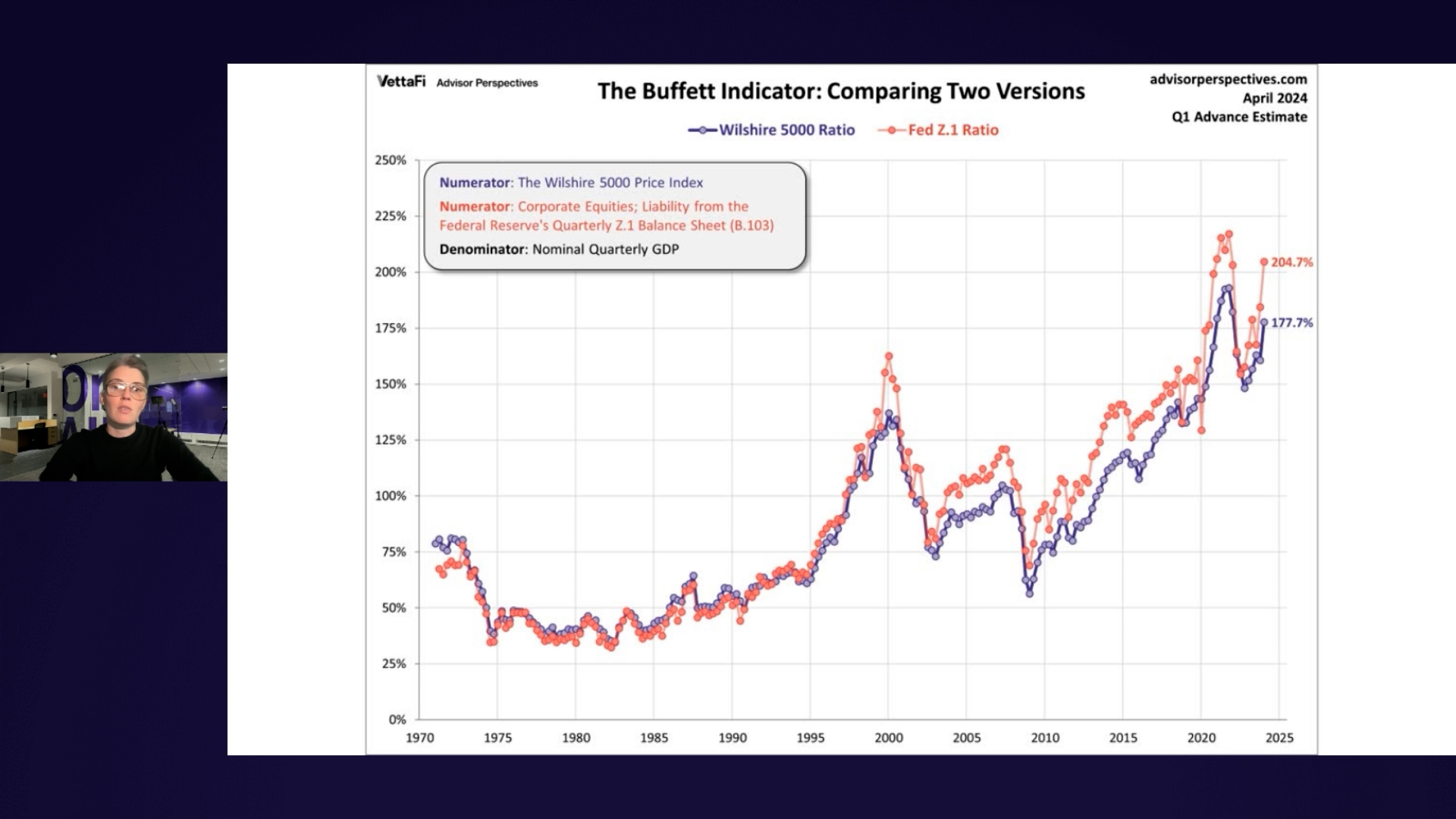
The Buffett Indicator, also known as Market Capitalization to GDP Ratio is a long-term valuation indicator for stocks that has become popular in recent years, thanks to Warren Buffett. Back in 2001, he remarked in a Fortune Magazine interview that "it is probably the best single measure of where valuations stand at any given moment." It is a measure of the total market value of all publicly-traded stocks in a country divided by the country's GDP and can be used as a way to assess whether the country's stock market is undervalued, fair valued, or overvalued.
In case you missed it, a $5 trillion tax hike looms over American households and businesses in President Joe Biden’s latest budget proposal, which would include a 25% annual minimum tax on unrealized capital gains for individuals with incomes and assets exceeding $100 million.
As equity volatility and market uncertainty continue, investors increasingly turn to equity income strategies for opportunity.
The dynamics of fiscal and monetary policy are now entering a new phase. Due to the emergence of negative Net National Saving (NNS), the law of diminishing returns can no longer fully capture the harmful effect of debt on economic growth.
The impact of high inflation on individuals’ finances is not something to take lightly, especially in the U.S., because for almost 40 years we have had no experience with such an event and have no clue how to deal with it or how to try to minimize its negative impact.
Copper is trading at a 52-week high, oil is above $90 a barrel and the S&P 500 Energy Index just hit a fresh all-time high.
So far this year, the US equity market has shown remarkable resilience and US inflation has remained sticky. Against this backdrop, a recent survey of our chief investment officers offers analyses and perspectives on key areas, such as Federal Reserve rate cut expectations, geopolitical risks, uncertain corporate earnings and opportunities in different asset classes.
Ben Graham, the value investor and Warren Buffett mentor, famously said the market is like a voting machine in the short run, but “in the long run it becomes a weighing machine.”
Reviewing the basics can keep you from being caught off guard if your investment is returned to you before the stated maturity date.
Oftentimes, we’re best able to understand something we’re interested in through analogies that clarify the matter by establishing connections between it and other parts of life.
When does a strong dollar become too strong? “Right now” would be the cry of most emerging-market currencies, not to mention policymakers in Japan. Even the European Central Bank says it’s paying attention to the foreign exchange market.
While immigration has positively impacted economic growth and disinflation, this story has a dark side.
The First Eagle Credit Opportunities Fund (FECRX) just reached its three-year anniversary. The fund offers advisors and their clients access to private credit and syndicated loans through an interval fund structure.
Artificial intelligence (AI) and Bitcoin were top of mind at Paris Blockchain Week, where I had the privilege of presenting to an enthusiastic crowd. The blockchain and digital assets event, held beneath the world-famous Louvre Museum, attracted close to 10,000 people, an impressive 25% increase over last year, as Bitcoin traded near its all-time high and AI dominated headlines.
2024 got started in a similar fashion to which 2023 ended: eyes were tightly focused on the proverbial briefcase of Federal Reserve Chair Jay Powell as to interest rate policy…and the conclusion for now is that interest rate cuts in 2024 remain largely on the table.
Private markets continue to become an even more prevalent component of investor portfolios, providing access to an expanded opportunity set and strong diversification beyond traditional stocks and bonds.
Suppose everything we believe about carbon and climate is wrong?
Understanding the social risks posed by climate transition requires discipline, nuance and a systematic approach.
Financial markets and the US Federal Reserve remain in disagreement on a subject crucial to asset prices and economic growth: how low interest rates will eventually go.
Thursday marked the final trading day of the week, month and quarter. It seemed only fitting the two major data releases delivered the overarching message of 2024.
Over the past 70 years, rising government debt generally has been accompanied by weaker economic activity. But it's not a simple relationship.
The upcoming US presidential elections transcend mere political rivalry. Stephen Dover, Head of Franklin Institute, examines the policy differences between the major parties and their potential implications on capital markets in the years to come. He also discusses whether elections and their outcomes have significantly affected equity markets or if other factors made more of an impact.
We believe optimism over a soft-landing scenario—where economic growth slows but a recession is avoided—may deliver more near-term market gains, as inflation declines and central banks look to start easing around mid-year.
Based on the valuation measures we find best-correlated with actual subsequent S&P 500 total returns across a century of market cycles, the stock market presently stands at valuation extremes matched only twice in U.S. financial history.
As Federal Reserve officials prepare for an in-depth conversation about its balance sheet at next week’s meeting, Wall Street strategists can only agree that all of the plans being discussed by the central bank carry some growing risks.
Global elections may lean towards nationalist policies that could hinder trade in goods via tariffs, but also boost growth in domestic industries to counter inflationary effects.
Valuation metrics have little to do with what the market will do over the next few days or months. However, they are essential to future outcomes and shouldn’t be dismissed during the surge in bullish sentiment.