Three months of discouraging inflation data coupled with some hot economic data points are considered headwinds for U.S. Treasurys.
Investing in private markets has obvious upsides, including potential higher returns, access to a broader opportunity set, and greater diversification.
Reviewing the basics can keep you from being caught off guard if your investment is returned to you before the stated maturity date.
Have you seen the price of natural gas lately?
The Northern Trust Economics team shares its outlook for key APAC markets.
Nouriel Roubini, Stephen S. Roach, Nancy Qian, and more assess what it will take to improve the country’s economic prospects.
Oftentimes, we’re best able to understand something we’re interested in through analogies that clarify the matter by establishing connections between it and other parts of life.
In this edition of Bull vs. Bear, staff writers Nick Wodeshick and Nick Peters-Golden ask whether rate cuts will still happen in 2024.
Q2 weakness is causing traders to up their bearish bets on bond prices, but it presents an opportunity for value-seeking investors.
The highest US yields since November are beginning to attract some opportunistic buyers, even as negative sentiment remains firmly entrenched throughout the Treasury bond market.
Ali Dibadj, CEO, shares the industry topics he’s hearing most in conversations with asset allocators, family offices, end-clients, colleagues, investors, and others he meets around the world.
For a typical consumer, the two most hot-button topics are food and energy. Both play a significant role in household spending, and just as importantly, both are highly visible.
It appears investors are heading for the exits on U.S. Treasuries and towards the entranceway of European bonds.
We had expected the Federal Reserve to start cutting rates in June. But as more of our audiences asked why, we saw the case was not strong. This week’s inflation reading seals the deal: we now expect the easing cycle to start in September.
Fed Funds Rate: According to Bloomberg calculations based on where Fed Funds futures are currently trading, there is a 20% chance that the FOMC cuts the overnight rate in June and a ~50% chance that they cut in July.
We have always maintained it is better to accept what the market has on offer than to stretch for returns. Thanks to the inverted yield curve and our flexible mandate, the current environment is making it easier than ever to be patient while we wait for fat pitches.
Our investment leadership team convened twice on Sunday to discuss the conflict between Iran and Israel, its key watchpoints in the days ahead, and the pertinent risks onto markets, our investment portfolios, and our clients. The team broadly agreed that maintaining a slightly defensive posture across portfolio strategies remained appropriate.
There are rules to follow if you set up a 529 college plan. If you don’t follow the rules, then the IRS will get involved, which is something you want to avoid.
Our profession is being transformed by powerful, AI-based technologies that will replace human-based financial advice. They will drive down costs, reduce valuations, and deflate the multiples paid in M&A transactions.
Here are the top 10 questions (and answers) about advisor marketing for 2024.
In the competitive financial advisory landscape and ongoing quest for new clients, advisors often miss an obvious opportunity – the children and grandchildren lying within their existing clientele.
VettaFi’s Todd Rosenbluth and Kirsten Chang discuss year-to-date ETF flows, along with tackling the challenges presented by fixed income right now. etf.com’s Kristin Myers previews their upcoming 2024 industry awards ceremony and highlights several hot ETF topics.
While these tax-advantaged accounts are effective tools for meeting future education needs, a 2023 analysis found that overfunding a 529 plan can result in a large tax bill if money remains in the account after the beneficiary has graduated.
While major indexes have seemingly been calm this year, there are notable and stealthy sector leadership shifts that have happened under the surface.
As the US economy hums along month after month, minting hundreds of thousands of new jobs and confounding experts who had warned of an imminent downturn, some on Wall Street are starting to entertain a fringe economic theory.
Advisors often get overexcited and overwhelm clients when discussing Roth conversions. Here’s how to dial back and effectively communicate this tax-saving strategy.
Fixed-income markets are back in a tizzy over inflation, thanks to the combination of rising risks for energy prices and strong retail sales data — both of which come on the heels of a higher-than-expected consumer price index last week.
Despite expectations for interest rate cuts by the Fed, yields have risen since the start of the year, with the government 10-year bond yield climbing nearly 70 bps this year through April 10. This is a sharp reversal from what occurred in Q4 2023 when the 10-year yield collapsed by 71 bps.
We’ve covered some of the issues related to America’s fiscal crisis in recent months.
On the latest edition of Market Week in Review, Investment Strategist BeiChen Lin and Product Operations Analyst McKenna Painter unpacked the latest U.S. inflation numbers. They also discussed recent rate decisions by the European Central Bank (ECB) and the Bank of Canada (BoC) as well as the economic and market outlook for China.
Improve your income potential with a tactical, unconstrained strategy that sources opportunities across geographies and asset classes. BlackRock Multi-Asset Income Fund takes a risk-first approach while seeking to deliver a consistently attractive yield.
For investors looking to position their portfolios amid ongoing uncertainty, many options strategies benefit from increased volatility.
On this episode of the “ETF of the Week” podcast, VettaFi’s Head of Research Todd Rosenbluth discussed the Invesco Senior Loan ETF (BKLN) with Chuck Jaffe of “Money Life.” The pair talked about several topics regarding the fund to give investors a deeper understanding of the ETF overall.
Most US Treasury yields climbed to new year-to-date highs, with the 2-year note’s approaching 5%, after hot retail sales data further eroded investor confidence that the Federal Reserve will start cutting interest rate cuts this year.
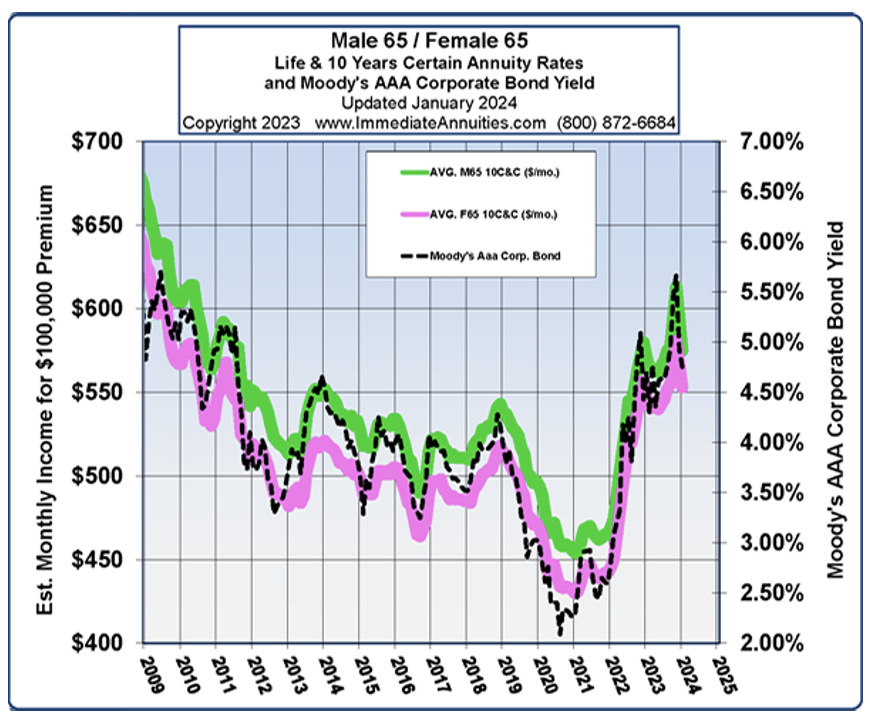
With the interest-rate peak being the highest in 15 years, now is the opportunity to lock in near-peak lifetime income payments while avoiding future stock market losses.
The First Eagle Credit Opportunities Fund (FECRX) just reached its three-year anniversary. The fund offers advisors and their clients access to private credit and syndicated loans through an interval fund structure.
Rob Copeland’s marvelously readable and well-researched book, The Fund: Ray Dalio, Bridgewater Associates, and the Unraveling of a Wall Street Legend, details a detachment from reality borne on the absolute power deployed by Dalio at Bridgewater.
Why the current momentum trade, despite stretched valuations, could continue.
There are signs that some previous "rolling recessions" are starting to turn into rolling recoveries.
Before we start discussing the Consumer Price Index again, we want to remind readers that CPI inflation is not what Federal Reserve officials use to determine monetary policy. It is true that markets put a lot of emphasis on this measure, but we would like to caution giving too much importance to it.
April 15 is undoubtedly one day that is not enthusiastically celebrated by most people. It is safe to say that the discomfort around Tax Day likely ranks right up there with your annual physical or renewing your driver’s license.
Fixed income poses big challenges and opportunities in 2024, with ETF leaders from several firms sharing their thoughts at ETF Exchange.
In the first quarter of 2024, fixed income investors turned to investment-grade corporate bond ETFs.
A look at private credit, and why increased activity in the broadly syndicated loans space is not necessarily a bad thing for direct lending, and vice versa.
An update on Model Portfolio Number 3 to see how it’s performed against the S&P 500. The portfolio was to get maximum income out of the portfolio but still try to deal with risk at the maximum extent possible.
he current state of the market for renters is akin to being in the eye of a multi-year hurricane. Rents surged in 2021 and 2022, driving a wave of apartment construction that helped to stabilize or even lower prices this year.
Investors wagering on an extension of last year’s global bond gains have been served a harsh reality check.
As pharma giants spend billions on acquisitions of startups developing new ways to harness radiation in the fight against cancer, the chief executive officer of Perspective Therapeutics Inc. found himself getting top billing at two different industry gatherings this week.
Choosing a school that enables you to graduate with the least amount of debt, or, even better, with no debt at all, is a message more students need to hear.
The first quarter was strong for major U.S. investment banks as the economy grew and M&A and IPO activity accelerated.