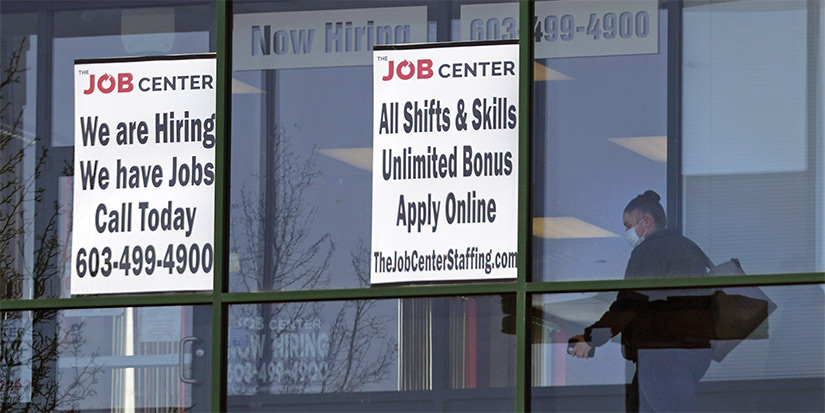
Emergency unemployment benefits in the U.S. expired two weeks ago, but employers who expected an increase in job applications are still largely waiting for them to roll in.
Review the latest Weekly Headings by CIO Larry Adam.
On the latest edition of Market Week in Review, Chief Investment Strategist Erik Ristuben and Head of Portfolio & Business Consulting Sophie Antal Gilbert discussed U.S. consumer prices and wages, key factors impacting U.S. small businesses and home sales in China.
You will get more results with messy communications. Here’s is how to communicate like a first grader while gathering assets as a consummate professional.
It’s becoming more and more difficult to be in the fossil fuel business. On both sides of the Atlantic, lawmakers and unelected bureaucrats are turning up the heat, so to speak, on companies over the issue of climate change.
Major central banks are exploring digital currencies, which seem likely to become a mainstay of tomorrow’s economy. As policymakers wrestle with the many moving parts of digital dollars, euros and yuan, their decisions will shape the next dimension in national currency—and could reshuffle international currency leadership.
It looks likely billionaires and private equity firms will keep loading up companies with debt to turn them into dividend-paying ATMs.
The most recent data on inflation shows prices rose last month by the smallest amount since January, but that doesn't mean consumers are in the clear.
We’ve all experienced shortages of various goods and/or services in the last year or so of the coronavirus pandemic. In recent decades, American manufacturers have increasingly outsourced the production of goods we consume to foreign countries where they can often be produced cheaper.
Investors often ask our team at Smead Capital Management what we spend our time on. We believe reading is the best use of our time to learn and think about the way that we can profitably apply capital for our investors.
With real rates trading below zero right now, many yield-starved investors are being forced into riskier and riskier assets, including high-yield junk bonds. But even these are no longer offering a positive real return, what with inflation at multiyear highs.
There are several “paradigm shifts” impacting markets today, according to Templeton Global Macro CIO Michael Hasenstab. He outlines how central banks might approach tapering of pandemic-driven asset purchases, and the potential investment risks and opportunities he sees.
If you've read our two most recent Monday Morning Outlooks, you know we raised our forecast for the S&P 500, but lowered our forecast for real GDP growth. How can that be?
Is it common for advisors with employees returning to the office to get requests like, “Can I get gas paid for?
The public wants prophets. The historian writes stories about the past, but what the public wants is the history of the future. This leads to a paradox.
Here are the 10 best books I read from September 2020 through August 2021.
Applying a relatively single-indicator trend-following strategy is an excellent way to obtain meaningful exposure to the overall market with significantly lower downside risk and higher long-term risk-adjusted returns.
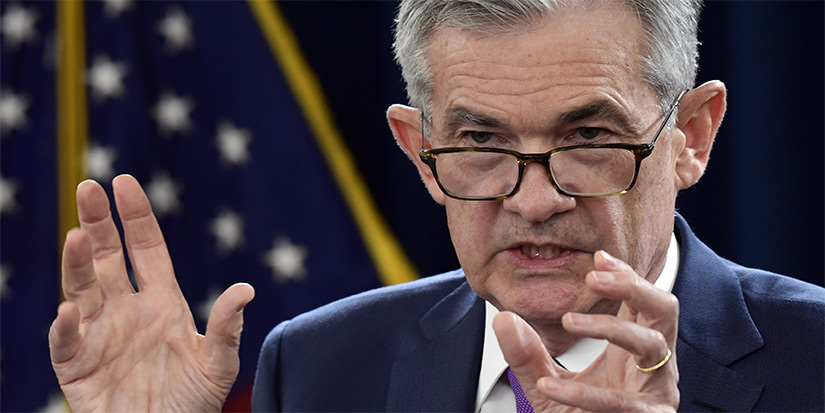
In addition to football, this fall will be eventful for our team of monetary policymakers at the Federal Reserve. Quarterbacked by Chairman Powell, the Fed will draft its route to easing its accommodative stance now that the economic recovery has put some points on the scoreboard.
U.S. equity markets continued to rally in August, with all three major indices setting new record highs during the month. We did see some midmonth volatility, but the Dow Jones Industrial Average gained 1.50 percent, while the S&P 500 experienced a 3.04 percent gain.
With a history spanning nearly 40 years and a mission to cultivate meaningful relationships, Grove Point Financial, a boutique broker-dealer and RIA solution with large firm resources, serves over 500 financial professionals across the country and prides itself on its nimble, visionary, and forward-thinking approach to client service. It is a partnership of professionals who share the passion and strength to grow independent businesses that serve the clients and the communities in which they operate. Its highly engaged leadership listens to advisors and evolves to serve them better.
Today I’m going to look at several possible futures. There are forces at work in both Congress and the Federal Reserve that could take us down radically different paths. There are also changes in the Zeitgeist, the way we act and think both in and as a society, that are going to have major impacts.
So much of life is managing risk. That’s true on a micro, personal-level scale as well as a macro, country-level scale. Crises often can’t be prevented. It’s how you deal with them that makes all the difference.
Now that the dollar is near the year’s highs, can the rally continue? We believe it can in the near term, although our longer-term view is more nuanced. Here’s what we see ahead.
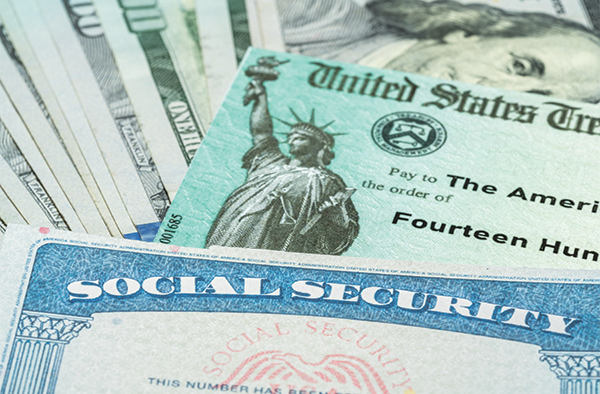
Social Security is in worse shape than we thought. The program’s Old-Age and Survivors Insurance (OASI) Trust Fund is now expected to be insolvent by 2033, a year earlier than anticipated.
We have argued for years that the biggest mistake being made by Berkshire Hathaway was not giving shareholders access to the thoughts and investment discipline of their two talented stock pickers, Ted Weschler and Todd Combs. After all, Buffett calls the shareholders “partners” and has not allowed his partners to understand anything about the strategies and results of upwards of $30 billion of shareholder capital.
Uncertainty always exists in financial markets.
We’ve known about the need transition clients to a new advisor for three years, but suddenly we are running out of time.
Household savings and central bank policies have reduced the need for credit.
While robos are beneficial as they often invest in low-cost funds and ETFs, ideally, they should also include quality SPIAs and DIAs to simplify investment planning and allow retirees to spend more.
The question of Japanization in the U.S. continues as the S&P 500 tracks the Nikkei of 1980.
We are in an odd situation where it’s unclear if labor is scarce or abundant. Many employers can’t seem to find enough qualified workers, but the August jobs report said 8.4 million are unemployed and millions more underemployed.
Social Security is in worse shape than we thought. The program’s trust fund is now expected to be insolvent by 2033, a year earlier than anticipated. According to the annual report, its finances have been “significantly affected” by the pandemic and 2020 recession, not to mention “rapid population aging.”
Supply chain issues are worsening again, reversing improvements seen earlier this summer.
In the 50 years since Richard Nixon officially severed the dollar’s link to gold, many have claimed that the greenback’s strength rests primarily on America’s unchallenged power and prestige around the world.
The labeled bond market has seen explosive growth in issuance over the past two years.
"Getting older is fine. There is nothing you can do to stop it so you might as well stay on the bus." John Byrne
Young Wall Street analysts are benefitting from the war for talent among investment banks.
Inflation remained in check following the global financial crisis for over a decade despite a massive expansion of the Fed’s balance sheet.
Defensive stocks are often misunderstood. In recent years, even when they have delivered strong and steady earnings, returns have disappointed.
The SEC’s view of investor trust rejects the underlying assumptions that financial advisors suffer from poor trust and that this lack of trust is a problem.
Being a speaker at a networking event is not uncommon. Being a knockout speaker is!
What first-time buyers are missing is that, despite popular opinion, most transactions are not propelled solely by a seller’s desire for monetary gain – they simply want to feel that by joining a larger organization, they can experience the next stage of career growth.
What if it were possible to immunize yourself from market volatility? Thankfully, it doesn’t require a vaccination.
Several potentially big storms are brewing. They could be minor annoyances or catastrophic disasters, or anywhere in between. I truly hope they all resolve with minimal fuss. But they may not. They could even combine into a perfect storm of even greater magnitude… so now is the time to prepare.
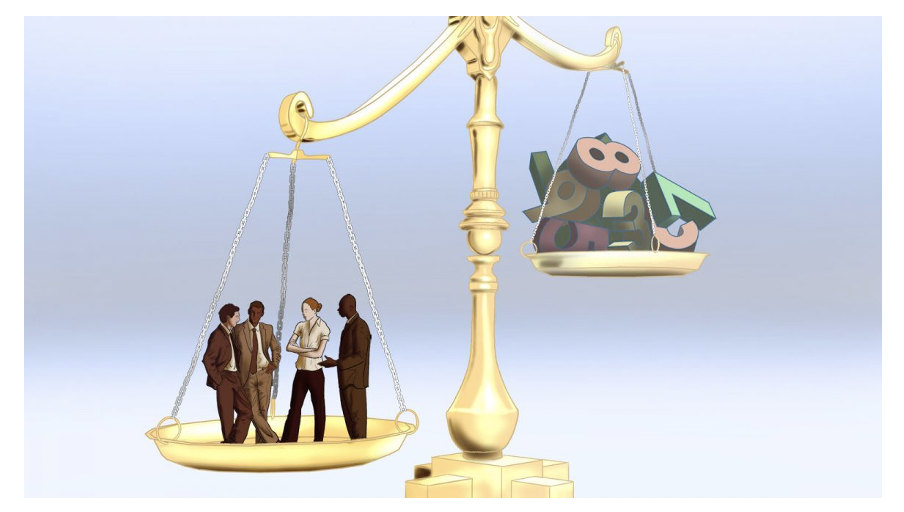
Culture matters. I share how I evolved from an analyst purely focused on numbers to an investor and CEO focused on people. I recount how running the business made me a better investor.
Want to know where the world’s biggest technology stocks are heading? Just watch one of the oldest measures there is: the bond market.
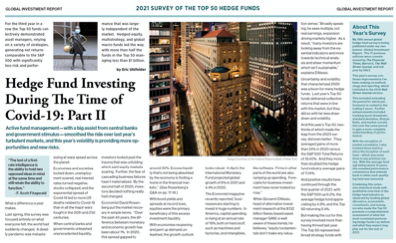
For the third year in a row, the top 50 hedge fund managers, relying on a variety of strategies, generated net returns comparable to the S&P 500 with significantly less risk and performance that was largely independent of the market. Hedged equity, multistrategy, and global macro funds led the way with more than half the funds in the top 50 managing less than $1 billion.
The gamification of markets spurred by the wave of retail investors has replaced disciplined investment analysis with speculation and conjecture. For a lucky few, the irrational behavior provided short-term success. However, such behavior goes hand-in-hand with steep losses… which you guessed it… is actually gambling rather than investing.
In today’s market, many advisors don’t realize they are dealing with gambling outcomes, thereby exposing their clients to a gambling risk that continues to grow in severity. This new dynamic makes the mitigation of gambling risk in a portfolio critical and begs the question: Are you rolling the dice with your client’s portfolio?
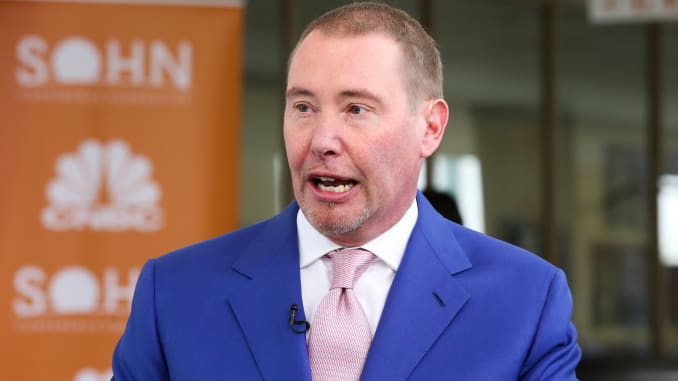
There is at least a 50/50 chance that headline CPI inflation will exceed 5% for all of 2021, according to Jeffrey Gundlach.
After 20 years, the longest war in U.S. history is finally coming to a (clumsily handled) close.