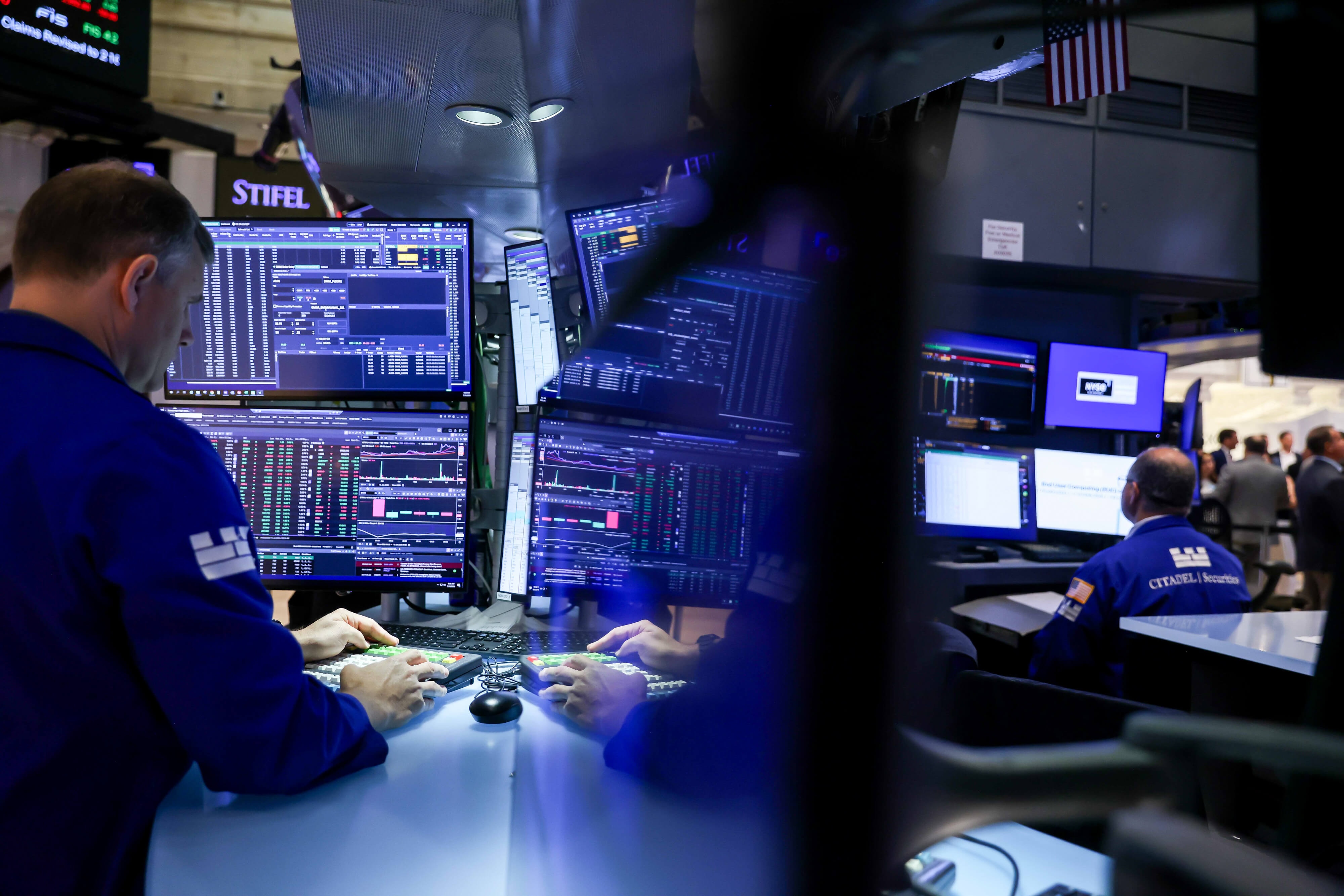
For the past five weeks, markets have been focused on a steady stream of corporate earnings, supported by upbeat management commentary and another quarter of strong results. But with second quarter 2026 earnings season nearing its end, investors' attention is shifting back to the macro backdrop.
Something strange has been happening in America lately. The Wall Street Journal says this is the summer when the U.S. became “a nation of Luddites.” The Economist calls it “the Summer of Ludd.”
U.S.-listed ETFs pulled in a record $193.42 billion in July, pushing year-to-date net inflows to $1.23 trillion. That total is the strongest seven-month haul on record, according to ETFGI’s July 2026 U.S. ETF industry report.
When it comes to equities exposure, investors typically gravitate toward a passive, market-cap-weighted index as the default strategy. These strategies are often billed as an efficient, low-cost method to capture broad market returns. As such, cap-weighted funds that track the S&P 500 or MSCI World have taken in trillions of dollars in global capital. However, within these market-cap-weighted indexes, a structural flaw exists.
When portfolios become standardized, investor experience becomes standardized right along with them, even though almost nothing else about those investors is standard. Their goals, tax exposure, risk tolerances, and individual spending needs are too individualized to be captured by many models that purport to be customized.
While it is useful to analyze holdings by asset class, a portfolio-wide view can provide additional insights. Typically, the bond sleeve and the equity sleeve are seen as entirely separate. However, they usually hold unnoticed concentrations in different companies.
Amazon.com Inc.’s Andy Jassy has begun making an audacious boast during conference calls this year. Though his company remains a top Nvidia Corp. customer, it’s also one of the world’s largest makers of data center chips in its own right.
The question facing advisors is no longer whether clients can hold digital assets, because many already do. It is whether the firm can explain, in writing, how each position was sized, why a particular product was chosen, and where that decision is recorded. Most firms cannot, and that gap is the exposure.
The Treasury Department could opt to draw down some of its cash pile to fund expanded buybacks of higher-yielding, older securities, CNBC reported Monday, citing two senior Treasury officials.
The debt problem is real. It just isn’t a bomb. As we’ve written before, the debt and deficit problem isn’t what you think. It’s a tax on future growth, collected slowly, and normal interest rates are simply the price of money doing its job, not the crisis the headlines keep selling.
Most of us try to be mindful not to put all our eggs in one basket. But the now-familiar concern that most portfolios are quite concentrated in a relatively small group of large US tech companies means that investors may still be doing just that.
To some, the debate over inflation targeting is largely an academic exercise. But its outcome will have direct consequences for the paths of global interest rates and global markets. Some background on how we arrived at this juncture, and where we might go from here, follows.
On the back of the White House’s cryptocurrency confab, which brought together policymakers and leaders of the digital asset community, Bitcoin notched a double-digit gain over August 19-20 — a rally that pumped new life into the largest digital currency.
For 11 of the 12 years following the 2008 financial crisis, U.S. stocks beat international markets. But that trend has flipped: Over the past four years, international equities have taken the lead.
The truth about the runaway costs of healthcare turns out to be a little more complex than any single source we've named. Hospitals, insurers, private equity, administrators, pharmaceutical companies… pull the thread on any one and we land in the same overextended, bloated, extractive system.
Morningstar's study, Mind the Gap 2026 reveals a 1.2% return gap. Learn how financial advisors can use automation to protect client wealth.
On August 19, the US Treasury announced that it will at least double the size of its long-term bond buybacks, from $2 billion to $4 billion per operation, between September 9 and the November Quarterly Refunding. The announcement followed a rise in the 30-year Treasury yield to roughly 5.3% and is drawing attention to how the Treasury may respond if pressure at the long end persists.
Gold climbed to the highest in three months as the US Treasury’s bold intervention to try to stem a damaging increase in borrowing costs revived investor fears about its fiscal burden.
Market exuberance returned to cryptocurrencies when US Treasury Secretary Scott Bessent announced Wednesday the department would at least double the size of its long-dated bond buybacks, triggering an upswing that forced traders to liquidate billions in short positions.
A brisk rally in industrial stocks this year has defied higher oil prices, rising bond yields and restrictive trade policies, as investors bet on big gains from the artificial intelligence boom. Now signs are emerging the optimism may have gone too far.
US stocks rose in early trading Friday, putting the Nasdaq 100 on track to end a five-day losing streak as bond yields stabilize and Bitcoin soars.
Leading asset managers T. Rowe Price announced the acquisition of $19 billion F/m Investments in a press release Thursday afternoon. The deal brings F/m’s suite of leading fixed income strategies and ETFs into T. Rowe Price’s fund stable, reinforcing those areas in the latter’s list.
High-yield municipal bonds are one of the best performing asset classes this year but that doesn't mean we think all investors should consider adding them to their portfolio.
There’s new life in the gold market, and that momentum could represent a buying opportunity for bullion-enthused investors seeking income. The NEOS Gold High Income ETF (IAUI) is ready to meet the moment.
Shares of Meta Platforms Inc. have been under pressure all year due to questions about its spending on artificial intelligence. But a trial accusing its social media platforms of targeting children goes beyond that, raising existential questions about the future of its core business.
Alibaba Group Holding Ltd.’s profit plunged more than 75% after the Chinese company ratcheted up quarterly capital spending to almost $10 billion, aiming to safeguard its position in a fiercely competitive global AI arena.
With a slew of unexpected maneuvers this year, Scott Bessent has emerged as the most interventionist Treasury secretary in financial markets in decades — putting his credibility on the line in an effort to quell a potentially damaging rise in US borrowing costs.
It has been a stellar Q2 earnings season, but we aren’t done yet. After the big retailers this week, Jensen Huang and NVIDIA grab the spotlight on Wednesday, August 26. Then Kevin Warsh takes the podium on the 28th. Through it all, daily market swings hinge on the latest AI developments, along with consumer trends and what’s happening geopolitically.
Hedged equity as a liquid alternative uses an options-based equity strategy — specifically Swan Global Investments’ Defined Risk Strategy (DRS), in continuous operation since 1997 — as a permanent alternatives allocation that stays invested in the equity market while actively managing downside risk through LEAPS put options
Investor appetite for fixed income continues to expand, as evidenced by the latest weekly ETF inflows report from TD Securities. For the week ending August 14, 2026, U.S.-listed ETFs gathered $41.0 billion in total weekly net inflows, which included $13.2 billion into fixed income funds.
Anthropic’s preliminary second-quarter results reignited enthusiasm across the artificial intelligence sector, lifting semiconductor stocks 1% on Monday despite broader tech sector declines. Q2 revenue topped $11.5 billion — a 14x surge year-over-year and more than 2x last quarter’s figures.
FactSet finds core clients still favor cheap funds, while active ETF buyers pay a premium for performance, a trade-off advisors should watch.
Learn how RAFI fundamental indexing offers an alternative to market-cap weighting in this interview with Rob Arnott and TMX VettaFi.
I’m always asked for scripts. You don’t want a script. You want to be natural and approach clients in a manner that fits you. Practice, practice, practice until it seems natural and comfortable. Authentic is always best.
Gold’s outlook has brightened considerably following its first-half correction. Spot prices have rebounded to flirt with $4,400 per ounce, supported by renewed central-bank buying, softer economic data, and diminished expectations for further Fed tightening.
The biggest political news of recent months is the rise of the Democratic Socialists of America. We suppose this started in New York City, with the election of Mayor Zohran Mamdani, but it has spread to Michigan and other states.
As private credit further cements its role as a primary source of corporate financing, it will be essential to balance opportunity with prudent risk management for long-term stability and sustainability.
VettaFi today officially completed its acquisition of RAFI Indices, LLC from Research Affiliates Global Holdings, LLC. The deal was originally announced in June 2026. The transaction unites RAFI’s decades of deep, academically grounded intellectual property with VettaFi’s agile, modern indexing infrastructure.
Small-cap equities are winning out against their large-cap counterparts in a classic David versus Goliath ETF battle. After years of mega-cap technology dominance, small-cap equities have delivered investors a historic first half of 2026.
Goldman Sachs Group Inc., Blackstone Inc. and Apollo Global Management Inc. had been working tirelessly for months to draw up debt deals that would help developers of artificial intelligence systems pay for chips from Nvidia Corp.
If the bad news is that members of Generation Z can’t afford to buy a house until they are middle-aged — which isn’t really bad news, honestly, but anyway — then the good news is that at least they are investing their money in high-performing assets.
“Think Like An Investor” is chapter 1 of a 5-part series examining the narratives around “investing for the long run. Learning to think like an investor rather than a speculator is not a personality quirk or a matter of taste. It is the entire game, and the good news is that it is a skill you can actually build, starting today.
I’ve said it before, and I’ll say it again: it’s not the political party that matters, but the policies. Investors, I believe, are better served when they focus not on the partisan noise and headlines but the policies that bring about change.
There is no one-size-fits-all approach to choosing between individual bonds and bond funds. The choice depends on an investor’s goals, time horizon, risk tolerance, need for predictable income, and available assets.
This bargain-hunting environment sets up a stark divide for upcoming earnings. Walmart (WMT) remains uniquely positioned as its dominant grocery business continues to draw trade-down traffic from higher-income households, whereas Target (TGT) faces headwinds due to its heavier mix of discretionary home and apparel goods.
For savers, it drives them to seek bigger and bigger returns to keep up with the government’s monetary devaluation. At first, a simple savings account with a relatively low yield will do the trick. But as the dollar loses purchasing power, you need a better return to keep up. So, maybe you stick your money in a higher-interest-yielding CD.
Chris Galipeau discusses high-conviction insights that go beyond media headlines.
Hoisington Investment Management — managed by Hunt and Hoisington — sharply reduced its clients’ bond duration and put the proceeds in Treasury bills. That reversal of such long-held opinions deserves serious attention. I will summarize Hunt’s new views and some counterpoints to help you assess his new stance.
Today’s market does not represent today’s economy. The ratio of market value dependent on future economic activity versus present activity has never been higher. These companies have earnings now, but those earnings stem from investments in the future, not present consumption.
Reasons to be wary about stocks are quickly disappearing and a Goldilocks scenario looks increasingly likely. That’s precisely why it’s a perfect time to hedge against a market priced for perfection.