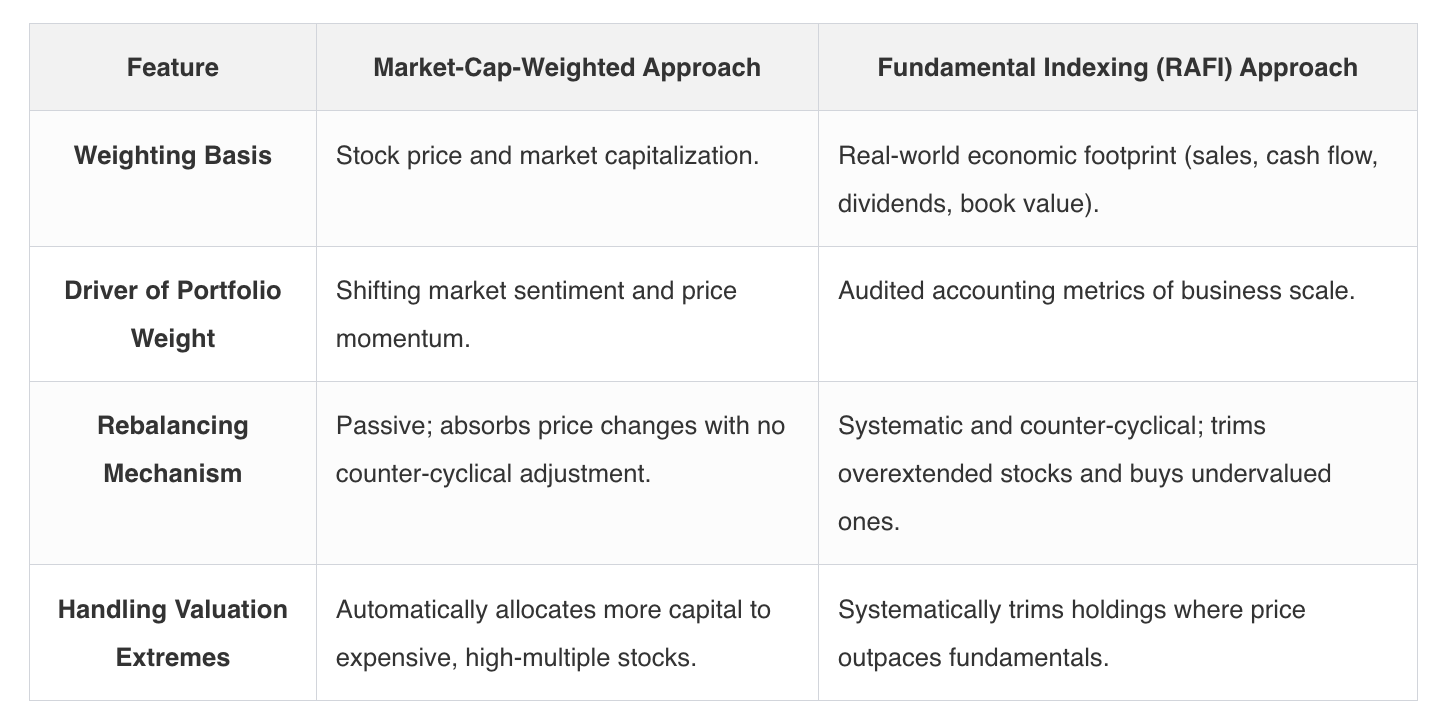
When it comes to equities exposure, investors typically gravitate toward a passive, market-cap-weighted index as the default strategy. These strategies are often billed as an efficient, low-cost method to capture broad market returns. As such, cap-weighted funds that track the S&P 500 or MSCI World have taken in trillions of dollars in global capital. However, within these market-cap-weighted indexes, a structural flaw exists.
A market-cap-weighted approach ties a company’s portfolio weight directly to its stock price, which could hamper performance over time. When a stock’s price rises, its index weight increases irrespective of the underlying fundamentals that indicate corporate health. This dynamic compounds performance drag when overvalued mega-caps inevitably pull back or experience mean reversion, bringing index returns down with them. As a result, traditional passive strategies tied to a market-cap-weighted approach systematically buy more of what has become expensive and less of what may be exhibiting value.
After Rob Arnott founded Research Affiliates in 2002, the quantitative asset management firm pioneered a solution three years later that solved the inherent flaws of market-cap-weighted indexing: the Research Affiliates Fundamental Index (RAFI). The index effectively decoupled portfolio weighting from stock price, sizing companies instead by audited accounting metrics of real-world business scale or economic footprint. In order to build portfolios with the resiliency to withstand market uncertainties that are constantly percolating in the background, investors must rethink the cap-weighted paradigm. Embracing the rules of RAFI’s fundamental indexing can help them break free from these market-cap constraints.
Key Takeaways:
Traditional market-cap-weighted indexes tie a company’s portfolio weight directly to its stock price, creating a structural flaw where rising valuations systematically push capital into overextended stocks regardless of underlying fundamentals.
The Research Affiliates Fundamental Index (RAFI) decouples portfolio weighting from market price by sizing holdings according to real-world economic metrics, such as sales, operating cash flow, dividends, and book value.
By evaluating companies against their true economic scale, RAFI introduces a systematic, counter-cyclical rebalancing mechanism that automatically trims overvalued stocks and allocates into underpriced assets.
As noted, the core mechanical vulnerability of market-cap weighting stems from its reliance on market price. A market-cap-weighted index operates like inverse gravity where market capitalization acts as buoyancy. As a company’s stock price increases, and thus its overall market valuation, it naturally floats to the top of the index. Capitalization-weighted indexes do not evaluate whether a company is generating cash, growing sales, expanding its real-world operations, or performing other activities that ultimately build shareholder value. They simply reflect market consensus, which means they could be prone to behavioral bubbles, momentum chasers, and speculative valuations.
When equity markets experience extreme concentration, this design creates significant risk. This is relevant today as technology names benefiting from the artificial intelligence (AI) buildout continue to get more expensive. As momentum pushes stock prices to elevated earnings multiples, a cap-weighted index will automatically allocate a larger proportion of investor capital to those stocks. Conversely, businesses with solid fundamentals may temporarily fall out of market favor and thus, are systematically underweighted.
Ultimately, this creates a structural dynamic where passive investors end up with greater concentration risk. Rather than owning a diversified slice of the broader economy, cap-weighted index investors hold an over-concentrated position in only a handful of high-valuation mega-cap names. In effect, this exposes their capital to potential drawdowns when valuation multiples eventually contract.
Decoupling Weight from Price
This raises the question: what’s an alternative approach to market-cap-weighted indexes that doesn’t rely on stock prices? It’s not guessing market timing or relying on an unconstrained active manager. As noted, it’s decoupling portfolio weighting from stock prices altogether. This is the foundational innovation behind RAFI’s construction.
Rather than determine the weight of holdings by market capitalization, RAFI evaluates a firm’s economic footprint. This means a stock’s weight in a portfolio is determined by fundamental measures of real-world business scale — specifically sales, cash flow, dividends, and book value. Gross sales and total revenue measure a company’s share of broader economic output, while operating cash flow evaluates the liquid cash generated from daily operations. Additionally, dividends account for direct capital returned to shareholders, and book value assesses the net physical and financial assets on the corporate balance sheet.
By selecting and then sizing index constituents by their economic footprint, portfolio allocation mirrors the real economy rather than shifting market sentiment. A company generating two percent of the aggregate fundamental scale, or economic footprint, receives a baseline weight proportional to that output, thereby anchoring portfolio allocations to tangible business size as opposed to speculative valuations.
The Structural Driver of Rebalancing Alpha
Basing portfolio construction on economic metrics also introduces an advantage known as systematic rebalancing alpha. In a market-cap-weighted index, portfolio weights drift automatically with stock prices. If a company’s share price doubles, its weight in the index also doubles. This means the cap-weighted index is purely driven by market momentum rather than any change in fundamental metrics like revenue or earnings. Because cap-weighted indexes lack a mechanism to realign price with underlying business value during their routine rebalances, they continuously let winners run and thus, automatically concentrate more capital into overextended stocks.
Conversely, RAFI has a built-in counter-cyclical methodology. When RAFI rebalances, holdings are re-evaluated against their economic footprint. This helps to ensure that target portfolio weights remain proportional to each company’s fundamental economic scale. If a stock’s price has surged ahead of its economic footprint, RAFI systematically trims that stock, effectively selling high. On the other end of the spectrum, if a stock suffers a steep price drop while its fundamental metrics remain intact, the index systematically purchases more shares of this company at lower prices. This mechanism introduces an inherent value tilt to the RAFI indexing strategy, which is a topic that will be examined in detail in a subsequent article.
Ultimately, this disciplined, rules-based approach eschews cap-weighted constraints and anchors portfolio weights to economic reality. In effect, RAFI transforms passive investing into a disciplined engine for long-term capital appreciation.
In Part II, the application of RAFI to the style-box factors of value, growth, and core/blended will be examined.