Shares of Meta Platforms Inc. have been under pressure all year due to questions about its spending on artificial intelligence. But a trial accusing its social media platforms of targeting children goes beyond that, raising existential questions about the future of its core business.
Meta, which owns Facebook and Instagram, is being sued by a bipartisan coalition of states on allegations of deceiving the public and designing the apps to encourage compulsive use among young users. If it loses the trial, the company says it could face penalties of as much as $1.4 trillion, which is roughly the size of its market capitalization.
“The risk is tough to game out or assign a probability to, and while I doubt any penalty will ultimately be north of $1 trillion, you need to consider it as a potential liability when the company itself is talking about such significant figures,” said Neville Javeri, a portfolio manager and head of the Empiric LT Equity team at Allspring Global Investments, which owns the stock.
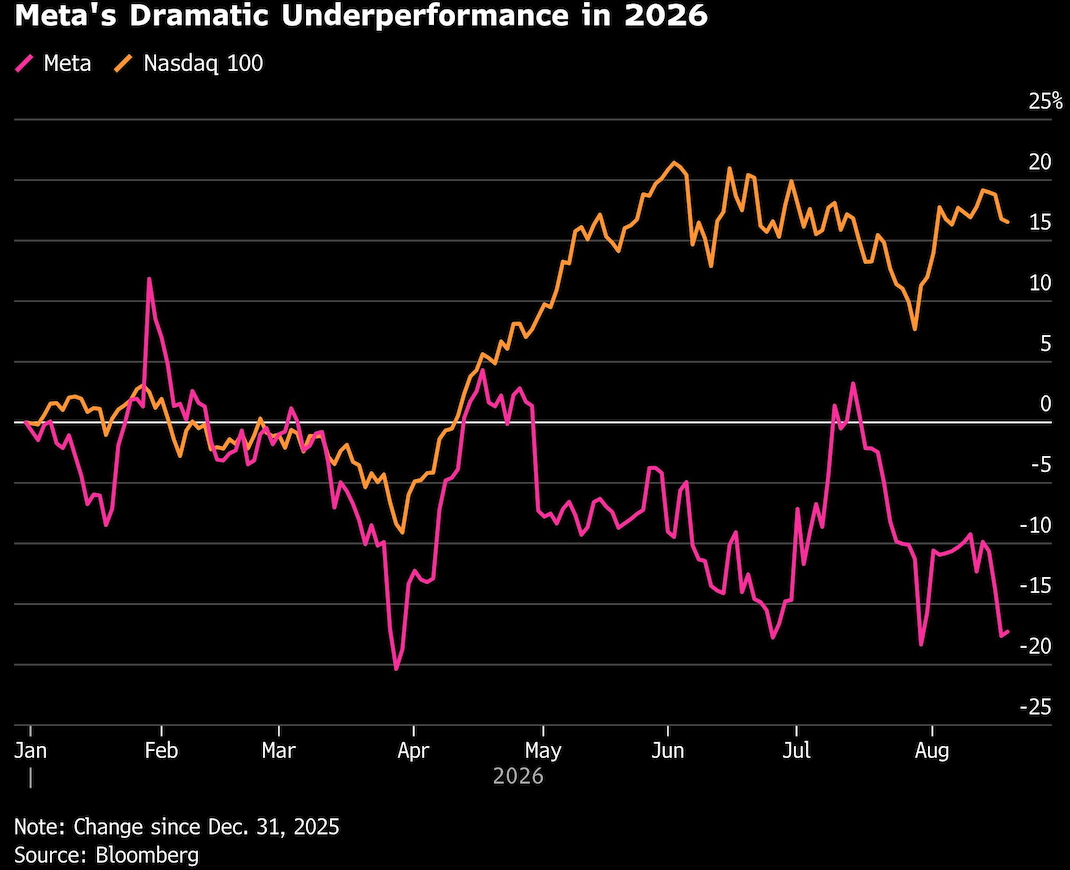
Meta shares fell 4.5% on Tuesday as the trial started, following a 3.5% drop on Monday. While the stock rebounded modestly on Wednesday, it remains down nearly 18% this year, making it the 11th worst performer in the technology-heavy Nasdaq 100 Index, which is up 16% in 2026. The company and Tesla Inc. are the only members of the Magnificent Seven in the red this year.
Shares were down 0.2% on Thursday morning.

See more: AI Giants Will Earn $1 Trillion This Year. It May Not Be Enough
The stock has been under pressure for an extended period, entering a so-called “death cross” — when the 50-day moving average drops under the 200-day, a sign of growing momentum to the downside — back in December.
“The multiple already reflects some risk, but if a verdict forces a change in how Meta does business, and that resets the growth algorithm to a substantially lower level, investors will start to look for alternatives and there will be considerably more weight on the multiple,” Javeri said.
Concerns about the company’s legal risk have been building for a while. In March, a New Mexico jury found that Meta had misled teenagers about the safety of its social networks. Around the same time, a Los Angeles jury found the company and Alphabet Inc.’s Google liable in a trial related to social-media addiction. And governments in Australia and Europe have moved to ban children from using social media to protect them from exploitation.
Taken together, some investors see these developments as a potential “tobacco moment” for social media, referring to landmark legal battles three decades ago that resulted in stronger regulation of the cigarette industry.
“The State AGs may call this a landmark case, but their limited claims are unsubstantiated and their financial demands are vastly disproportionate,” a Meta spokesperson said in a statement to Bloomberg News. “We stand by our record of creating strong protections for teens, and look forward to making our case in court.”
For Meta, however, the problem is compounded by investors questioning the company’s strategy of spending aggressively on AI infrastructure. Its capital expenditures have severely diminished its free cash flow, which is projected to turn negative in the third quarter. And a weak revenue forecast last month triggered an 8% drop in the shares, underscoring how investors are losing patience and recalling the company’s widely criticized focus on the metaverse a few years ago.
“There’s no question it can grow revenue, but the key question is how quickly we’ll see a return on all this spending,” Javeri said. “From a pure business model standpoint, I am absolutely more sanguine about, say, Microsoft’s ability to justify its capex than Meta.”
The company is expected to devote $139 billion to capex this year, nearly double the 2025 total of $69.7 billion. That figure is expected to swell to about $197 billion in 2027 and $212 billion in 2028, according to the average of analyst estimates compiled by Bloomberg.
While the comparisons to the metaverse are easy to make based on the level of spending, some Meta shareholders see investing in AI as crucial for the company’s future because of the technology’s broad use cases across the corporate landscape. The metaverse, on the other hand, was an in-house fascination with virtual reality that wasn’t based on external demand.
“This is obviously very different from the metaverse,” said Stephen Lee, founding principal at Logan Capital Management, which owns the shares. “That was another time when it was trying to invest for the future. But the difference is that the metaverse didn’t work out, but AI seems to be, because we’ve already seen it boosting ad revenue.”
The spending is weighing on Wall Street view of Meta’s financial outlook. Estimates for Meta’s 2026 earnings per share have dropped by 4.1% over the past month, and projections for 2027 earnings have come down 3.8%, according to data compiled by Bloomberg.
Still, earnings per share are expected to rise 35% in 2026, before decelerating to a 7% pace in 2027 and then picking up in the subsequent two years. Revenue is projected to grow 26% this year and then slow moderately in each of the coming three years, hitting a 14% pace in 2029.
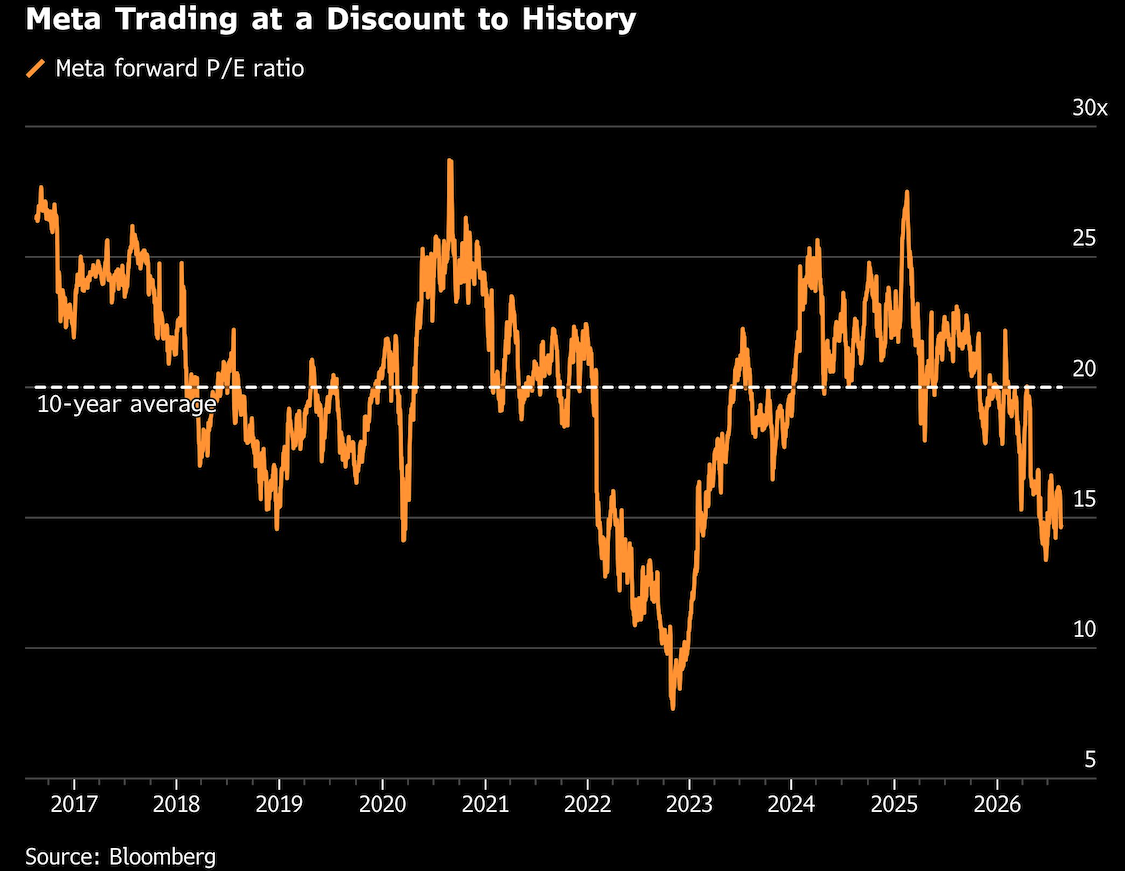
Of course, all the selling has left Meta shares relatively inexpensive. The stock trades at less than 15 times estimated earnings, down from 22 in January and a discount to its 10-year average of 20. The company has the lowest multiple in the Magnificent Seven and is among the 20 cheapest stocks in the Nasdaq 100.
“I’m comfortable paying this multiple for the stock,” Lee said. “Not only is it well off its highs, meaning it is a better valuation than it was not too long ago, but it is around a level where we’ve had success adding to positions in the past.”
Tech Chart of the Day
A message from Advisor Perspectives and VettaFi: Discover something new! Click here to register for our upcoming webcasts.
Bloomberg News provided this article. For more articles like this please visit
bloomberg.com.
Read more articles by Ryan Vlastelica