Nvidia’s Trillion-Dollar Chip Market Has Friends and Foes Closing In
Membership required
Membership is now required to use this feature. To learn more:
View Membership BenefitsAmazon.com Inc.’s Andy Jassy has begun making an audacious boast during conference calls this year. Though his company remains a top Nvidia Corp. customer, it’s also one of the world’s largest makers of data center chips in its own right.
If Amazon’s semiconductor operation were a standalone business, it would generate annual revenue of more than $25 billion, the chief executive officer told analysts in July. And the sales are growing by a percentage in the triple digits.
“We’re quite excited about what’s happening in our chips business,” Jassy said.
See more: Nvidia’s $500 Billion Plan Envelops Wall Street in Its AI Frenzy
The swagger underscores how much the semiconductor landscape is changing — and how fast. Though Nvidia remains the dominant maker of data center processors, particularly ones that help train artificial intelligence models, it’s facing increasing competition from all sides, including its biggest customers.
Amazon and other cloud-computing providers, still the biggest buyers of Nvidia chips, have been developing in-house silicon designs and even selling them to third parties. Rival chipmakers such as Advanced Micro Devices Inc. and Broadcom Inc. are booking tens of billions of dollars in data center revenue. And a raft of startups are raising billions more from investors keen to back the next breakthrough.
Just in the past few days, Google forged a deal with Marvell Technology Inc. to further its chipmaking ambitions and Nvidia rival Cerebras Systems Inc. announced a new computer that it says can process AI prompts faster than any other. Anthropic PBC, meanwhile, has hired a Google silicon veteran at a time when it’s plotting its own foray into chips.
Nvidia, the world’s most valuable business, will be hard to catch: It’s still growing faster than many of its challengers. And the company has expanded into software, networking and other technologies to ensure it remains essential to the AI economy.
But with the AI chip market poised to cross $1 trillion in revenue, the onslaught is only going to grow more intense.
“Nvidia has a strong ecosystem,” said Hendi Susanto, a portfolio manager and analyst at investment firm Gabelli. Shifts in the market — like Amazon and Google suddenly selling their own chips to others — have been unpredictable, though. “That came on us relatively fast,” he said.
Nvidia’s earnings report on Wednesday will likely serve as another reminder of the company’s commanding lead. Analysts estimate that revenue nearly doubled last quarter from a year earlier to $92 billion. That’s more money than any of its rivals get in a full year. But the flood of cash — with sky-high profit margins — only makes its turf more attractive. Meanwhile, some of Nvidia Corp.’s biggest customers have been told that the prices of servers containing its artificial intelligence chips are going up more than 15% in many cases, people familiar with the matter have said.
The Santa Clara, California-based company didn’t respond to a request for comment.
The threats to Nvidia can be divided into a few broad categories. On one side, existing chip competitors and a growing group of upstarts are both vying for a bigger share of the market. On the other, you have AI labs and so-called hyperscalers — the largest cloud-computing providers — designing their own chips.
1. Longtime Rivals
Nvidia ascended to the top of the semiconductor industry after developers realized that its graphics processing units — technology popularized by computer gamers — were well-suited for training AI models.
Demand for these GPUs, also known as AI accelerators, exploded after OpenAI’s ChatGPT hit the scene in late 2022. And that opened up an opportunity for Nvidia’s longstanding competitors.
AMD, the second-largest maker of GPUs, saw its data center revenue more than double last quarter to $6.7 billion. And CEO Lisa Su expects the total market for AI accelerators to reach $1.4 trillion by 2030.
Still, it’s unclear how much of that category AMD will claim. Nvidia retains roughly 90% of the accelerator market.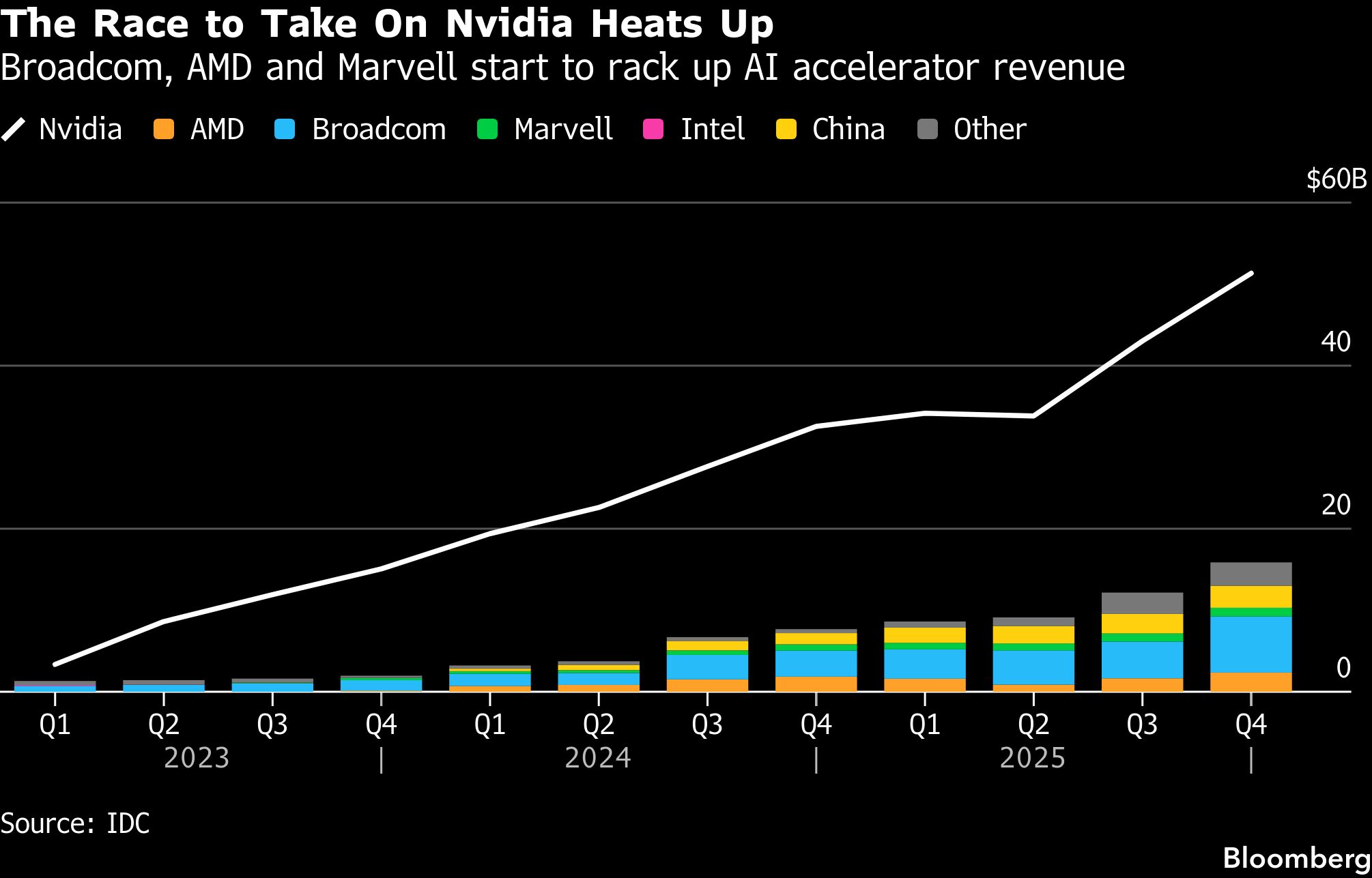
Intel Corp., which once eclipsed Nvidia in the chip industry, has attempted to sell its own accelerators — with limited success so far. But it’s benefited from the broader spending spree on AI data centers, fueling a resurgence in its sales and share price.
Broadcom and Marvell, which make customized components for clients, have beaten their own path to the AI market. They’re helping Google and other so-called hyperscalers — the biggest cloud-computing companies — develop chips to fill a fast-growing fleet of data centers.
Then there are competitors in China, where Nvidia is grappling with trade restrictions. US export controls mean the company can’t sell its best products to Chinese buyers. And though Nvidia has lobbied hard to overturn them, the rules have lit a fire under Chinese efforts to develop domestic alternatives. Companies such as Huawei Technologies Co. — blacklisted in the US — are making rapid strides toward developing products that are directly competitive, Nvidia has said.
2. The Upstarts
A turning point in the AI industry is helping give Nvidia’s challengers a lift. Data centers are shifting from the training of AI models — a stage that involves bombarding them with data — to a phase known as inference. That’s the point when the software begins responding to real-world inputs and spitting out responses. In other words, the AI models have been built and are now being put into use.
Nvidia’s GPUs are an undeniably powerful tool for training models, but the inference stage is creating opportunities for a wider range of processors. That’s set up a potential land grab by the chip upstarts. There are currently 150 companies working on more than 200 different AI semiconductor designs of one form or another, according to Jon Peddie Research.
The idea is to tailor chips to handle inference faster or more efficiently. Products can also be fine-tuned to accommodate certain kinds of models.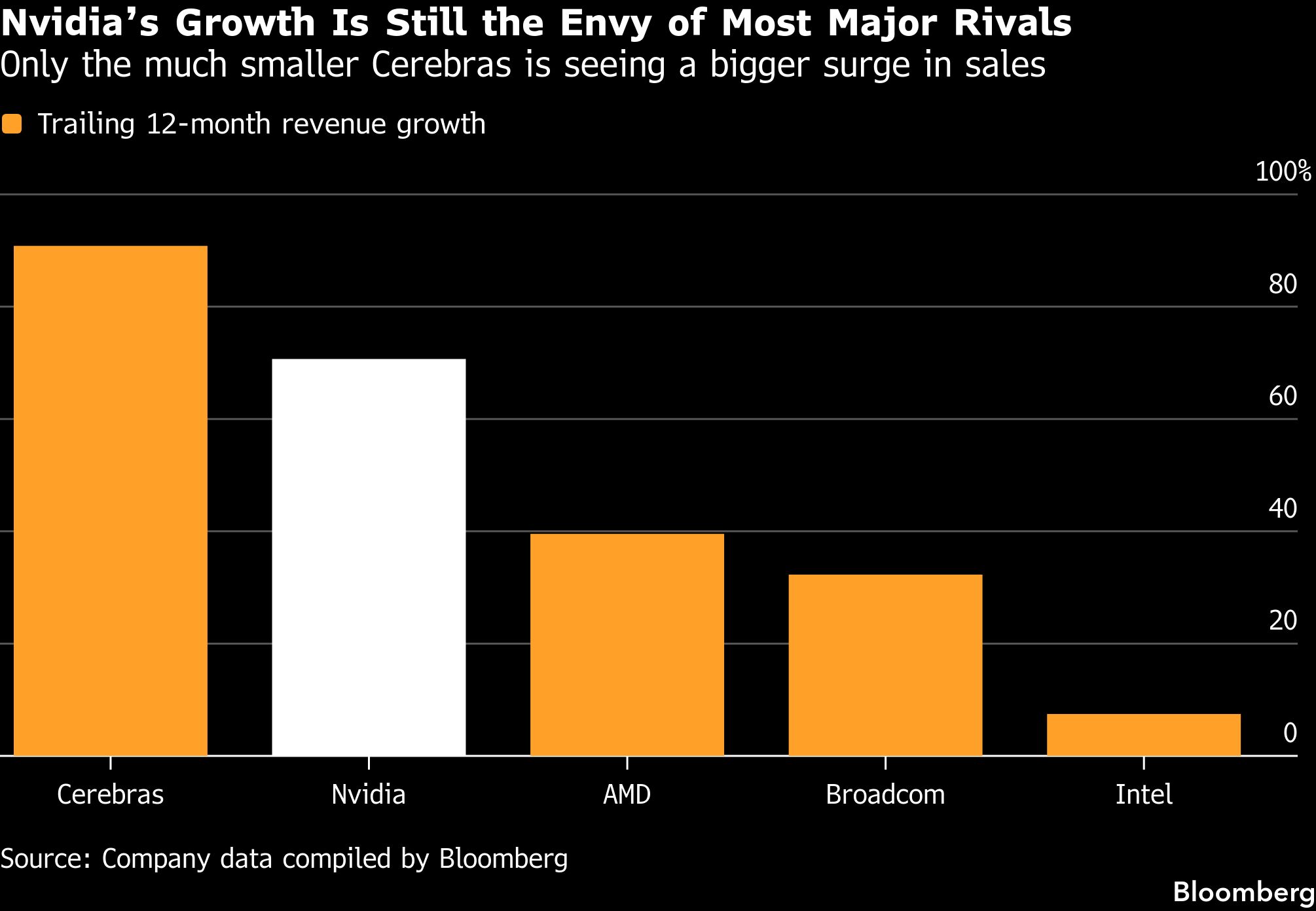
“Inference is not a one-size-fits-all, so brute-forcing inference with a single chip is not going to work,” said Sid Sheth, who is CEO of d-Matrix, a startup focusing on the space.
Another motivation? A desire to keep Nvidia from being quite so dominant. The company charges about $30,000 per chip for its high-end accelerators. Its profit margins have expanded to a remarkable 75%, roughly 20 points wider than those of its nearest rivals.
“The markets prefer a little bit of an oligopoly structure rather than a monopoly,” said Mitesh Agrawal, CEO of chip startup Positron.
The public and private markets are awash with cash for anyone with a plan to make a dent in Nvidia’s lead. Cerebras held the semiconductor industry’s largest-ever initial public offering in May, raising a record amount in an oversubscribed debut.
That company’s CEO, Andrew Feldman, has a simple pitch: His chips are much faster than Nvidia’s at providing an answer to an AI prompt. “This is a market that cares desperately about speed,” he said.
OpenAI and Amazon have both forged deals with Cerebras, which relies on dinner-plate-sized chips to boost performance. At the same time, previously obscure startups like Positron, Fractile and Etched are attracting rapidly growing valuations in funding rounds aimed at helping them field novel chips.
None of this is easy. Designing semiconductors isn’t for the impatient, inexperienced or short of cash. Chips can take years to develop — at a cost of hundreds of millions of dollars or more — and companies rarely get them right on the first try.
Sheth, of d-Matrix, has personally overseen about 20 chip tape-outs, the final stage in design before a company starts manufacturing a processor in mass quantities. “I don’t think it gets easier the 21st time,” he said.
3. The Hyperscalers
Hyperscaler companies — so named because they run computing operations with unmatched capacity — have a problem. They’re adding data centers too quickly for the chip supply to keep up.
That’s made it a near-necessity to seek alternatives to Nvidia, and increasingly they’re looking to do the job in-house.
That’s where Broadcom fits in. The company, once best known for Wi-Fi semiconductors and other communications components, is now the go-to partner for in-house chip design.
Broadcom is working with Google, Meta Platforms Inc. and others to develop AI chips, and it expects to sell $56 billion of the products this year. The push involves using application-specific integrated circuits, or ASICs, to fill a role held by Nvidia’s GPUs.
AI-related revenue at Broadcom’s design division is now more than doubling, according to analysis by Bloomberg Intelligence.
But the drive to diversify suppliers means that even Broadcom isn’t enough. Google is also working with Marvell to develop its AI chips, which it calls tensor processing units, or TPUs.
In another sign of escalation, Google will release two versions of its TPUs simultaneously this year for the first time. That will let it target one of them at the market for fast inference. The company also has begun letting customers use those chips outside of Google’s cloud and data centers, a model more akin to the way Nvidia sells.
4. The AI Labs
Top AI developers such as OpenAI and Anthropic are racing to build their own infrastructure, and that goes beyond seeking data centers and equipment. Like the hyperscalers, they want their own chips, which they can tailor for each company’s needs.
Anthropic, the maker of Claude AI software, has taken aggressive steps to decrease its reliance on Nvidia. That’s included lining up tens of billions of dollars in contracts to use AI accelerator chips from Google, Amazon and AMD. OpenAI, the company behind ChatGPT, is making similar moves.
The next step is to build in-house chip operations. Anthropic hasn’t given much detail about its plans to create an AI accelerator, but SK Hynix Inc. has been approached about supplying the memory chips to accompany the technology. Chey Tae Won, chairman of conglomerate SK Group, acknowledged the discussions during an event last month.
Read More: SK Chair Says Anthropic Asked for Supplies to Make Its Own Chips
OpenAI has provided more of a road map for its in-house chip, called Jalapeno. That processor, developed with Broadcom, will be deployed to data centers later this year.
To start, the chip will only focus on inference — with training remaining on Nvidia GPUs. But future versions may handle additional tasks. Broadcom CEO Hock Tan has said that the silicon will be refreshed in 2028 and then annually thereafter.
Notably, OpenAI may opt to let other businesses use its chips, Richard Ho, the company’s semiconductor chief, said in a June interview.
Designing its own chip is critical for OpenAI to get the best combination of performance, cost and speed, he said. “This is the beginning of a series of steps for OpenAI to take real full control over the entire infrastructure stack.”
Meta, meanwhile, is planning a variety of in-house semiconductor designs to underpin its AI ambitions. It has signed agreements with literally everyone of consequence in AI components, even relative latecomer Qualcomm Inc. But there are signs it’s still early days: In recent months, Meta’s spending dedicated to Nvidia actually went up.
On Wall Street, Nvidia’s star has dimmed a bit. Though its shares have climbed 15% in 2026, the Philadelphia Stock Exchange Semiconductor Index has gained 66%. Intel and AMD have more than doubled, and memory producer Micron Technology Inc. is up more than threefold.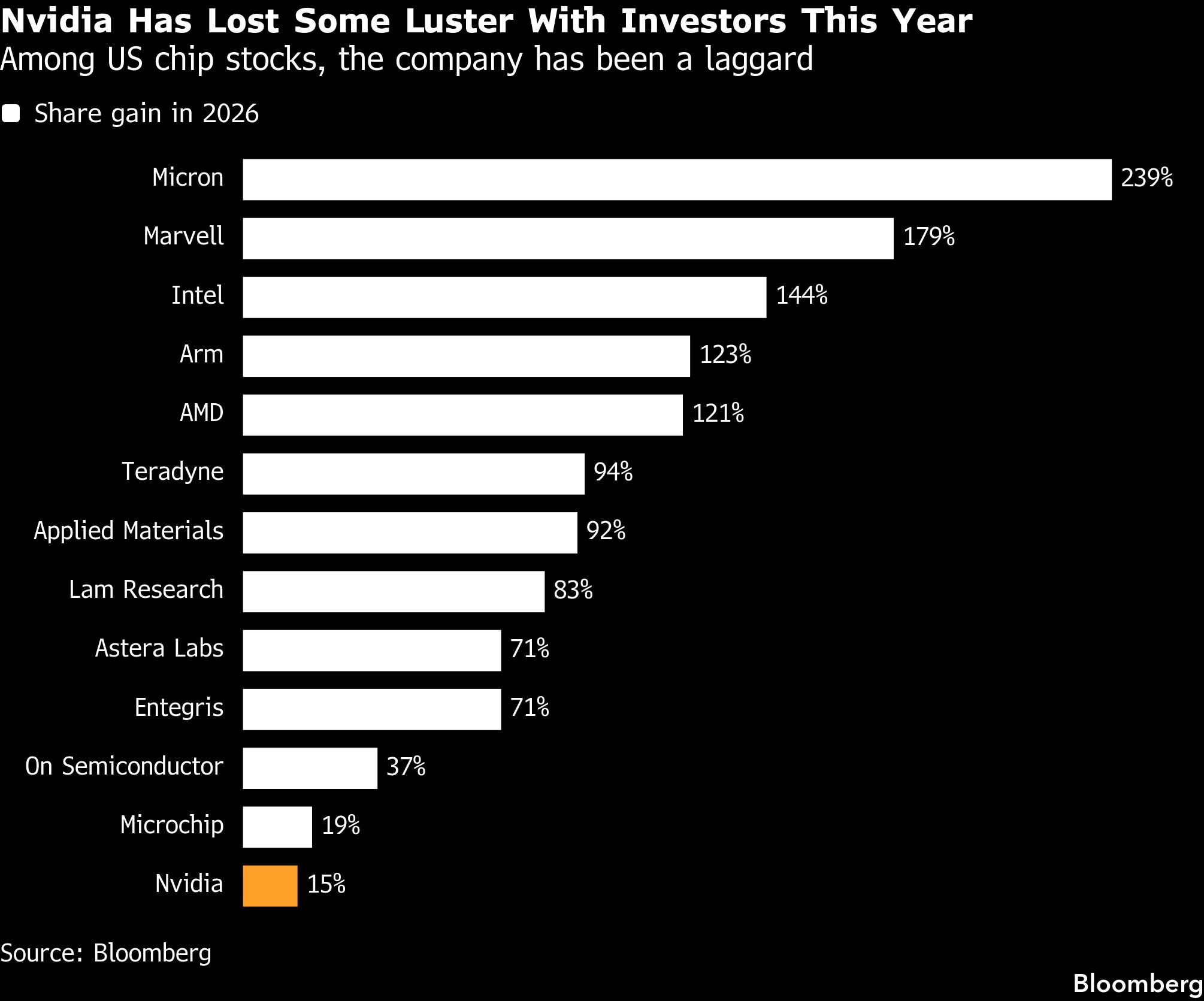
But Nvidia has made its own moves to stay competitive in inference. In December, it agreed to pay a reported $20 billion for technology and personnel from Groq, a startup focused on this market.
Another challenge that Nvidia’s contenders face is supply. In the modern chip industry, most companies design their products and then outsource production to a handful of manufacturers known as foundries.
Taiwan Semiconductor Manufacturing Co. is the dominant foundry and produces the most advanced chips. That makes it the kingmaker in the AI processor race. Nvidia has a long-term relationship with TSMC and can use its growing financial muscle to cement its central role in the industry.
“With supply commitments above $100 billion, the company is effectively locking in critical AI-infrastructure capacity multiple quarters in advance,” according to Bloomberg Intelligence analyst Kunjan Sobhani. “As AI-infrastructure spending accelerates, Nvidia’s size and purchasing power can become competitive advantages themselves, making it harder for smaller rivals to secure sufficient capacity at a similar pace.”
And Nvidia is moving ever-faster. The company is now completely overhauling its designs every year, and it’s able to offer a widening range of other technology, including data center cooling systems, networking and storage.
Nvidia’s would-be rivals acknowledge that they lack the scale needed to compete yet. Cerebras has secured a contract worth tens of billions, but the startups in its wake have yet to reach that level, said Positron’s Agrawal.
It’s hard to even claim to be an Nvidia rival, he said. “Genuinely, no one is a competitor of Nvidia until you can claim at least a 10th of their revenue,” Agrawal said.
And even Amazon, the proud chip juggernaut, remains deeply reliant on Nvidia. For all its in-house efforts, the e-commerce giant continues to send about a quarter of its capital expenditures to the company.
A message from Advisor Perspectives and VettaFi: Discover something new! Click here to register for our upcoming webcasts.
Bloomberg News provided this article. For more articles like this please visit bloomberg.com.
Membership required
Membership is now required to use this feature. To learn more:
View Membership BenefitsSponsored Content
Upcoming Virtual Events View All











