Bond investors, still reeling from Treasuries’ worst two days in more than a year, are preparing for a new test on Wednesday when the government holds its biggest-ever sale of 10-year debt.
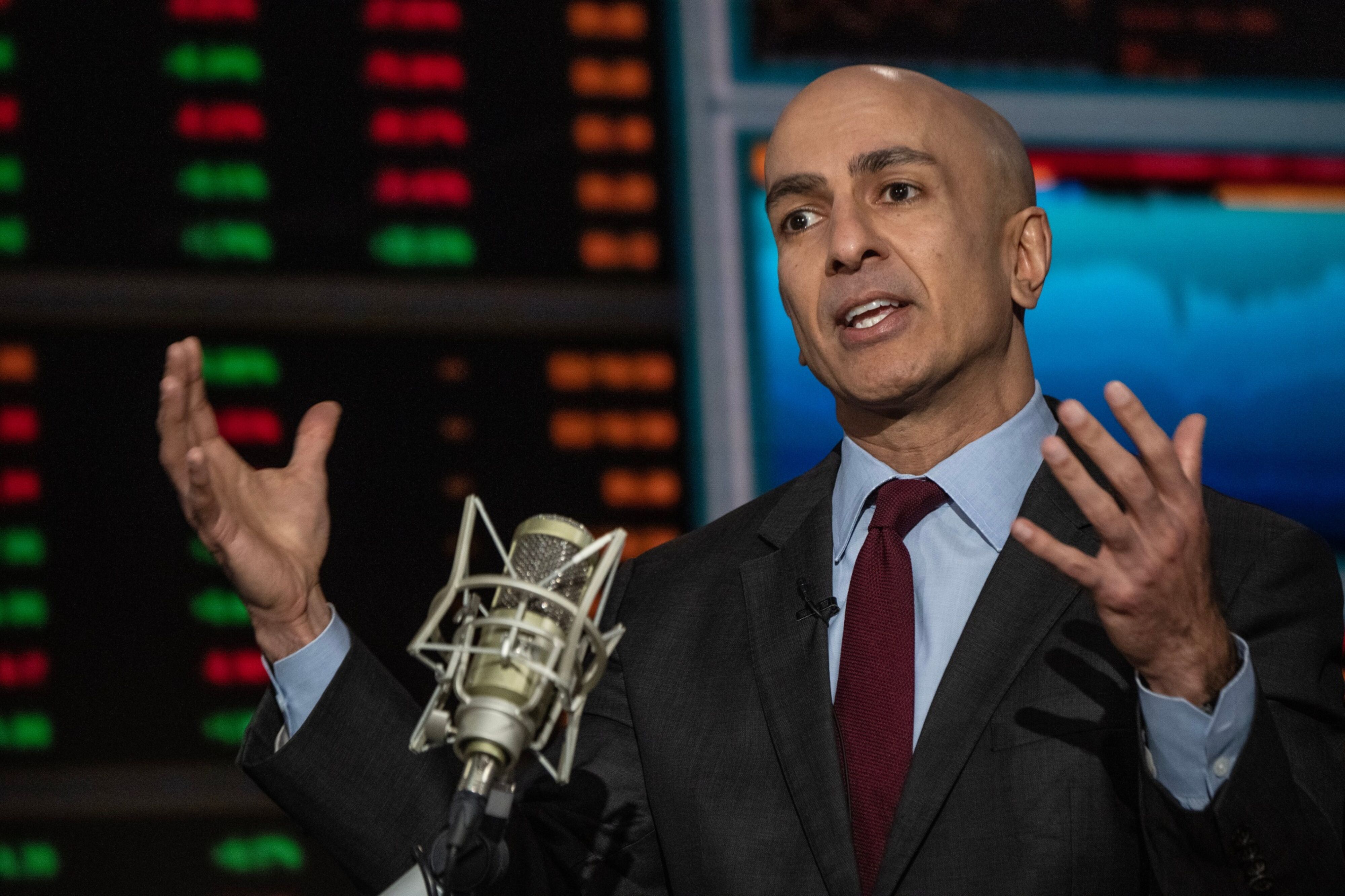
Federal Reserve Bank of Minneapolis President Neel Kashkari said officials need to see “a few more months” of inflation data before cutting interest rates, adding that he thinks two to three cuts will likely be appropriate for 2024.
I received an email this past week concerning George Soros’ “Theory Of Reflexivity.” It’s an interesting question, and I have previously written about the “Theory of Reflexivity.” Notably, this theory begins to resurface whenever markets become exuberant.
Instead of pivoting directly toward an easing bias, the Federal Open Market Committee opted for a wait-and-watch approach in January. Franklin Fixed Income Economist Nikhil Mohan expects rate cuts to come, but not quite as soon as or as many as markets have been anticipating.
The can has been kicked down the road several times but it feels like the end of the road is in sight.
As I observed last month, the strongest stock market returns in the coming decade, perhaps longer, are likely to emerge during advances in the S&P 500 that attempt to catch up with the cumulative return of risk-free Treasury bills.
While focus remains on when the Fed will start cutting rates, history suggests other factors must be looked at when assessing forward stock market performance.
Reliable sources of liquidity are at the top of traders’ minds as they brace for another year of turbulence, according to a JPMorgan Chase & Co. electronic trading survey.
Treasuries are headed for their biggest two-day loss in months as strong economic data reinforced the message of Federal Reserve officials including Chair Jerome Powell that interest-rate cuts are unlikely to begin before May.
Markets have made themselves clear for a while: they want more rate cuts than what Federal Reserve (Fed) members seem to be willing to accept at this time.
There is no shortage of hope – and hype – about what artificial intelligence could do for productivity and economic growth in the future. But we must bear in mind that our politics have proven too dysfunctional, and our policies too misguided, to manage even the most obvious threats to our future.
Small businesses are a vital part of the American economy. The U.S. Small Business Administration estimates that they represent over 46% of employment and account for the majority of new job creation. Small business openings are an expression of optimism in an entrepreneur’s ability and support from their community.
I'm going to predict the future. Not the coming year. Not the markets. But the trends that will emerge in 2024 and will shape the future, which advisory firms can prepare for now so that the strong, gusty winds of change will howl at their backs instead of in their faces.
Saving rates rose immensely across economies during the pandemic period. Government support programs, many designed to stimulate demand, elevated household incomes.
American shoppers won’t be deterred by mounting credit-card bills or the recent ripple of layoffs, according to the latest Bloomberg Markets Live Pulse survey.
As the financial markets grind higher, retirement savers have consciously decided to add more to equity risk. Such was the result of a recent Bloomberg survey.
The US economy is testing bond traders’ faith that the Federal Reserve will deliver a series of interest-rate cuts this year.
Despite analysts’ increasingly optimistic forecasts for the coming year, the risks to global growth are still tilted to the downside. In fact, recent developments in China, Europe, and the United States suggest that the world economy’s biggest challenges may lie ahead.
A period of market volatility and consolidation is likely as markets have already priced in much of the economy's good news.
The start of 2024 has been marked by record issuance in bonds both in the public and private sectors. But as fresh supply hits the bond market, prices have been dipping as of late.
While interest rates were left unchanged at the January Fed meeting as expected, there were some interesting hints about future monetary policy. Stephen Dover, Head of Franklin Templeton Institute, opines.
Modern economies, even small ones, are unfathomably complex. The number of variables is far more than any human can comprehend or any model can track. It’s really no wonder so many forecasts are wrong.
Copper was one of only two metals that finished 2023 in the black, gold being the other metal.
Many investors limit their mandates to credits rated BBB or higher. But they could tap high-quality high yield—without adding to overall risk.
Big tech appears to be sloughing off its slow start to 2024 and tech dominance could continue if history once again proves to be correct. If that’s the case, bulls can continue riding the tech wave.
The Federal Reserve sees progress on inflation, but wants more certainty before it’s prepared to lower the policy rate.
The Monetary Policy Committee (MPC) vote in favor of keeping the Bank of England (BoE) policy rate at 5.25%.
Rate hikes are in the rearview mirror, now the issue is when the Federal Reserve starts to cut.
The rush into technology stocks is resembling the bubble of 1999, reflecting an assumption that the economy will perform strongly despite tighter monetary policy, according to Bank of America Corp. strategists.
Political risk is global in 2024: Franklin Templeton Institute’s Kim Catechis highlights key elections to watch across the world in the coming year.
In Russell Investments’ factor portfolios, the Global Large Cap Growth, Momentum and Size factors outperformed the MSCI All-Country World Index during Q4, while the Global Large Cap Value and Low Volatility factors underperformed the index. The Global Lage Cap Quality factor was flat for the quarter.
The Fed concluded its January policy meeting leaving interest rates unchanged, which was widely expected.
For several months, I have pushed back against the market expectation that the Federal Reserve’s cycle of interest-rate cuts would start as early as March.
When it comes to financial markets, nothing is certain. For much of the last few decades, however, it was easy to convince yourself otherwise: Interest rates mostly went in one direction, down, and high inflation was a thing of the past.
The basic tenets of building wealth, like having a well-diversified portfolio with long time horizons, are not difficult concepts that are relatively easy to implement. So, why don’t people follow them? In our latest insight, we analyze several risk/return charts across multiple time horizons and reveal the results that investors tend to find surprising.
Treasury yields tumbled Thursday as a second day of declines for US financial stocks led traders to price in a more rapid pace of Federal Reserve interest-rate cuts.
The panel discussion, moderated by Freedom Investment Management CIO Ben Lavine, will include Eric Veiel, Head of Global Investments, CIO at T. Rowe Price, and Alex Zweber, Managing Director – Investment Strategy at Parametric.
Many advisors wait until the end of the year to harvest tax losses, but that may not be the best policy. Stock markets frequently go up in the last two months of the year so better harvesting opportunities may be available at other times.
As expected, the Fed held rates steady in January, but importantly downplayed the likelihood that rate cuts will start as soon as March.
The Federal Reserve (Fed) elected to not raise the federal funds rate at the January 2024 Federal Open Market Committee (FOMC) meeting.
Over the next few pages, I will argue that consumer price inflation (CPI), which is now falling rapidly across the OECD, will soon return to levels that central bankers are comfortable with.
In this article, Russ Koesterich discusses why a different approach to portfolio construction within equities is warranted in 2024.
The inflation problem is largely behind us, and most signs suggest that Federal Reserve policymakers know it. So why didn’t they just go ahead and cut rates on Wednesday instead of leaving their target range at 5.25% to 5.5%? Why wait until March or (more likely) May?
Initial and recurring applications for US unemployment benefits both rose to a two-month high, suggesting some slowdown in the labor market.
Jerome Powell delivered a clear message to traders eager for the central bank to start slashing interest rates: Not so fast.
US gross domestic product surprised to the upside in the fourth quarter of 2023, primarily led by US consumers and the government. Franklin Fixed Income Economist Nikhil Mohan sees the growth mix remaining largely the same in 2024.
A renewed sense of optimism emerged during the fourth quarter, sparking an increase in U.S. equity trading volumes and a rally in risk-on fixed income assets.
As the calendar closed on 2023, investors were once again treated to magnificent returns in their stock and bond portfolio.
History shows that monetary policy drives investment performance. When the Federal Reserve (Fed) hikes or cuts the fed funds target rate in response to economic conditions—or stays on hold while it assesses the data—performance will differ by sector.
We move on to the recent inflation that was kicked off by the pandemic. This summary allows us to appreciate better the similarities and differences between now and 50 years ago.