Excitement over AI has driven equities this year. Yet investors should maintain a disciplined, long-term focus amid uncertain market conditions.
Rob Tayloe discusses fixed-income market conditions and offers insight for bond investors.
India's growth initiatives and demographics may help its economy continue to advance; its stocks seem to have priced in high expectations for the world's fifth-largest economy.
In our Quarterly Strategy Update, we explore the changes that have been occurring in Japan and why we hold a favorable investment stance toward Japanese equities in the Knowledge Leaders Strategies.
Depending on who you ask, the word bond can either refer to a specific type of financial instrument, or when capitalized, your favorite British Secret Service agent. For this guide, we’ll be talking about the lowercase version, which represents one of the largest financial markets in existence.
Many stock market observers have commented regarding the market’s narrow leadership. However, few observers agree why this narrow leadership is occurring. Some, like us, believe it's purely speculation and others believe there's fundamental justification for it.
Music star Taylor Swift has taken the country by storm this year, selling out large football stadiums in every city lucky enough to have her perform.
After years of lagging behind the tech-heavy US market, Franklin Mutual Series sees international value stocks coming back into the spotlight over the coming years as the traditional economy comes into sharper focus.
Given the current economic climate, now may be an opportune time to look closely at long-term bond ETFs.
We see different and abundant opportunities in the new macro regime. We go granular within asset classes, regions, and sectors – and harness mega forces.
Central banks in the developed world have raised interest rates higher and faster than at any time in recent memory. But until labor markets start to slow, policymakers are unlikely to take their feet off the brakes.
We are going to talk about how you identify great businesses, and Colton will go over the Financial Statements to help determine which of these two companies has the stronger financial situation, I am going to look at it from the perspective of which is the best value.
The U.S. economy grew at a more-than-expected 2.0% annualized rate of growth during the first quarter of the year compared to the previous quarter. In some sense, this rate of economic growth makes a little bit more sense than the previously reported 1.3% rate...
Spring cleaning is essential to a cleaner home, just like rebalancing is essential to keeping an investor on track.
Optimism is the madness of insisting that all is well when we are miserable.
Is the recent rally a “bull trap,” or are we in a new “bull market?” Such was a question I recently received on Twitter. Of course, understanding the term “bull trap” is needed for those not deep into technical analysis.
As a result of these technological advancements in finance, fintech ETFs have emerged as a popular investment vehicle, offering exposure to a range of disruptive companies that are making waves in the financial industry.
In 1852, Karl Marx said, "Men make their own history, but they do not make it as they please; they do not make it under circumstances chosen by themselves but under circumstances directly encountered and transmitted from the past."
The Bank of England surprised market participants yesterday morning when they raised the Official Bank Rate by a full half point to 5.00%. The move caught traders off guard as the BOE had chosen to raise rates by only a quarter percentage point at each of the two meetings prior.
This weekend marks the official start of the Tour de France – one of the biggest cycling events in the world! Cyclists begin their journey in Bilboa, Spain and over the next 23 days will traverse through challenging terrain, covering a grueling ~2,200 miles.
Lower bond-market liquidity and insurance investors’ unique needs raise the stakes for liquidity management in what’s likely to be a volatile environment.
It is human nature to be captivated by unbelievable stories, great victories, and thrilling endings. One could argue that we have a penchant for the dramatic.
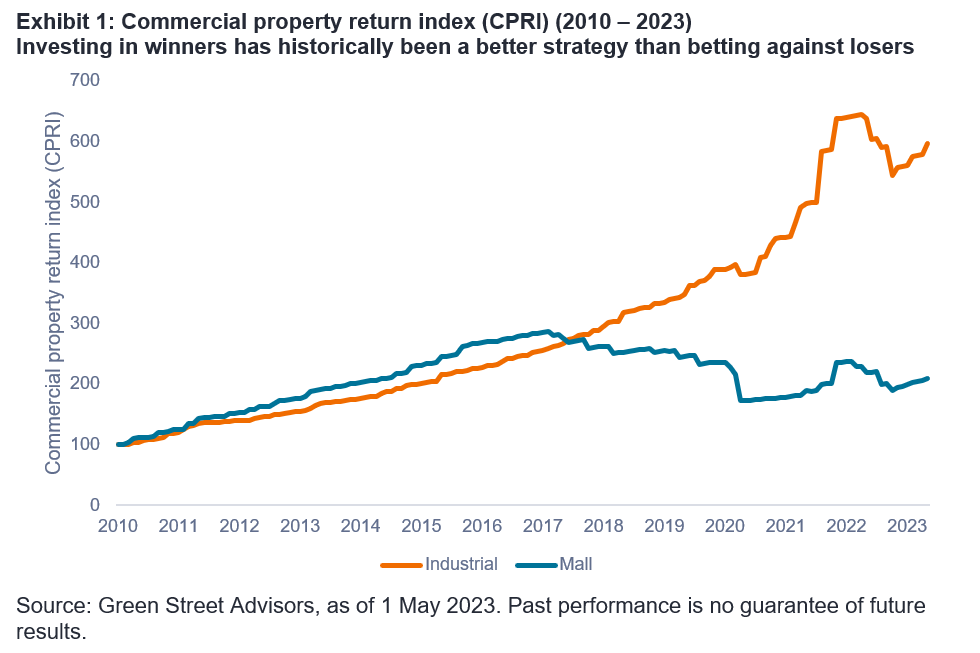
While the financial media has focused on the headwinds for commercial real estate and the challenges the office and retail sectors face, this narrative ignores the differences across sectors and the potential opportunities available in today’s market environment, according to Franklin Templeton Institute’s Tony Davidow.
We believe that the creeping economic slowdown in the United States will probably persist for a few more months, with a recession possible over the next 12-18 months. The onset of the recession may be delayed until 2024.
Central bankers think they can handle a situation and fire the artillery. It always has an effect… but ultimately it is rarely the effect they wanted. Doing nothing at all might have been better but that wasn’t an option. They’re trapped in an endless spiral of intervention.
In this article, we take a deeper look into three key housing releases from the past week: existing home sales, building permits, and housing starts. By examining this data, we gain valuable insights into the current state of the housing market and the broader economy.
Economies are struggling to shake off effects of COVID.
India is rapidly transforming into a formidable global superpower and an increasingly attractive destination for investor capital. Amid rising geopolitical tensions and the impact of disruptive technologies, India's story is a beacon of opportunity in a challenging landscape.
Exchange-traded funds are certainly popular with investors—here’s a look at how they can coexist in harmony with other investment vehicles, from David Mann, Head of ETF Product & Capital Markets.
One crystal-clear pattern has emerged. Everyone wants real-world, specific examples of how AI can and can’t enter into an advisor’s, investor’s, or creator’s workflow.
For decades, rich countries have urged developing countries to shift away from fossil fuels while failing to heed their own advice or offer meaningful funding. Kenyan President William Ruto’s recent call to establish a new “global green bank” is the sort of thoughtful proposal that developed countries must seriously consider.
One such company is NVIDIA Corporation, a leader in the AI industry. With the growing interest in AI, it’s no surprise that investors are looking for ways to gain exposure to NVIDIA, including through leveraged and inverse ETFs.
A direct indexing solution can help make an investment portfolio as personalized as a home.
Did you know that American forests offset 12% of total U.S. emissions? With wildfires back in the headlines, Energy Analyst Pavel Molchanov discusses the crucial role of reforestation efforts.
After the disruptions of the past few years, many of us are looking for a return to normal. For investors in emerging-market bonds, normal would mean a world in which global inflation is in check, interest rates are no longer rising, China is healthy, and traditional asset correlations resume.
Evan Harp sat down with financial advisor Ramona Maior. Maior reflected on how financial advisors can better serve LGBTQ+ clients. She offered a number of quick and useful tips for advisors.
Aggressive monetary policy tightening in developed markets led to a drawdown in house prices in 2022, but not a meltdown.
A month or two ago, people were having a conniption about commercial real estate. An absolute meltdown.
Financial advice often focuses on boosting personal savings rates and maximizing return on investment during a worker’s accumulation years. Equally important, however, is the decumulation process, when people spend those savings in the form of income.
We review the key themes of the first half of a busy year.
Activities that help companies avoid emissions are an attractive investment opportunity, according to Templeton Global Equity Group Portfolio Manager Craig Cameron. By actively seeking opportunities to reduce emissions, he says investors can align themselves with sustainability goals that contribute to a low-carbon economy.
The Federal Reserve (Fed) still has a very tough job ahead to bring inflation down to its 2% target over the long run while facing pressures from markets, which have a very different timetable than the Fed.
The World Silver Survey is an annual report published by The Silver Institute since 1990. It provides market participants with supply and demand statistics for critical sectors of the silver market, along with price and trade data.
The European Central Bank (ECB) hikes rates and signals more tightening ahead.
After falling into its own recession last year, the housing market has started to turn decisively higher; but a sustained recovery might not be the strongest elixir for the economy.
In this article, we’ll closely examine the EM bond ETFs that have performed the best over the past year.
In a hawkish move coming on the heels of data that showed a reacceleration in inflation, the Bank of England raised its key lending rate by 50 basis points at today’s policy meeting.
1969 is often remembered as one of the biggest years in pop culture history.
After yesterday’s testimony by Fed Chair Jerome Powell to the US House of Representatives I analyzed its sentiment on key issues compared to his previous four FOMC policy statements, using ChatGPT. The table below shows the results.
Howard Marks (Co-Chairman) and David Rosenberg (Co-Portfolio Manager, U.S. High Yield, Global High Yield, Global Credit) discuss topics from the June 2023 edition of The Roundup. They consider the evolution of the high yield bond market, investor optimism, and why this time might actually be different in financial markets.