If 2023 was the year of the “Magnificent Seven,” 2024 may be a year where small-, mid- and large-cap companies will take the spotlight, according to Franklin Equity Group.
With 2024 just around the bend, fixed income exchange-traded funds (ETFs) are offering investors bright prospects for bond exposure in the new year and capital allocation is expected to increase.
As we near the end of 2023, Head of Franklin Institute Stephen Dover reviews how his forecasts for the year panned out and shares the themes his team is watching out for in 2024.
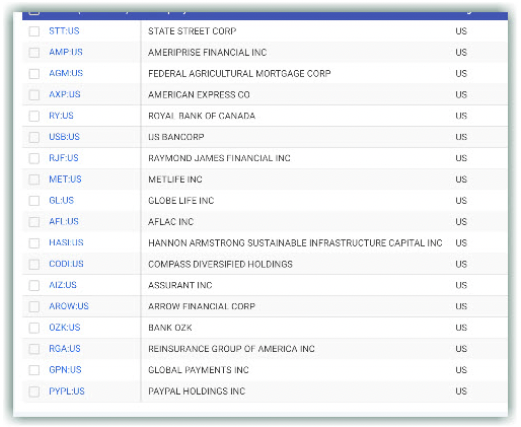
Thanks to the great recession of 2008 and 2009, there is more value to be found in the financial sector than any other of the 11 sectors.
The year-end fiscal 2023 government funding bill contained legislation that makes the most significant changes to the U.S. retirement savings system in decades. The SECURE 2.0 Act builds on retirement savings changes passed in 2019 and contains new provisions that further raise the required minimum distribution (RMD) age, shift to automatic plan enrollment and provide for new matching/emergency withdrawal opportunities.
Very early this year our economics team got a pleasant surprise: Consensus Economics, which collects forecasts from roughly 200 economists around the world, rated us the most accurate forecasters of the United States for 2022, based on our forecasts for GDP and CPI. Unfortunately, we don’t expect a repeat award for 2023.
A recent warning by YahooFinance warns investors to sell their cash and buy bonds and stocks now as the Fed pauses.
First, let me wish you Merry Christmas, Happy Holidays or your favorite personal form of greetings for this time of year.
The market has been indecisive but with reason. 2023 has been filled with strong opinions however, many of the opinions are of contrasting beliefs. Reading the future is not easy.
2023 was a year of surprises. These are five key sector themes illustrated in charts that dominated the ETF world this past year.
Equity markets are on track for a strong finish to the year, powered by mega-cap growth stocks — the equity MVPs of 2023.
US equity market returns have been disproportionately driven by the so-called Magnificent Seven (Mag 7) stocks this year. Their dominance has created style imbalances within large-cap benchmarks that deserve closer attention from investors.
In this video, Chuck Carnevale, Co-Founder of FAST Graphs, a.k.a. Mr. Valuation, will analyze the investment potential of various Energy Sector companies.
A lot of different asset classes are currently being discussed as possible places to invest in 2024, but one that hasn’t garnered much attention is gold.
Bond markets expect more cuts than the Fed is signaling, and this expectation largely reflects a return to pre-COVID dynamics of low inflation, massive central bank support, and suppressed term premia.
While 2022 was a brutal year for bonds, fixed income enjoyed many tailwinds this year, from high interest rates to lowered inflation to a less volatile economy. This made 2023 the year for fixed income. And in particular, it was a good year for Vanguard.
Broadly speaking, Chinese equities and the related exchange traded funds disappointed investors this year, but there’s a growing sense that 2024 could bring better things for this asset class.
CIO designate Sean Taylor discusses his investment outlook for the year ahead and how he sees 2024 unfolding for emerging markets, regionally, economically and thematically.
As European inflation rates converge with targets, markets expect rate cuts. But central banks are set on a decisive victory over inflation.
The holiday season is often the busiest time of year for any profession, and for advisors it is no different. Business demands, family obligations, and heavy social calendars can make for an overwhelming time.
Will Beijing take the necessary steps to restore confidence in its economic policies? Sinology explores.
There are material short- and long-term implications for hydrocarbon markets following the COP28 meeting in Dubai, including tailwinds to oil.
Markets had been living through an era of slow burn, low interest rate-boosted index funds for years until rapid rate hikes in 2022 and 2023.
The economics team shares a few things that have been on our minds.
Investors are warming to opportunities stemming from climate change, and other takeaways from COP28.
Over the past month and the past 90 days, the Russell 2000 Index is higher by 12.07% and 8.49%, respectively. What’s notable about those periods is that they include increased chatter that the Federal Reserve could be positioning for multiple interest rate cuts in 2024.
Kathlyn Collins, Head of Responsible Investment and Stewardship, says a renewed purpose among regulators and pressure from investors is yielding breakthroughs in the governance and the capital efficiency of Japan’s-listed companies.
In this video, Chuck Carnevale, Co-founder of FAST Graphs, a.k.a. Mr. Valuation provides a detailed analysis of seven stocks in the Communication Services Sector, focusing on their valuation, growth potential, and dividend yields.
Municipal bonds posted their best performance of the year, and we believe municipal credit conditions remain strong.
In this article, we will explore how gold has performed throughout 2023 and share more information on what experts expect from gold in 2024.
GMO has published a new 7-Year Asset Class Forecast
The economics teams looks back at the most significant stories we covered during 2023.
In this video, Chuck Carnevale, Co-Founder of FAST Graphs, a.k.a. Mr. Valuation will discuss the challenges of finding long-term investable companies in the Industrial Sector.
Today's uncertain economic climate is putting particular pressure on four market segments. Here's what to watch out for in the months ahead.
It’s exciting times in the ETF industry. For example, we might be headed for a photo finish in the ETF leader board. As of December 15, two ETFs stood above the rest.
The use of “factors,” or broad and persistent drivers of investment returns, has grown rapidly in equity markets, but with less adoption in fixed income.
The first actively managed exchange traded funds came to market in 2008. But 2023 may be remembered as the year when the asset class matured, paving the way for broader long-term adoption.
The cornerstone of diversification is the allocation of investments to counterbalance losses and dampen volatility. But what happens when traditional assets, like stocks and bonds, move in lockstep as they are now?
In the same way that a swimmer can make the biggest splash by jumping off of a higher diving board, so too fixed income asset returns can appear prospectively most attractive after a prolonged back up in rates.
High yield fixed income has always been considered a riskier investment relative to other bonds. But strong corporate fundamentals are making this asset class far less risky these days. And that makes so-called junk bonds currently a bit of a misnomer.
Over the last few months, we have highlighted that the Fed should be done with its tightening cycle based on real-time, high-frequency data that suggested that economic growth and inflation were cooling.
In this video, Chuck Carnevale, Co-Founder of FAST Graphs, a.k.a. Mr. Valuation will analyze the healthcare sector stocks and discuss the value of different companies within it.
What is the “wealth effect,” and why is it important? It is a great question and reminded me of “A Funny Thing Happened on the Way to the Colosseum.“
Private assets and alternative investments are usually illiquid in nature but can help an investor meet their long-term objectives in a more efficient manner.
What was the biggest story in ETFs in 2023 for you? What has the potential to have a lasting impact on the industry? Or is there something you think was a flash in the pan?
There are many risks for 2024 including those that are an ever-present part of investing and not unique to the outlook for any particular year. We've highlighted our top five.
The 60/40 portfolio composed of stocks and bonds, respectively, has somewhat fallen to the wayside in the past decade. But with optimism flooding the bond markets for 2024, it could make a comeback.
For multi-asset income investors, adapting portfolios for equity defense, credit potential and duration exposure should be on the docket for 2024.
Markets cheered a “dovish” December Federal Reserve meeting, seen as an early gift to investors. But has the battle against inflation been won? Franklin Templeton Fixed Income CIO Sonal Desai weighs in.
Earlier this year, many industry observers and investors were expecting an imminent slowdown with markets. But with rates coming back down and the risk outlook improving, the outlook on fixed income has improved.