Loomis Sayles' Global Credit Sector Team shares their outlook on key themes in the euro credit space.
To persuade someone to do something, you have to show them the positive opposite of what they are doing by using this one word.
I spend a lot of time studying about how financial advisors should differentiate themselves. But perhaps this is a waste of time for several reasons.
Credit markets have staged an epic rebound from the depths of March 2020. But in a low-growth, low-yield world, we believe there may be more room to run in 2021.
Are you committed to using digital marketing to grow your practice in 2021? What’s the ideal path to convert a prospect into a client? If you don’t have a crystal clear strategy to convert prospects into clients, chances are you’ll end up spending more money, energy, and time than you ever should. Worse yet, you may end up “striking out” on developing new client relationships with rich opportunities. The good news? You can 5x your return on marketing spend by following a simple, proven strategy. It’s exactly what the top 25% of advisers are doing right now to move prospects from “cold to gold” - quickly.
With a record high number of SPAC IPOs and the success of some well-documented investments with triple digit returns, investors and advisors might be interested in evaluating a potential allocation to their portfolios. In this article I focus on a few basic criteria of the best-performing SPACs and tips on how to perform your own analysis.
The seemingly endless election of 2020 is finally over, with Democrats winning both Senate seats in Georgia.
While valuations are high across the market, on a relative basis, they are still most attractive for international stocks. The pandemic has delivered a global growth shock, but in doing so, it has accelerated the timeline for mega trends such as productivity enhancement (robotics, automation, and software), e-commerce, electronic payments, and rapid drug development.
They’re still in the minority, but investors and economists who think America is in for a bout of inflation -- perhaps a serious one -- start the year with some fresh ammunition for their arguments.
The dichotomy of “value” and “growth” investing has become a sharp stylistic divide. But is it helpful? Howard Marks writes in his latest memo how he views the art and science of value investing, especially in the increasingly efficient and complex world we face today.
What can investors expect this year? Positive (but unsteady) economic growth, a powerful boost in earnings and continued success for information technology stocks, says Raymond James Chief Investment Officer Larry Adam.
Whereas commodity production had been a major economic driver in emerging markets, we think technology is now the leading force. Semiconductor advancement is the “new oil.” semiconductor companies are so far ahead of their competitors that supply is in fact a constraint—and therefore a major investment consideration.
As we enter 2021, there are two myths told to investors to support the bull market narrative. The first, as we debunked recently, is that low-interest rates justify high valuations. The second is that since valuations are not as high as the “dot.com” crisis, there is no “stock market bubble.”
This should be positive for gold, given the potential for greater government spending and, therefore, inflation.
This week’s letter is the first part of my 2021 forecast. There is simply too much to cover in one letter, and today we’ll start with the most important factor, a known unknown, that I think will be the driver for 2021.
Mortgage rates in the U.S. started 2021 by setting another record low. The average for a 30-year, fixed loan fell to 2.65%, down from 2.67% last week and the lowest in data going back 50 years, Freddie Mac said in a statement Thursday.
Despite extensive economic and human costs, 2020 may be a turning point in multiple ways.
Doubling the size of an investment advisory firm is hard even without a pandemic. But Dave Welling, the chief executive officer of Mercer Advisors and this week’s guest on the Masters in Business podcast, did it.
It’s coming. Is it here? Perhaps. Or maybe not. But sooner or later, it is coming. Preparing now for the eventuality seems the most prudent course.
If your client meetings look, sound, or feel a little similar to a sales call, you’re de-credentialing yourself and creating unnecessary barriers to developing trust.
We have a lot to reflect on this year. Here’s what I’d like to see more and less of in 2021.
I'm going to assess the state of the profession as we emerge, exhausted, from our tumultuous 2020 experience.
As the new year begins, the investment grade (IG) market faces multiple challenges, including a recovering economy, low yields, tight spreads, and record high duration. At the same time, market technicals remain favorable, fundamentals are improving, and there are attractive sectors in the index. Overall, we are modestly bullish about 2021 and feel there are compelling opportunities for those who know where to look.
As we look toward 2021, one of the key issues facing wealth managers will be the changes that may come with the Biden administration. There has been talk of raising both income and capital gains tax rates, as well as Social Security taxes that could be imposed on high earners. Although Biden has rejected a wealth tax advocated by some in the Democratic Party, he has proposed changes to estate tax laws, such as taxing unrealized capital gains at someone’s death
At this point in the typical year, this column would be filled with all the usual personal financial advice: max out the contributions to your 401(k) and 529 savings plans, add to your health savings account, make year-end charitable donations and make sure to rebalance your investment portfolio.
Colleges face an uncertain future as the coronavirus disrupts U.S. higher education. How should parents, especially those with younger children, set money aside for college costs when things are so unpredictable?
Given the escalating costs of a four-year college education in the U.S., it makes sense for the government to nudge families to save for it. Currently, however, tax breaks for college savings mostly benefit the wealthiest Americans, while doing little to make college more affordable for the middle class -- and congressional Republicans’ tax-reform plan would exacerbate this imbalance.
When it comes to attracting people, jobs, and businesses, some states are just better than others. While the total US population increased 6.5% from 2010 to 2020, it increased 17.1% in Utah, 16.3% in Texas, 16.3% in Idaho, 16.1% in Nevada, 15.8% in Arizona, and 15.3% in Florida.
Gold and Bitcoin had a very good 2020. Investors, worried about currency debasement from all the money-printing, sought stores of value. Gold surged over 25%, its best year in a decade, while Bitcoin was up more than 300%.
Although some on the committee agreed with the market consensus for a moderate continuation of economic growth and equity markets, the majority agreed with a more positive scenario in which the global economy outperforms market consensus, while equities, especially those outside of the US, rally sharply.
Ongoing uncertainty around the COVID-19 pandemic has strengthened headwinds to global growth, says Franklin Templeton Investment Solutions CIO Ed Perks. In his 2021 investment outlook, he says nimble and diversified positioning is key to effective investment strategies.
Our Head of Equities, Stephen Dover, shares his 2021 equity outlook. He sees opportunity amid upheaval.
In October, I discuss how the “2nd Derivative Effect” would mute the impact of future stimulus programs. With the passage of the $900 billion stimulus package, we can update the estimates for the economic impact heading into 2021.
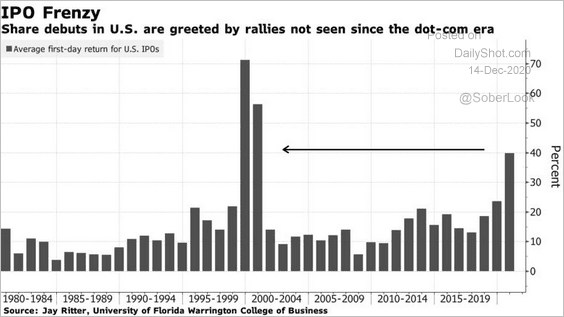
“Maybe this time is different. Those words, supposedly the most dangerous to utter in the investing realm, came to mind amid the frenzied pops in the highly anticipated initial public offerings recently.” That quote was from Randall Forsyth discussing why the current market mania reminds him of the “Shades of 1999.”
Rick Rieder and team describe how revolutionary changes taking place in corporate business models will impact investing for years.
Investors and planners desire clarity around tax rates to help make informed decisions around investment moves and related impacts to portfolios.
Cambiar Investors Senior Analyst Charmaine Chan, who holds a doctorate in molecular biophysics and biochemistry from Yale University, details the coronavirus mutation first identified in Southern England and how it may change the nature of the economic re-opening many investors are anticipating.
Online meetings will evolve in 2021 as client needs drive changes to both platforms and business norms.
From global responses to local lockdowns, we all witnessed dramatic changes in 2020.
And then there’s Bitcoin. The world’s biggest cryptocurrency has surged nearly 220% this year, touching an all-time high of $23,717 in intraday trading on Thursday.
We’ll take a closer look at the stock market and where it may be going.
As the sun sets on one of the most challenging years in memory, many healthcare systems and other types of non-profits find themselves in starkly different financial situations than they were at the start of the year.
The third wave of the pandemic may be showing signs of a peak. While new cases remain very high, the seven-day daily average was down for two days in the past week, suggesting we may be close to a peak.
Several former world leaders, a Hong Kong media tycoon, the CEO of Theranos and Jeffrey Epstein’s confidante — all are scheduled to have their day in court next year.
They were once America’s corporate titans. Beloved household names. Case studies in success.
Real estate is no exception to COVID-19’s disruptions, accelerating trends, and shifting how we live, consume, and work.
We hope you enjoy the December NewsLetter from Harold Evensky.
Promising developments surrounding vaccination give us hope that 2021 will be a better than year than the one that is about to end.
On December 21, Tesla will be the largest company ever to enter the S&P 500 Index. Tesla’s skyhigh valuation, which meets our real-time definition of a bubble, conforms to the observation that market-cap-weighted indices buy high and sell low—the antithesis of prudent investing.
Is the rotation toward value here to stay? What could stall the economic recovery? In the first in a four-part series of blog posts, we explore the key issues that are likely to impact the investment landscape in 2021.