The upcoming US presidential elections transcend mere political rivalry. Stephen Dover, Head of Franklin Institute, examines the policy differences between the major parties and their potential implications on capital markets in the years to come. He also discusses whether elections and their outcomes have significantly affected equity markets or if other factors made more of an impact.
For this edition of Bull vs. Bear, Karrie Gordon and Nick Peters-Golden debate whether alts deserve portfolio allocation in 2024.
After a career in design that included restoring furniture and textiles for nine presidents, Iris Apfel became a fashion icon in her 80s. This isn’t a commentary on how to live out one’s retired years (some may air-quote that term). It’s to drive home the point that she lived – really lived – to 102.
On Jan. 30, Senior Director and Head of ESG and Investment Management Kris Tomasovic Nelson moderated an online discussion exploring the findings of Russell Investments’ 2023 Manager ESG Survey. In its ninth year, the annual survey offers valuable insights into the evolving landscape of ESG practices within the investment management industry.
We believe optimism over a soft-landing scenario—where economic growth slows but a recession is avoided—may deliver more near-term market gains, as inflation declines and central banks look to start easing around mid-year.
State and local governments borrowed nearly $9 billion for affordable housing so far this year — the most for the period in at least a decade — as buying a home in the US remains expensive.
Rate cuts should help ease volatility in the bond markets, making it ideal for prospective bond investors to get core exposure.
It is long past the time that we face the fact that “Social Security” is facing a retirement crisis. In June 2022, we touched on this issue, discussing the stark realities confronting Social Security.
The Federal Open Market Committee (FOMC) comprises the Federal Reserve System’s decision-makers on monetary policy in the United States. This monetary policy is designed to keep the Fed’s dual mandate of maximum employment and price stability in line with targets.
Bob Doll, CEO & CIO at Crossmark Global Investments, explains why double-digit earnings growth and multiple Fed rate cuts seem incompatible.
Global Head of Client Portfolio Management Seth Meyer discusses the hidden risks and potential strategic pitfalls of sitting in cash.
Changes in China's economic policy tend not be communicated prior to implementation. What can we expect from China's stock market in response to any shifts?
Larry Adam takes stock of how the economy and markets have performed since the beginning of the year and take a fresh look at where we are heading as we progress through the year.
In a chaotic and uncertain world, investors crave a measure of predictability. Despite the best efforts of strategists and analysts to predict how markets will perform, no one knows what the future will hold. Defined-outcome ETFs offer investors a new way to reduce uncertainty while still maintaining exposure to the market’s upside. This has been one of the fastest-growing segments of the ETF market and many believe it’s got a long way to go.
Bond traders are cautiously reloading wagers that burned them just weeks ago as the Federal Reserve and key global peers finally appear set to begin reducing interest rates as soon as June.
Morgan Stanley’s exchange-traded lineup now holds more than $1 billion thanks to the firm’s first-ever mutual-fund conversions.
Franklin Templeton Fixed Income CIO Sonal Desai believes that the Fed's March policy meeting was not as dovish as some commentators and market participants have claimed, and that the Fed is still pragmatic and cautious about inflation and rate cuts.
On this episode of the “ETF of the Week” podcast, VettaFi’s Head of Research Todd Rosenbluth discussed the PIMCO Multisector Bond Active ETF (PYLD) with Chuck Jaffe of “Money Life.” The pair talked about several topics regarding the fund to give investors a deeper understanding of the ETF overall.
Junk-rated US companies have seen their interest costs rise after the Federal Reserve’s rate-hike campaign, but profits haven’t kept up, putting a squeeze on finances and underscoring a key risk for investors in high-yield debt as the trend persists.
It’s budget season in Washington, which means the politicians are delivering their annual warnings about the looming Social Security crisis.
Here are some reasons couples should sign a formal prenuptial agreement.
If one wants a guaranteed store of real purchasing power to pay off a future liability or to provide a multi-year income stream such as for retirement, then a ladder of TIPS provides a much stronger guarantee than other readily available assets.
At a time when financial professionals are increasingly looking for differentiated alternative investment products for diversification and return benefits, these are the three things you need to know about the growing asset class.
As the anticipation of rate cuts build, it may cause fixed income investors to fret, but an ultra-short option could help ease those worries.
Most clients have no idea what retirement failure means to them and how a given failure rate should influence their planning. We present a planning framework that improves on existing models by dynamically adjusting for market performance and longevity.
Markets have taken the Federal Reserve (Fed) decision to keep about 75 basis points (bps) cuts in its dot plot as a very positive sign that the Fed is going to actually cut 75 bps during the year and are still acting upon the news.
Thoughts on the US monetary policy path ahead from Franklin Templeton Institute’s Stephen Dover and Rick Polsinello.
There have been several big changes in the municipal bond market lately. Here's what you should know.
Gold staged a blinding comeback this week, surging to fresh all-time highs above $2,200 an ounce. The rally, which has added around 10% to gold’s value since mid-February, caught many market watchers off-guard.
Corporate defaults have been on the rise. As such, investors may want to consider investment-grade debt until credit risks subside.
Based on the valuation measures we find best-correlated with actual subsequent S&P 500 total returns across a century of market cycles, the stock market presently stands at valuation extremes matched only twice in U.S. financial history.
We will explore research concerning passive, covered call income strategies, give an overview of the derivative income category and due diligence considerations, and take a closer look at an ‘active-active’ approach deployed in a new ETF.
The Federal Reserve suggested that interest rates likely will move lower, but perhaps not as quickly as markets had been expecting.
As the S&P 500 continues climbing, investors don't need to worry about a sudden drop, which bodes well for high-yielding dividend funds.
Treasury yields are on the rise following new economic data and upcoming indicators from the Federal Reserve.
The US industrial renaissance is not a new theme for RBA. We first wrote about it in 2012 when we argued that US corporations had moved operations overseas because they were too focused on labor costs, and were ignoring transportation, governmental, geopolitical, and supply chain risks.
India’s equity markets are being driven by fundamentals in the form of robust economic expansion which is leading to strong earnings growth. India is also, helpfully, in the draft of favorable geopolitical tailwinds. In this paper, we make the case for India.
Using a tactical approach to fixed income investing based on the evaluation of yield spreads across a variety of fixed income sectors makes sense.
The Bank of Japan raised interest rates for the first time since 2007 and has eliminated the yield curve control framework. Franklin Templeton Fixed Income Economist Rini Sen expects the bulk of further tightening will likely come in 2025 as BoJ seeks to reach a sustainable 2% inflation target by end of fiscal year 2025.
The heated debate surrounding traditional 60/40 portfolios in today’s markets has dwindled in recent months. Given ongoing market volatility and the growing popularity of alternatives, does the traditional portfolio hold up today?
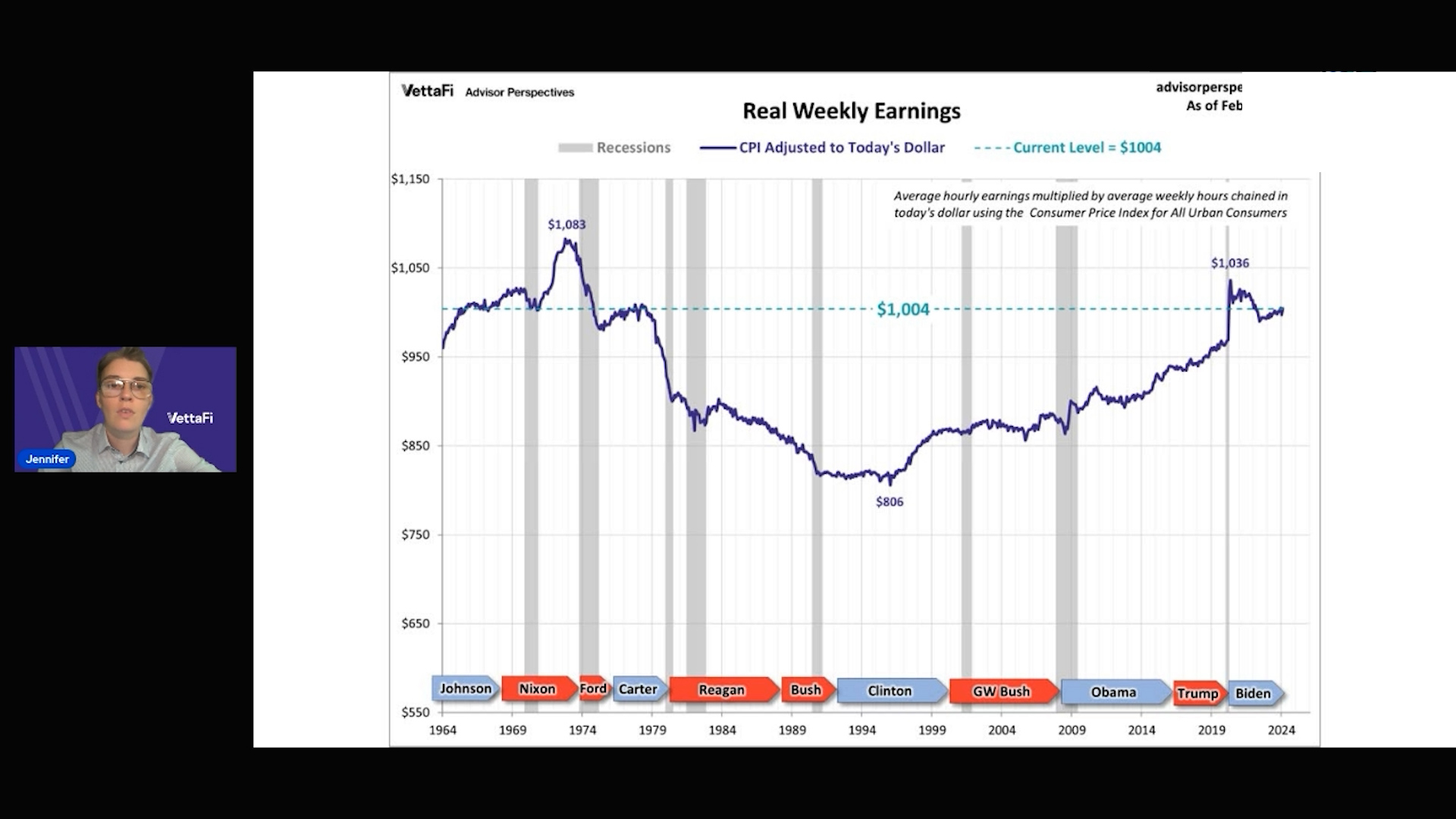
The latest hypothetical real (inflation-adjusted) annual earnings are at $50,210, down 7.3% from over 50 years ago. After adjusting for inflation, hourly earnings are below their all-time high from April 2020.
Between adjustments in Fed policy and a coming presidential election, it's going to be an emotional year, but historical data shows staying invested is the best course for investors.
Goldman Sachs Asset Management is charting a path to break into the top ranks of what’s projected to grow into a more than $10 trillion industry by the end of the decade.
Doug Drabik discusses fixed income market conditions and offers insight for bond investors.
In recent years, private equity fundraising surged, yet exits slowed drastically in 2022, prompting institutional investors to rebalance portfolios through increased secondaries activity. Franklin Templeton Institute’s Senior Strategist Tony Davidow explains.
In a global macroeconomic environment fraught with high inflation, consumers are stressing needs over wants, but that’s not to say they’re abstaining from the latter completely.
An obscure investment product used to finance risky real estate projects is facing unprecedented stress as borrowers struggle to repay loans tied to commercial property ventures.
Is there a point where support crosses a line and becomes a form of dependency for adult children while putting the financial security of the parent at risk?
The Federal Reserve weighs the data while investors wonder: When will rate cuts begin?
At Mutual Series, we do not believe the packed and contentious 2024 global election season will upend the major long-term trends around supply-chain links, energy security and defense—all of which can further support certain value stocks.