The market's rebound from the April lows has had a speculative, risky leadership profile—but broader participation suggests the bull can keep running for now.
Doug Drabik discusses fixed income market conditions and offers insight for bond investors.
In a series of blogs, our experts look back on an exceptionally volatile first half, then offer their insights on what we might expect to see for the balance of the year. Let’s start with a high-level overview.
We’re not surprised by the macro and market resilience, but it’s too soon to say we’re out of the woods, especially as the impact of uneven fiscal policy comes into sharper focus. Opportunities are out there, but context and discipline are critical.
With our most reliable stock market valuation measures at the highest extremes in U.S. history, it’s useful for investors to remember that a market crash is nothing but risk-aversion meeting a market that is not priced to tolerate risk.
As we move into the second half of 2025, it is an opportune moment to reassess our market outlook and provide updated insights for investors.
Congressional Republicans delivered the much anticipated One Big, Beautiful Bill Act (OBBBA) to President Trump’s desk just in time for a symbolic July 4 signing.
Chief Economist Eugenio J. Alemán discusses current economic conditions.
U.S. customs duties topped $100 billion for the first time ever in a single year this month. That number is even more remarkable when you consider that most of President Donald Trump’s new tariffs haven’t even taken full effect yet.
Every year the Per Jacobsson Foundation hosts and publishes a lecture on Monetary Policy. Back in 1979, Arthur Burns delivered the annual lecture in Belgrade, Yugoslavia (link). He titled the lecture “The Anguish of Central Banking” and he came clean about the Federal Reserve’s inflationary policies in the 1970s.
US equities advanced on Monday as traders prepared for a busy week of earnings, with big names such as Tesla Inc. and Alphabet Inc. set to report.
What do one of the largest private-school operators in the UK, a Spanish waste management company and a European fast food franchise of Burger King have in common? Their private equity owners are readying sales that don’t need debt underwriters.
Few are as candid and historically accurate as hedge fund manager Kyle Bass when identifying structural breaks in the global economy. In a recent interview, Bass painted a grim but telling picture of China’s economic condition, warning.
Unfortunately, the lush financial terrain we enjoyed from 2008 to 2022 was more like artificial turf. It wears out, gets ugly holes, and eventually needs replacement. But how to replace it without causing other problems? That turns out to be a real problem.
Investors enjoyed broad gains across major asset classes in the first half of this year, but they endured considerable market swings to earn those returns.
On this week’s edition of Market Week in Review, Global Chief Investment Strategist Paul Eitelman discussed key drivers behind the stock market rally.
Will he or won’t he? That’s the question on investors’ minds as tensions rise between President Trump and Fed Chair Jerome Powell.
While uncertainty gradually eased in the second quarter, the sustained decline in the US dollar and the ongoing changes in the geopolitical order indicate that markets may continue to be dynamic and offer opportunities for a variety of hedge fund strategies, as well as heightened risks.
Last week's economic data presented a picture of consumer resilience emerging alongside the continued challenge of rising inflation.
The sweeping 900-page tax and spending law signed on July 4 introduces a wide array of provisions that touch nearly every American in one way or another.
Current volatility and optimism are some of the topics being discussed in this new roundtable from Royce Investment Partners.
The second quarter featured a trade war, armed conflicts in the Middle East and Europe, and continued turmoil in Washington, yet markets continued to rally, likely due to an elevated money supply and an increase in passive investing.
With inflation proving to be sticky, sovereign debt burdens escalating, and trust in institutions coming under scrutiny, investors are reassessing the role that hard assets play in protecting and preserving long-term purchasing power.
As inflation concerns continue to influence 2025 market dynamics, investors seek equity-based strategies to provide rising-price protection.
The S&P 500 Index finished within striking distance of all-time highs after whipsawing on whether President Donald Trump will fire Federal Reserve Chair Jerome Powell.
June was a month of stabilization and subtle strength for preferreds.
Three themes are worth emphasizing as we reach the midpoint of 2025: tariffs, interest rates, and global diversification. We emphasize these themes even amid recent heightened geopolitical tensions.
Global equity markets swung from steep losses to fresh highs during the quarter. In early April, President Trump imposed a baseline 10% tariff and reciprocal tariffs of up to 50% on dozens of trading partners, only to suspend most reciprocal tariffs for 90 days amid market panic.
Investors may be happy to shift some of their focus away from the ongoing tariff saga and back toward economic data and earnings reports.
The U.S. economy remains resilient despite headline volatility tied to shifting trade and tariff policies. Meanwhile, we continue to see a lot of volatility in the economic data as the world adjusts to these changing policies.
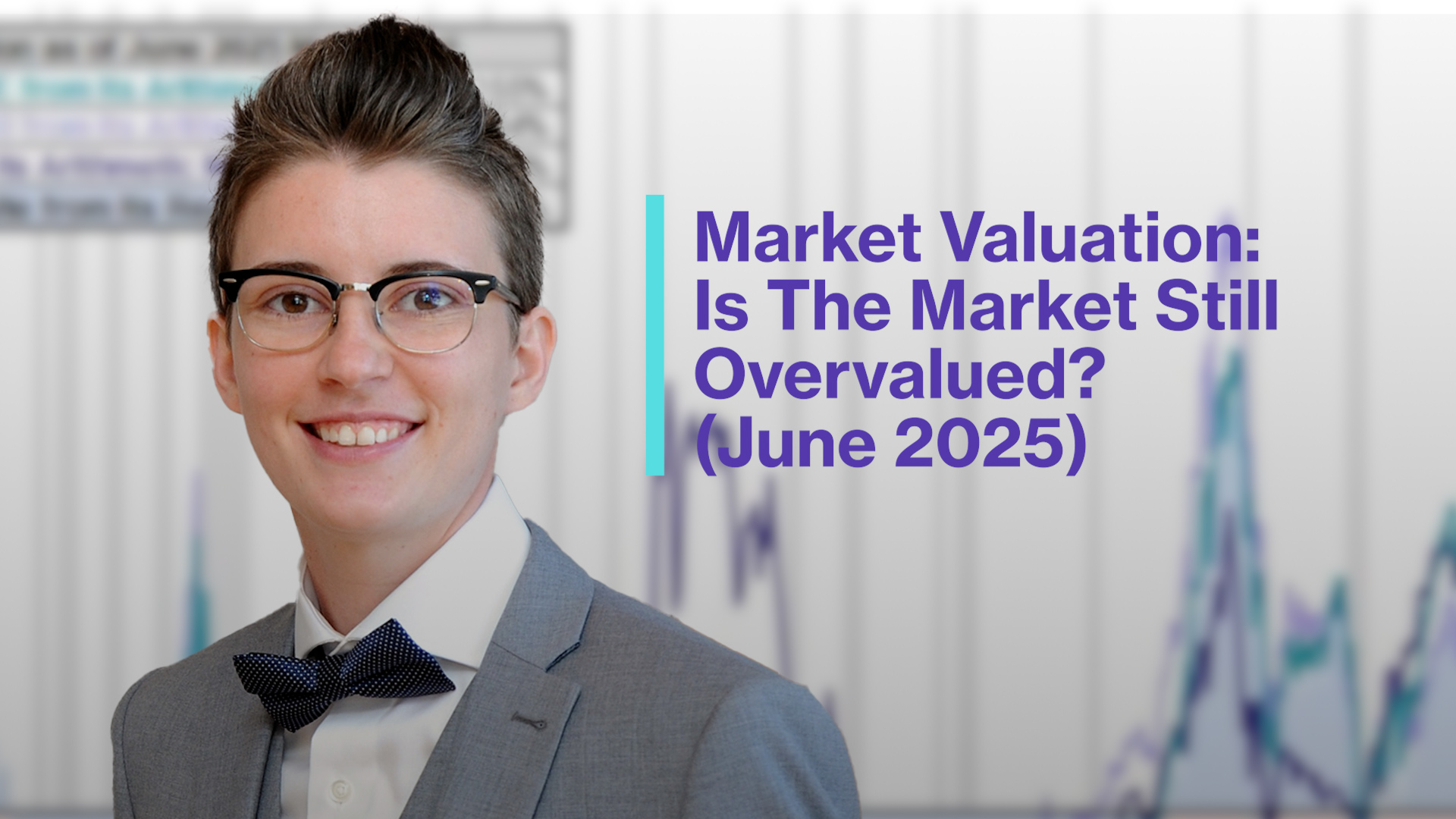
Market valuation indicators are used by investors and analysts to gauge whether markets are overvalued, undervalued, or fairly valued relative to historical norms. This video examines four market valuation indicators to assess the current market's valuation with data through June 2025.
Chief executive officers in the US and beyond are becoming accustomed to the policy swings of President Donald Trump and are deciding they can pursue growth ambitions regardless.
Markets continued their strong run last week before pulling back slightly as a flurry of tariff rhetoric hit the wires. It’s important to understand markets are rallying because they assume these tariff threats are more political posturing than lasting economic policy.
Emerging market (EM) countries are often generalized as all the same and driven by commodity prices. The reality can be very different. Here's what you should know about EM stocks now.
With the One Big Beautiful Bill Act (OBBBA) signed into law on July 4, this note briefly discusses some of the implications for energy broadly and the energy infrastructure space.
On Wednesday, Vanguard expanded its fixed income ETF selection with the launch of three new funds.
As 2025 progresses, investors and policymakers are navigating a highly complex economic landscape shaped by three powerful and interrelated forces: evolving trade policy, a cautious U.S. Federal Reserve (Fed), and growing concerns over U.S. fiscal discipline.
We continue to believe we are seeing a rare opportunity in EM local debt, and our conviction has been strengthened by the Trump administration’s trade and economic policies, which suggest continued dollar weakness and relative strength for EM local currencies.
It is easy to invest when markets are rallying, but it can be tough for investors to stay in their seats when markets inevitably decline again.
Every year around this time, we update our Periodic Table of Commodities Returns to reflect the performance of raw materials in the first six months. I’m biased, but few tools do a better job of providing a clear, interactive picture of the commodities landscape than ours.
Geopolitical flare-ups and a “wait-and-see” Federal Reserve stance have created plenty of noise, but markets continue to defy the headlines with a balanced global allocation and improving sentiment indicators.
Our advice to Fed Chairman Powell is to consider both sides of the argument and act to lower inflation over the longer term.
Bond investors worried about rising fiscal deficits are turning to an unusual haven: emerging markets.
The resilient job market has supported stock gains, but Washington policy has been a primary market driver so far this year.
As investors try to determine the policy direction of the Trump administration, there is good reason to believe there will be a lot of back and forth.
There’s a connection between our willingness to let the debt problem fester and investors throwing their money into a wildly overvalued stock market. In both cases, we’ve grown way too comfortable with uncertainty.
ClearBridge Investments believes tariffs remain the key risk to corporate profits in the second half of the year and is less concerned about geopolitical events or the outlook for fiscal and monetary policy.
Uncertainty has not impaired overall economic performance.
Now that we're more than halfway through 2025, let's take a look at the top 10 most-read charts so far for the year.
A full three months since President Trump’s “Liberation Day” tariff announcements sparked panic in financial markets, macro developments have been benign. The passage of the Big Beautiful Bill has brought clarity on the fiscal outlook, but uncertainty on trade negotiations remains. Franklin Templeton Fixed Income CIO Sonal Desai explains what this means for investors going forward.