Though recent data suggests China's re-opening growth has slowed, it's likely temporary. As China's recovery continues, it may have implications for U.S. inflation and rates.
In this article and video, we are going to cover Fidelity National Information Services.
Sticky inflation looks to compel developed markets (DM) central banks to crank policy rates higher – and keep policy tight for longer. The Federal Reserve paused last week but pointed to more hikes on the way.
Sunsetting a core benchmark rate is no small feat.
Join the Delaware Funds by Macquarie® Municipal Fixed Income team for an interactive discussion that will help answer some of the biggest questions on municipal bond investors’ minds.
Open up BlackRock Inc.’s annual report and – in case you didn’t know – the company tells you what it does. “BlackRock provides a broad range of investment management and technology services to institutional and retail clients worldwide,” it states.
With unanimity, the Federal Open Market Committee held the federal funds rate in its current range, but updated projections suggest this rate-hike cycle is not yet over.
Federal Reserve Chair Jerome Powell said policymakers expect interest rates will need to move higher to reduce US growth and contain price pressures, even though they held rates steady at their meeting last week.
Although once considered a niche strategy, secondaries have matured and now represent a vital cog in the private equity ecosystem, according to Franklin Templeton Institute’s Tony Davidow.
Our long-term outlook for commercial real estate investing argues for a flexible, long-term approach to seize opportunities in debt and equity investments across the real estate landscape.
Few of the advisors who will listen to this podcast have had professional careers that spanned a period of rising interest rates. But rates have been rising, and passive allocations to bonds or stocks cannot be counted on to provide the same results they did for the last 40 years.
Given that regime change, my guest today is here to discuss what should be the appropriate allocation to fixed income in a multi-asset portfolio. We will discuss how advisors should think about liquidity in their bond allocations, and to what extent tactical adjustments will be needed.
Federal Reserve Chair Jerome Powell is testifying before Congress this week on the state of the US economy and monetary policy, and there will be some tension.
The real estate market has been challenging, but specific real estate sectors may present opportunities. Data and infrastructure real estate enables technology that is critical for AI, Bitcoin, cloud networking, 5G and e-commerce. Industrial real estate has become crucial for e-commerce distribution and logistics networks. Join Pacer ETFs and VettaFi as Pacer celebrates the 5th anniversary of two popular REIT strategies.
Topics will include:
There was nothing but worrisome news in Wednesday’s economic data releases for the UK. And the implications extend beyond Britain in a multifaceted way.
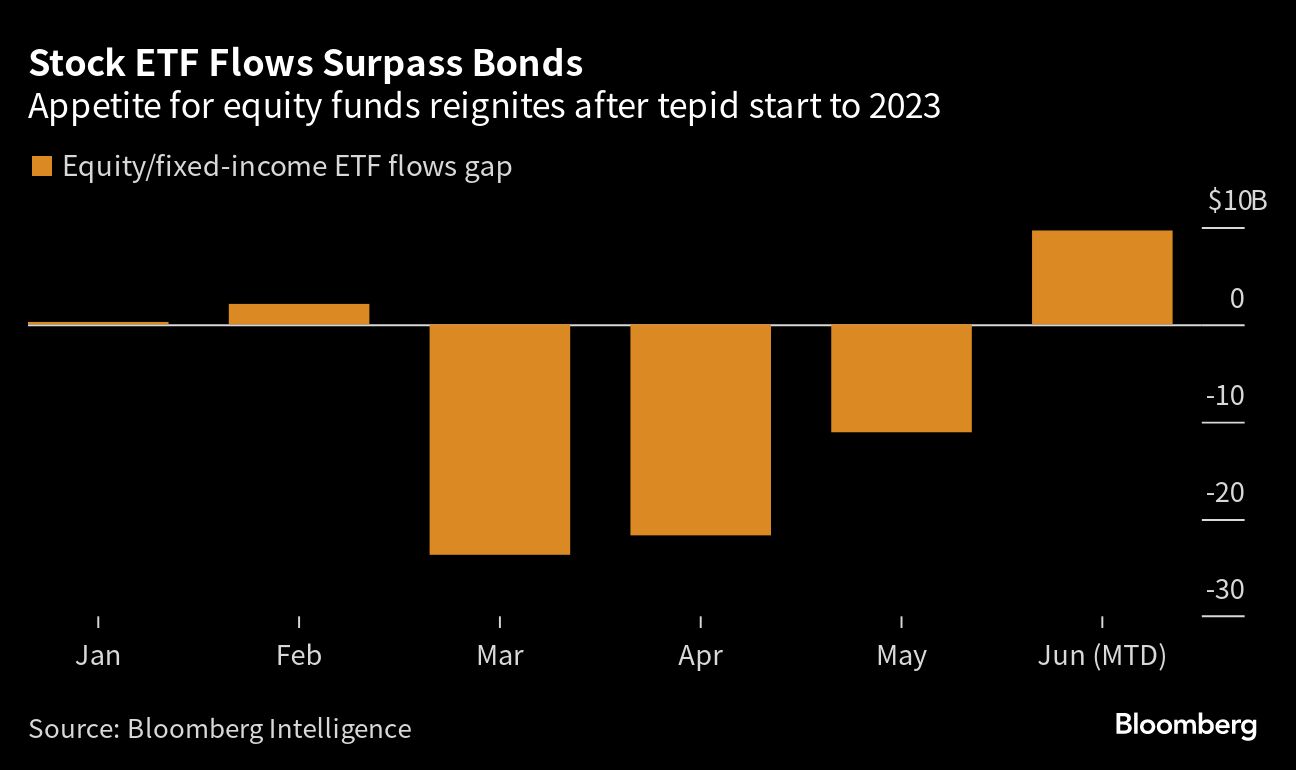
What was billed as the year of fixed income is morphing into a massive game of catch-up for investors trying to capture some of the stock market’s gains.
T. Rowe Price Group Inc., Allspring Global Investments and AllianceBernstein Holding LP are among investors seeking opportunities in longer-dated high-grade corporate bonds, reflecting bets that the peak in interest rates is nearing and a US recession would force policymakers to reverse course.
Quarterly Macro Themes, a quarterly publication from our Macroeconomic and Investment Research Group, spotlights critical and timely areas of research and updates our baseline views on the economy.
Most of the things we expected to happen during the first half of the year in fact did: Inflation eased, U.S. economic growth slowed, the Federal Reserve appears to be near the end of its rate-hike cycle, and the U.S. government debt ceiling standoff was resolved before a potential default.
For this edition of Bull vs. Bear, James Comtois, and Elle Caruso debate the pros and cons of investing in high-yield fixed-income ETFs.
A type of charcoal first used by Amazonian tribes thousands of years ago is becoming a key component of net-zero goals set by Microsoft Corp., JPMorgan Chase & Co., and other blue chip companies eager to offset their carbon emissions.
Opportunities and risk abound in the fixed income space as questions remain about whether or not the Fed will continue to tighten. With the long end of the curve starting to look appealing, but short end yields still being attractive, investors need to unpack how they are approaching the fixed income space. Join iMGP and VettaFi for a webcast that digs into how investors can capitalize on the return of fixed income.
Topics covered will include:
Here are the key elements you need to financially “undress” to weed out the trouble spots in your practice.
As high mortgage rates make potential sellers wary of listing a home and buyers feverishly compete for disappearing inventory, some employers are stepping in to offer employees affordable housing solutions. An offer too good to refuse? It may not be as simple as that.
Hedge funds that deploy a basket of computer algorithms for trading are gaining popularity in China after many investors got burned by human stock pickers.
While there are dozens of variables and decisions that go into transitioning to the RIA model, two of the more meaningful hurdles are registering your RIA and getting a clearing agreement with a custodian.
The potential for a Fed pause presents an opportunity for investors to consider adding duration back into their portfolios.
Sometimes it feels like the economy and markets are on different tracks.
Chief Economist Eugenio J. Alemán discusses current economic conditions.
VettaFi’s Todd Rosenbluth covers several recent developments including iShares’ Bitcoin ETF filing, Amplify’s agreement to acquire ETFMG’s ETFs, and several active ETF launches and filings. Charles Schwab’s D.J. Tierney discusses ETF flows, standout ETFs, and their direct indexing platform. T. Rowe Price’s Tim Coyne highlights the firm's expanding actively managed ETF suite including their approach to fees and the transparent versus semi-transparent structure.
A year ago, the US Consumer Price Index was rising at an almost 9% annual rate. The Federal Reserve was trying to change that trend with tighter policy. But it wasn’t just the Fed. All of us—businesses, consumers, everyone—responded to the pain.
Measuring changes in consumer prices is a messy, imprecise undertaking, one that can result in conflicting data, and yet these data are used by both the public and private sectors to guide important policy decisions.
Doug Drabik discusses fixed-income market conditions and offers insight for bond investors.
Money managers are flocking to extremely precise fixed-income exchange-traded funds as a hawkish central bank and economic uncertainty batter the bond market.
Going into the Fed meeting today it seemed like the consensus was toward a skip, pause, or possibly a full-on stop in raising interest rates going forward. Indeed, there are reasons to be optimistic about inflation coming down despite currently sticky “core numbers.”
State and local tax revenues sank in April, yet we believe most governments have strong fiscal positions, with ample reserves and budget flexibility to manage the decline.
Macroeconomic uncertainty has sparked questions over the durability of the traditional 60/40 portfolio—highlighting why investors may want to add alternative investments to the mix.
It’s been a challenging year for many managed futures strategies but they continue to offer long-term potential for portfolios. The benefits of trend-following strategies are numerous and worth consideration for inclusion in any alternative sleeve.
A diligent worker who invests for retirement will effectively lose the value of the dollars they’ve saved if they don’t also make an investment in their health.
Artificial intelligence tools have demonstrated the capability to shake up nearly any industry. That includes financial advising.
Interest-rate volatility on shorter-duration assets is running near historical highs, even as rate changes begin to level off.
Municipal bonds posted negative total returns in May amid continuing heightened volatility. Interest rates rose throughout most of the month as banking concerns abated, economic data exceeded expectations, comments from the Federal Reserve turned more hawkish, and the debt ceiling negotiations remained contentious to the very end.
Advisors parking cash in short-term T-Bills yielding are missing out on potential capital appreciation. The current fixed income market provides an opportunity not seen since the financial crisis to earn total return from longer-dated, high-duration bonds.
In 2022, both fixed income and equities stumbled, creating greater focus on alternatives. As market headwinds continue to remain strong, investors are increasingly turning to alternative strategies to increase diversification, address higher rates, and mitigate risk. Join the experts at Swan Global and VettaFi for a webcast that digs into where alternatives can fit in a portfolio.
Interest rate volatility and inflationary pressures have continued to challenge income seeking investors. Rates may have topped out and where we’ll go from here remains to be seen. That’s why it’s important to understand where income opportunities may lie in our current markets while planning for the future. In this upcoming webcast you’ll hear from a fellow advisor who’s navigating these challenges for his clients, as well as from a fund manager that’ll outline factors to consider when evaluating income-focused investments.We invite you to join the experts at NEOS Investments and VettaFi as they highlight tax-efficient monthly income strategies across core portfolio exposures that may offer a compelling addition or alternative to current client allocations.
With interest rates elevated and the number of UK mortgage deals shrinking on a daily basis, many borrowers are seeking to shore up their finances by paying down their home loans early. However, just because you can doesn’t mean you should.
Ken Griffin, whose hedge fund churned out a record $16 billion for clients last year, is increasing his focus on credit trading as he braces for a potential US recession.
In this article, we will compare the three largest U.S. real estate ETFs by market capitalization: Vanguard Real Estate ETF (VNQ), Schwab US REIT ETF (SCHH), and Real Estate Select Sector SPDR Fund (XLRE).
With their ability to act as an inflation hedge, diversified, and return enhancer, commodities should be considered an important portfolio allocation over the long term.
Investor activism in Japanese companies has been the subject of a fair amount of recent conjecture. Specifically, foreign investors have been concerned about the relative prevalence of minority interest, the ghosts of fading Keiretsus on Japanese companies’ financial statements.