For the first time in roughly fifteen years, interest rates in the United States are about right. In economics, we call it the “neutral” or “natural” rate.
On this episode of the “ETF of the Week” podcast, Tom Lydon discussed the SPDR® Gold Shares (GLD) with Chuck Jaffe of “Money Life.” The pair talked about several topics regarding the fund to give investors a deeper understanding of the ETF overall.
The change in tone from the Fed Chairman regarding inflation suggests that rates may have peaked. This month, we're highlighting the positive performance of the markets, with the S&P 500 approaching levels last seen in July. We're also experiencing an improvement in consumer confidence as things remain relatively healthy despite housing costs.
Passive investing means buy and hold, and that’s not what I do for my own portfolio or recommend to clients. Here are eight ways I’m an active investor.
Last year was a record one for personal income taxes in the US and close to a record for taxes overall.
Investors are facing a pivotal week as a key measure of inflation that hits Tuesday and the Federal Reserve’s interest-rate decision on Wednesday are expected to set the tone for the stock market and economy heading into 2024.
Well, the strength of the US economy surprised everyone once again on Friday. We learned that the unemployment rate fell to 3.7% in November, average hourly earnings grew by 0.4%, and 199,000 more jobs were added when economists were expecting around 185,000.
It’s that time of the year where Wall Street polishes up their crystal balls and pin targets on the S&P index for the upcoming year. As is often the case, while Wall Street is always optimistic, the forecasts prove pretty wrong.
A review of recent US inflation data, the Recession Risk Dashboard, and thoughts on if we’ve reached the peak in the fed funds rate. Join us for this conversation with Jeff Schulze of ClearBridge Investments.
It’s been a very good year for U.S. high yield. In fact, BondBloxx Investment Management has noted that riskier fixed income assets have outperformed U.S. Treasuries.
We see potential opportunity in municipal bonds in 2024, although there may be more volatility.
Airline consolidation is not only relatively common but necessary for growth and competitiveness, and the recent announcement of Alaska Airlines’ planned acquisition of Hawaiian Airlines is a prime example of this trend.
The Franklin Templeton Fixed Income team believes that sustainable investing will be a dominant investment trend in the coming years, with structural tailwinds that could help improve financial returns.
The Market Outlook Symposium is coming on December 14. The latest symposium from VettaFi will offer investors a deep and incisive look at how to position for 2024 and beyond. In today’s unusual market environment, this is a critical topic.
Funds will begin paying out their 2023 distributions this month which could lead to a tax bill for your clients. While capital gains distributions will likely be lower this year than in recent years, interest income is expected to be higher.
The financial markets, investor opinions, and world events have been all over the place – so bear with me this morning as I am going all over the place with a variety of year-to-date observations and comments.
Stephen Dover, Head of Franklin Templeton Institute, recently sat down with Franklin Templeton Fixed Income Portfolio Manager Josh Lohmeier and Western Asset Portfolio Manager Mark Lindbloom to discuss the fixed income landscape—and why they believe 2024 will be a good year for fixed income investors.
It’s possible that a 2024 recession could be avoided, but we see recessions risks as remaining elevated in most developed markets. We believe there is limited upside for equities amid expensive valuations and recession concerns. Government bond valuations, however, look attractive in the U.S., UK, Canada, Germany and Australia.
When it comes to commercial real estate, a lot of attention is obviously paid to offices. But it's not the only sector facing strains.
Against the odds, the Federal Reserve’s effort to guide the US economy to a soft landing — reducing inflation without causing a recession — seems to be working.
It should be no surprise that Bitcoin sold for over $44,000 this week, more than double its March 13 price. Going back to 2014, it has taken the cryptocurrency an average of nine months and 21 days to double; the milestone came 28 days early this time.
Stock markets will suffer in the first quarter of 2024 as a rally in bonds would signal sputtering economic growth, according to Bank of America Corp.’s Michael Hartnett.
Bond traders who powered a ferocious rally in the $26 trillion US Treasury market are about to find out if they’ve gotten ahead of themselves.
The capital markets are already pricing in rate cuts ahead of 2024, causing yields to fall. One way to continue supplementing income amid a potential drop in yields is to diversify income using a pair of active exchange-traded funds.
Although some volatility may continue, we believe interest rates have peaked. We expect lower Treasury yields and positive returns for investors in 2024.
Our portfolio managers field some tough questions on Matthews Asia Dividend’s performance, its positioning and what they believe are its unique strengths for investors.
Early last year, critics — and there were many — said the Fed was woefully behind the curve on inflation, and that the only way it could win the battle was to push the economy into a damaging recession by raising interest rates very high, very fast.
Would you gamble your life savings on a few hands of blackjack? Probably not.
The sizzling global bond rally stalled on Thursday ahead of a key US jobs report, with a slump in Japanese debt adding to the nerves of Treasury traders already fretting that yields had dropped too far.
Stock investors are turning to roughed-up corners of the market from small caps to value shares as they seek out bargains with the S&P 500 Index riding a five-week winning streak and soaring almost 9% since the start of November.
Insurance is making national headlines in 2023 as major providers retreat from writing new policies in large parts of the country and renewal premium prices skyrocket.
Markets improved last month across the board as interest rates pulled back on signs of slowing growth. U.S. markets were up by high-single to low-double digits, while international markets were also up by high-single digits.
New home prices are much lower than a year ago. The average price of a new home sold in October was 10.4% lower, while the median price was down 17.6%.
The federal deficit is already high at 6% of GDP. But if a recession hits – as Jeffrey Gundlach fears will happen next year – unemployment will rise, and the deficit and the interest the government pays on it will cripple the economy.
“BUY BTC.” The logo stamped on this week’s leaked version of the Grand Theft Auto VI trailer, depicting a faux glamorous world of speedboats, supercars and “shoot-em-ups,” was well timed.
If Mike Tyson were speaking to a group of investors, what he may have been saying is that everyone has a financial plan until life throws a “punch.”
Our forecast for the federal funds rate has the Federal Reserve (Fed) starting to cut rates in July 2024, with a second rate cut before the end of 2024.
The global economy is still overwhelmingly powered by fossil fuels, with more than 80% of primary energy sourced from coal, oil, and gas, as of 2021.
Money markets paid nothing. The dividend yield for the S&P 500 Index was 2%, and the 10-Year Treasury yield was stuck between 2%-3%.
The Canadian economy is buckling under the weight of higher interest rates, household debt and immigration.
The long-standing economic consensus that interest rates would remain low indefinitely, making debt cost-free, is no longer tenable. Even if inflation declines, soaring debt levels, deglobalization, and populist pressures will keep rates higher for the next decade than they were in the decade following the 2008 financial crisis.
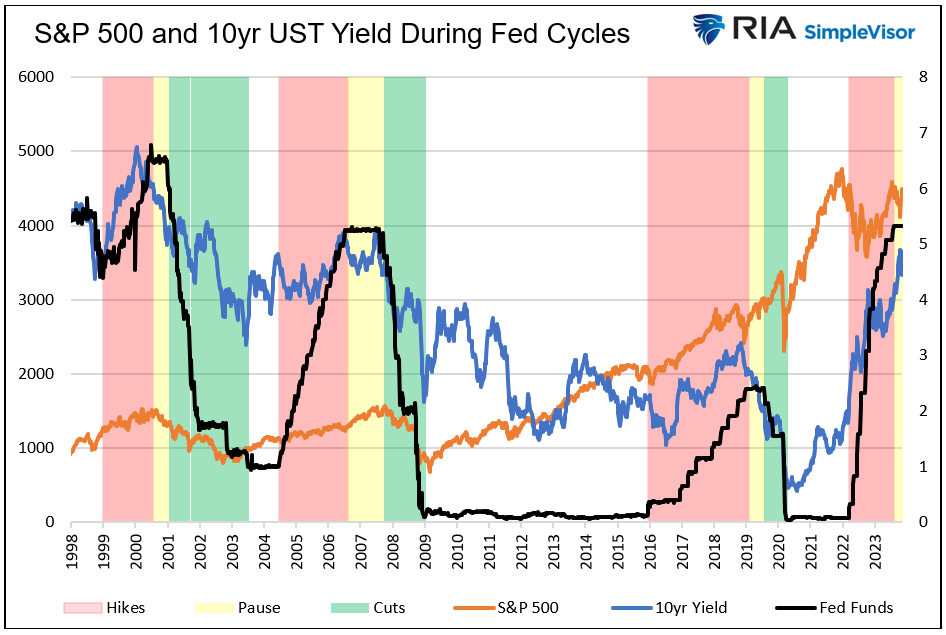
How might stocks and bonds perform during the pause and eventually when the Fed cuts rates?
Big central banks are going to keep shrinking their balance sheets next year, pulling money out of the financial system, even if the fight against inflation looks to be won and interest rate cuts begin.
Our outlook for 2024 is for a gradual U-shaped recovery composed of seemingly chaotic movements in economic data with turning points in policy rates and earnings growth.
Market rents in the US are, depending on which measure you look at, either rising slowly or falling outright. Home purchase prices, after a slight dip last year, are climbing again.
One of the big winners from the sudden furious rally in the US bond market: Bill Gross.
Don’t look to US stocks for big gains next year — or for at least the next decade. That’s the bold take from Stifel Nicolaus & Co.’s Barry Bannister, one of a few Wall Street strategists who predicted the rally in the first half of 2023.
December’s whipsaw opening shows investors may be concerned November’s epic rallies went too far, too fast in anticipating a near-perfect soft landing for the economy.
November was kind to fixed income investors as bonds posted their best month of 2023. High yield corporate debt participated in that rally as highlighted by the fact that the largest junk bond exchange traded fund is higher by nearly 4.3% over the past month.
For much of 2023, the market has tried to anticipate a Fed pivot – only to be wrongfooted several times. However, sharply higher interest rates, cooling inflation pressures and moderating wages have the market convinced that the Fed’s current tightening cycle is over.