The wildfires may affect some municipal bond issuers in the devastated areas, but the impact to other California bonds or to the broader muni market is likely limited.
Donald Trump and Republicans support sweeping changes that could affect the economy, markets and investors. But narrow margins in Congress could complicate that agenda.
Ten years ago, Research Affiliates launched the Asset Allocation Interactive online tool, making our CMEs freely available to the public. With one full cycle complete, we can see what has worked well and where we can improve.
Managing Director, Washington Policy Analyst Ed Mills looks at how several of the top market-relevant Washington DC issues could play out in 2025.
On this episode of “ETF of the Week” podcast, VettaFi’s Head of Research Todd Rosenbluth joined Chuck Jaffe of Money Life to talk about the Fidelity Blue Chip Growth ETF (FBCG).
The aerospace and defense industry plays a pivotal role in both national security and the stock market. With U.S. defense spending leading the world, the largest contractors are well-positioned for growth amid rising global tensions.
Many people these days are on heightened alert for bubbles, and I’m often asked whether there’s a bubble surrounding the Standard & Poor’s 500 and the handful of stocks that have been leading it.
In a recent discussion on TheRealInvestmentShow, Bob Farrell and his 10 investment rules were discussed, which elicited several email questions asking, “Who is Bob Farrell, and where are these rules?”.
The most important issue regarding what lies ahead from an economic perspective is that the economy’s fundamentals remain solid with very few misalignments that could derail it, at least for now.
2024 was about as good as it gets in the equity markets – with the BGEP up 31% and the broader market as a whole posting double digit gains. Underneath the surface, we believe that there are three main drivers of the year’s solid returns. We discuss them below in our market review and outlook.
Stocks rallied in 2024, delivering a second consecutive year of gains exceeding 20%, as investors embraced cooling inflation, falling interest rates and the prospect of lower corporate taxes under a second Trump administration.
With 2024 behind us, let's revisit the top 10 most-read charts of the year.
The AI market has evolved significantly in the past two years, shifting from a heavy reliance on mega-cap and semiconductor dominance to a more diverse set of beneficiaries.
The US banking system’s reserves, a key factor in the Federal Reserve’s decision to keep shrinking its balance sheet, tumbled below $3 trillion to the lowest since October 2020.
December's market activity highlights the need for caution in the near term.
We prefer equities over fixed income, in particular U.S. equities as the outlook for the U.S. economy is solid and promising.
The Federal Reserve’s recent meeting signaled a notable shift in its monetary policy approach.
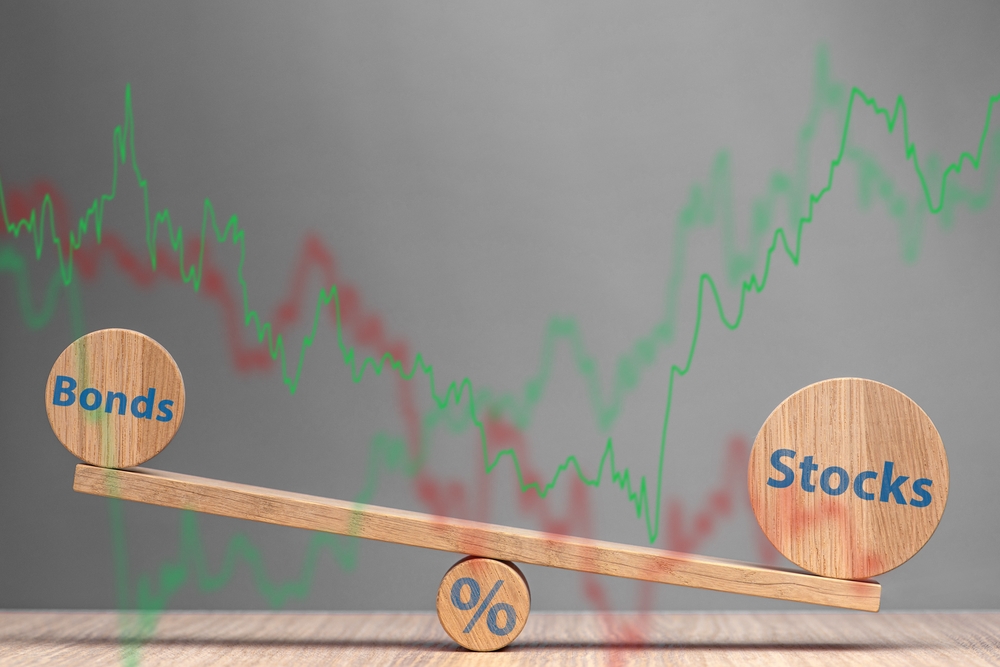
As investors continue to step out of cash and potentially rebalance out of equities following their strong performance, we expect bonds to play a larger role in diversified portfolios next year.
CAPE, or the cyclically adjusted price-to-earnings ratio, introduced in 1988 by economists John Campbell and Robert Shiller, is arguably the best-known indicator of broad market valuation. And CAPE is now at an almost (though not quite) all-time high level, according to data from Robert Shiller's website.
Central banks’ climbdown from the post-pandemic inflation peaks commenced amid both optimism and trepidation.
Surprises most often are hiding in plain sight. Being aware and prepared with a plan for the unexpected are keys to achieving goals.
Investors anticipating another calm year in 2025 should be on guard for more shocks like the one seen in August as uncertainty around Donald Trump’s tax and tariff policies threaten to roil markets.
The clouds hanging over Boeing’s operations finally appear to be clearing.
The U.S. economy and stock market are entering 2025 from a position of strength, but risks of volatility—especially pertaining to policy—are much higher compared to last year.
On the latest edition of Market Week in Review, Investment Strategist BeiChen Lin discussed the ouster of France’s prime minister and the potential market implications. He also provided an update on the health of the U.S. economy.
We believe municipal bonds currently offer a compelling balance of risk and reward for investors in higher tax brackets.
Just a few short years (months?) ago, few would have believed it possible. But it happened: Bitcoin has traded above $100,000 for the first time ever.
Investment themes are highly dynamic, shouldn’t your investment process be too? Learn about a systematic framework to help with identifying and investing across the themes driving markets.
Historical trends are being permanently broken in real time as mega forces, like the rise of artificial intelligence (AI), transform economies.
How to unlock value in a complex market landscape.
The bond market is caught between the Federal Reserve's plans to cut interest rates and the risk of higher inflation and federal debt levels.
Quite a few observers have described the dramatic fall of the Barnier government in France not just as a political crisis but also an economic and financial crisis.
While the economy helped President Trump win a second term, it also created expectations that could prove difficult to meet.
At the 2018 Berkshire Annual Meeting, Buffett noted that “multiple times in my life, people have felt the country was more divided than ever.
International markets are expected to clear the hurdles of uncertain trade policy, tighter fiscal policy and slower than average economic growth to support solid overall returns.
The U.S. economy faces growing risks, from a surging Federal deficit to geopolitical uncertainty. Investors must assess how these factors could ignite market instability and take proactive steps to safeguard their portfolios.
For most of the last fifty years, fixed income investing has been characterized by owning some combination of Municipals, Corporates, Treasuries and Agency Mortgage-Backed Securities.
There has been a lot of talk about (in)efficiencies in government spending, both before and since the election. Much of the conversation has been driven by Elon Musk, who will co-head the Department of Government Efficiency (DOGE, not an actual government agency). Musk has boasted he could find $2 trillion to cut from the federal budget.
Rick Raczkowski, PM, Relative Return Team, Loomis, Sayles & Company, discussed how the team views fixed income investing looking ahead.
The inverse correlation between bonds and stocks has returned, broadening potential for risk-adjusted returns in multi-asset portfolios.
The current global expansion has been characterized as one of US exceptionalism. Despite many developed market economies outperforming low expectations, the robustness of the US expansion has stood out. We believe this can continue based on differences between the US and European economies.
Change is the sum of fundamental trends, the gradual elimination of accumulated extremes, and the random arrival of new shocks.
Market prognosticators and the financial media will often point to a particular piece of anecdotal evidence as bullish or bearish. Quite often, the evidence is intuitively appealing as a contrarian indicator.
With President-elect Donald Trump set to assume office in January, the U.S. military and cybersecurity sectors could experience sweeping changes, creating opportunities for investors who recognize the long-term growth potential in defense and technology.
Republicans won the White House and Senate in the 2024 U.S. election, while vote counting continues for the House of Representatives. Here's a look at the policies that could affect markets.
Here’s our outlook on what to expect and how investors might navigate this new phase.
Even with Republicans poised to control the White House, the Senate, and the House of Representatives, slim congressional majorities could hinder the president’s efforts to enact his agenda.
Maslow’s hierarchy of needs was a groundbreaking concept when it appeared in 1943. American psychologist Abraham Maslow argued that certain basic needs—food, water, shelter, etc.—must be met before a person can move on to higher levels of self-worth and fulfillment.
At GMO we have spent the last four decades taking a long-horizon approach to equity investing. Over time, a unique and reliable group of standout companies emerged from our research.
Bill Bernstein digs into a book that follows the complicated history of Elon Musk's chaotic acquisition of Twitter and its subsequent transformation into X.