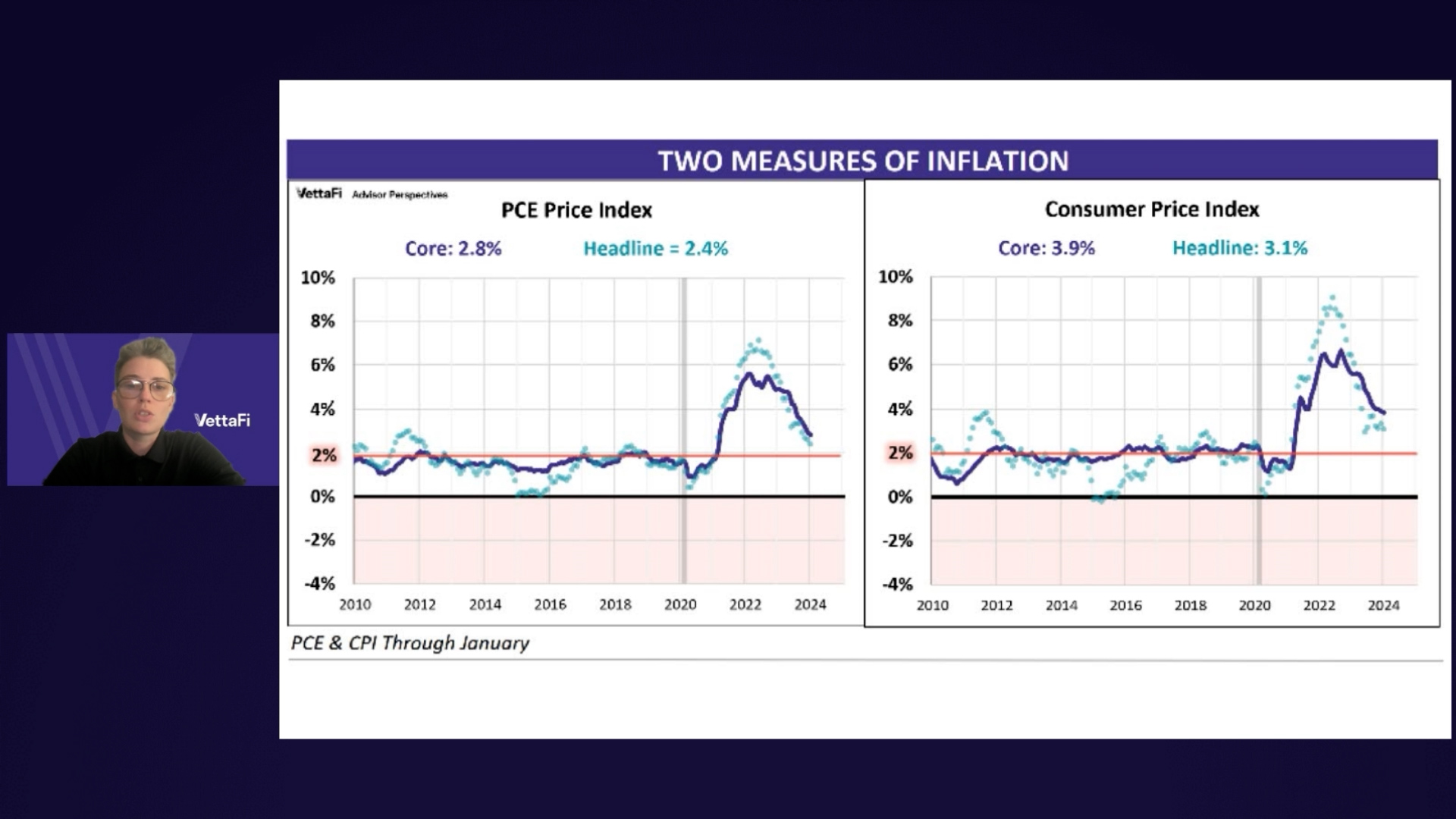
The BEA's core Personal Consumption Expenditures (PCE) Price Index for January shows that core inflation continues to be above the Federal Reserve's 2% long-term target at 2.8%. The January core Consumer Price Index (CPI) release was higher, at 3.8%. The Fed is on record as using core PCE data as its primary inflation gauge. For a closer look at each of those releases, check out our latest Consumer Price Index and PCE Price Index releases.
Ever since the Federal Reserve began its policy-tightening campaign, Jerome Powell has been happy to ignore one form of inflation: Rising asset prices.
The Fed is talking about cutting rates and reducing QT. The only rationale for it in such an environment is a concern with liquidity problems.
Treasuries held modest gains ahead of remarks from Federal Reserve Chair Jerome Powell and key labor-market data, which are set to test bond investors’ conviction about interest-rate cuts in the US.
Rodney Comegys, Global Head of Vanguard Equity Index Group, offers actionable insights to investors on how to select active strategies that can help them achieve investment success.
Investor sentiment and stock market valuations are getting increasingly stretched as indexes trek higher, but solid underlying breadth has been a positive offset for now.
This PIMCO Perspectives assesses how the term premium’s 40-year downturn could start to reverse.
The economy continues to hum along (Atlanta Fed 1Q24 GDP estimate: +3.0%), albeit shifting down a notch from the pace seen in the final quarters of last year.
The shift from a regime of secular stagnation to one of reflation is contributing to both a broadening of global earnings growth and significantly higher dispersion in company results and performance.
A curious thing has happened in the US market discourse: In the absence of major concerns about jobs and growth, commentators have started to worry that the economy is too good to keep inflation contained.
The sharp rally in US stocks this year has left strategists at JPMorgan Chase & Co. and Goldman Sachs Group Inc. divided about whether a market bubble is forming.
US households are now paying roughly as much interest on other kinds of debt, from credit cards to student loans, as they are on their mortgages, according to the latest numbers from the Bureau of Economic Analysis.
European nations still have a long energy transition ahead.
Personal income increased more than expected in January, up 1.0% (or $233.7 billion). The increase in January closely matches what happened in January of 2023 when it increased by 0.95% (or $213 billion).
Buoyed by the artificial-intelligence boom, the US stock market is breaking records with no apparent end in sight. But given the significant challenges and uncertainties facing the American economy regardless of who occupies the White House in 2025, there is little reason to believe that the current rally can last.
Why are we prone to irrational behavior as investors? Why do we too often sell when we should buy and buy when we should sell? Market history is replete with examples of this behavioral dynamic.
With the US economy booming, the job market growing and inflation retreating, the consensus is near-unanimous: Bidenomics has been vindicated.
The apparent disconnect between the state of the US economy and voters’ perceptions of it has puzzled economists for months. Unemployment is low, inflation has come way down and real wages are no longer lagging behind.
Traders surprised by this year’s painful rise in bond yields are still looking to snap up US debt given their ongoing assumption the US economy will eventually slow in 2024.
OPEC+ strategies and geopolitical tensions could roil markets.
Ed Perks, Chief Investment Officer of Franklin Income Investors, explores the impact of these changes on the fixed income and equity markets and offers insights regarding opportunities in different asset classes.
Equity investors didn't mind the extra day this February as both domestic large-cap stocks and small-to-mid-cap stocks saw steady gains through the month, bringing both groups into positive territory year-to-date, though the latter continues to lag.
The markets these days have been especially sensitive to economic data, as any indication of weakness could mean rate cuts may finally be close. That, in effect, should also push the S&P 500 to even higher heights.
Today, we have a different kind of letter. I’ve been in California for some rather innovative and hopefully life/health span-extending medical treatment.
Bitcoin and gold were both top of mind at this past week’s 2024 Investment U Conference in Ojai, California, which I had the privilege of presenting at.
Pacific Investment Management Co. is warning that US fiscal profligacy threatens to drag the Treasury market back to 1980s, a time when bond vigilantes demanded far higher compensation to own longer-dated bonds.
This week bitcoin prices reached over $60,000 — the highest level since November 2021. Since the launch of spot bitcoin ETFs in early January, demand continues to pile on. So far the nine new spot ETFs (ex-GBTC) have seen over $7 billion in net inflows.
Recently, retail investors have started chasing small-cap stocks in hopes of both a rate-cutting cycle by the Federal Reserve and avoiding a recession.
It’s right for economic data to influence the Federal Reserve’s policy approach. Yet, there is an important distinction between being informed by the numbers and being held hostage by them — particularly for an institution whose tools operate on the economy with a lag.
Federal Reserve Bank of New York President John Williams said he doesn’t see a need for officials to tighten policy further and reiterated that he expects the central bank to cut rates later this year.
The 2024 survey found US workers are prioritizing higher compensation and the ability to save more for retirement. At the same time, employers’ perceptions of what workers are seeking has diverged. In this piece, our Jacque Reardon shares findings from the survey and potential implications for employers.
The world is still in the shadow of the Covid-19 pandemic, with inflation finally cooling and fiscal stimulus effects dwindling. As the Fed considers rate cuts, and geopolitical tensions impact commodities, there are unique opportunities available to investors.
Adding real assets to a stock and bond portfolio can help boost returns and smooth volatility when inflation runs above 2%.
Despite conventional wisdom, political uncertainty doesn’t necessarily pose acute risks to the healthcare sector.
Dina Ting, Head of Global Index Portfolio Management for Franklin Templeton Exchange-Traded Funds, delves into these positive developments and sheds light on Japan’s expanding economic prospects.
In this article, Russ Koesterich discusses the reason behind the recent resiliency of stocks, despite rising rates.
A retreating dollar is exactly what gold needed to put the precious metal back into the investment spotlight. Hotter-than-expected inflation in January pushed the yellow metal below the $2,000 mark. But it has been rising again with geopolitical factors providing tailwinds along with a weaker greenback.
The article explores potential parallels between 1968 and 2024, specifically in the context of the stock market and economic trends. It delves into the concept of secular trends, emphasizing the importance of considering inflation-adjusted stock prices to comprehend the potential impact on portfolios.
In the early months of the COVID-19 pandemic, many people with the means to do so left New York City and New York state. With state finances in particular highly dependent on high earners’ income taxes, this was a worrying development.
Every man, woman, and child on planet Earth must spend about $45 on Apple products yearly to justify its valuation.
What was supposed to be the darling trade of 2024 has unraveled, thanks to the Federal Reserve upending predictions over how fast it would lower interest rates.
We see Japan stocks climbing higher on robust earnings, corporate reforms and a Bank of Japan likely worried about returning to a chronic deflationary mindset.
Consumers are less willing to spend freely.
The second-largest stock market has captured the interest of investors, supported by stronger, more broad-based earnings, and incentivized by Japan's fiscal and monetary policies.
Investors in US Treasury debt are bracing for another auction, after sales of two- and five-year notes drew only middling demand — despite yields near the highest levels of the year.
BlackRock Inc., which capitalized on a decade-long boom in index investing, said investors should rely more heavily on actively managed strategies.
Every day this week, investors will get data on the economy. New home sales today, then capital investment, GDP, consumer incomes and spending, manufacturing, and auto sales are on the list. All of this will feed into the outlook for what the Federal Reserve might do with interest rates this year.
Four years ago this week (2/19 to be exact) the S&P 500 climbed to an all-time high of 3,386 before plunging over -34% as the world economy shutdown due to the pandemic.
Investors have been basking in the sunlight of a year-end market rally in 2023 that appears to be continuing in 2024 after a slow start to January.
Debt levels will likely continue to rise absent policy changes, and the yield curve is likely to steepen.