Search Results
Results 4,601–4,650
of 6,535 found.
Does Socially Responsible Investing Work? And How to Do It
by Adam Jared Apt,
Since the 1990s, there has been a movement—a very, very small movement, and mostly foreign—to produce the data needed to evaluate the social responsibility of corporations, by integrating measures of their social responsibility into financial reporting.
Understanding Factor-Based Investing: An Overview
by Envestnet,
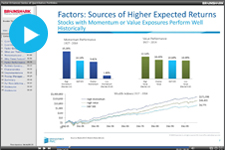
Increasingly growing in popularity, factor-enhanced investing combines the benefits of index-based investments with active exposure to key “factors” that strive to improve risk-adjusted returns compared with traditional market cap-weighted indexes. In the first of this presentation series, Brandon Thomas, Chief Investment Officer at Envestnet | PMC, explains the markets, factors, and how factor-based strategies work.
Speculative Extremes and Historically-Informed Optimism
by John Hussman of Hussman Funds,
There’s a field in one of our data sets that rarely sees much play, being driven primarily by only the most extreme combination of overvaluation, overbullish sentiment, and overbought conditions we’ve identified across history. It’s one of a variety of such syndromes we track, and I’ve simply labeled it “Bubble,” because with a single exception, this extreme variant has only emerged just before the worst market collapses in the past century.
The Perils of Populism
by Carl Tannenbaum of Northern Trust,
Populism is not new, and its current incarnation is certainly not its most extreme expression. Wikipedia describes populism as “a political position which holds that the virtuous citizens are being mistreated by a small circle of elites...the elites are depicted as trampling in illegitimate fashion upon the rights, values and voice of the people.”
ECRI Weekly Leading Index: WLI Up 1.1, Growth Index Highest Since 2013
Today's release of the publicly available data from ECRI (Economic Cycle Research Institute) puts its Weekly Leading Index (WLI) at 138.1, up 1.1 from the previous week. Year-over-year the four-week moving average of the indicator is now at 3.00%, up from 2.53% the previous week. The company's Weekly Leading Index annualized growth indicator (WLIg) is at 7.5, up from last week, its highest since February 2013.
What Will Happen To the Stock Market When Interest Rates Rise? Part 1
by Chuck Carnevale of F.A.S.T. Graphs,
Interest rates have been in a freefall for the better part of the past two decades. Moreover, the yield on the 10-year US Treasury, which is the flagship interest rate benchmark, has mostly been below 2% since the beginning of 2012. The 10-year Treasury note did reach 3% by the end of 2013 but has promptly fallen ever since to its current level of 1.59 percent.
View From the Bottom: Reconciling Managed Fund and Allocated Strategies
by David Kleinberg of Universal Orbit,
In dominant ‘top-down, bottom-up’ approaches, portfolio strategies often meet at eclectic intersections: points joining benchmark indexes, structural nomenclature assignments and company-specific business segment operations. The structural inefficiencies embedded within performance benchmarks at these junctures result in measurable tiering effects on peer group analytics and, subsequently, valuation.
ECRI Weekly Leading Index: WLI Up 0.3
Today's release of the publicly available data from ECRI (Economic Cycle Research Institute) puts its Weekly Leading Index (WLI) at 137.0, up 0.3 from the previous week. Year-over-year the four-week moving average of the indicator is now at 2.54%, up from 2.12% the previous week. The company's Weekly Leading Index annualized growth indicator (WLIg) is at 6.9, up from last week.
Weeks Where Decades Happen
John Hathaway, manager of the Tocqueville Gold Fund (TGLDX) writes in his latest investor letter that "the precious metals markets have clearly turned the corner, becoming flat-out bullish following the extensive and painful correction from August 2011 to year-end 2015. Despite the impressive year-to-date advance, we believe this cycle is still in its infancy, and that it promises to be extremely powerful."
Mid Year Market Commentary
Here at the mid-point of 2016 it is worth noting the remarkable turn of events, both inside and outside of the financial world in which we, as professionals, occupy. The last six months have been “bookended” by great (more or less) market tumult: first with plummeting energy prices and confidence in Chinese markets in the first quarter calling into question the direction of US and Global economies, and second, by the stunning vote of British citizens to divorce themselves from the union they’ve shared with the 27 other members of the European Union for the last 40 years.
Global Macro Shifts: Mapping the Opportunities
Perhaps the most important step that emerging markets have taken to reduce their vulnerability to financial crises is the remarkable deepening of domestic financial markets over the past decade. In many countries, the development of a reliable domestic investor base has benefited from the rise of a broad middle class.
How Fidelity is Positioning Its Index Fund Offerings
by Robert Huebscher,
Two recent announcements from Fidelity Investments, well-known for its actively managed mutual funds, show that it intends to strengthen its competitive positioning and grow its market share in the index fund business. I spoke with Colby Penzone, the senior vice president for Fidelity’s Investment Products Group, about those announcements.
Advisors’ Views on Emerging Markets Investing
by Team of Calamos Investments,
To financial advisors, exposure to emerging markets is a means of gaining essential diversification for clients’ portfolios. At a time when growth is muted in the U.S. and elsewhere, emerging markets have the potential to drive returns, further helping clients achieve their investment objectives.
But committing to emerging markets hasn’t been easy, on either advisors or their clients.
Has the Brexit Sell-Off Created an Entry Point?
by Matt Peden of Invesco,
In the lead-up to the referendum on the UK’s continued membership in the European Union (EU), certain British bookmakers were offering strong odds on bets the UK would opt to exit, anticipating an approximate 25% probability of a leave win. At the same time, both sides were running neck-and-neck in the polls, rationally implying around a 50% chance of a leave vote result. This is an obvious example of a mispriced bet.
Race to the Bottom: Injuring the Real Economy with Paper "Wealth"
by John Hussman of Hussman Funds,
The global economic outlook has experienced a downward shock in recent weeks, largely as a result of the “Brexit” referendum where British citizens voted to exit the European Union, coupled with deterioration in China that has led it to accelerate the depreciation of its currency. That combined deterioration, coupled with expectations of further central bank easing, has resulted in a plunge in global interest rates, with $20 trillion of government debt (primarily in Japan and Europe) now sporting negative yields. The plunge in yields has also affected U.S. Treasury securities, where the 10-year Treasury bond yield dropped as low as 1.32% last week. This advance in asset prices isn’t a reflection of economic health. To the contrary, it is a yield-seeking race to the bottom resulting from a downward shock to the global economy.
Weighing the Week Ahead: Will Earnings Expectations Sustain the Rally in Stocks?
This week’s calendar includes a pretty normal schedule, but not the most important economic reports. There will be an abundance of FedSpeak, with questions about last Friday’s employment data. Despite this, the real story will be the start of earnings season. Expectations are pretty low. Statements about the outlook are always important, but that is especially true right now. The financial media will be asking: Can the profit outlook sustain the rally in stocks?
ECRI Weekly Leading Index: WLI Up 0.4
Today's release of the publicly available data from ECRI (Economic Cycle Research Institute) puts its Weekly Leading Index (WLI) at 136.7, up 0.4 from the previous week. Year-over-year the four-week moving average of the indicator is now at 2.12%, up from 2.10% the previous week. The company's Weekly Leading Index annualized growth indicator (WLIg) is at 6.8, down from last week.
Recession Probability Models - July 2016
by Ted Kavadas of RevSD,
There are a variety of economic models that are supposed to predict the probabilities of recession.
While I don’t agree with the methodologies employed or probabilities of impending economic weakness as depicted by the following two models, I think the results of these models should be monitored.
Breaking up Is Hard to Do
As the financial markets adjust to the aftershocks of the historic U.K. referendum vote, spectators aren’t the only ones left scratching their heads. After the referendum, financial markets have begun to adjust, moving beyond the initial emotional response. So, as the dust begins to settle, many are left asking, “Now what?”
Dazed and Confused: Brexit Contributes to Volatile Times
by Liz Ann Sonders of Charles Schwab,
Market expectations are that The Federal Reserve is unlikely to raise rates this year in light of weak growth and the deteriorating financial conditions associated with Britain’s vote to leave the European Union, known as Brexit. We expect the U.S. economy and stock market to continue producing mixed results. One silver lining is that sluggish growth has kept interest rates low and inflation at bay.
A New Framework for Comparing Withdrawal Strategies
by John Walton,
A number of different strategies are available for living off assets in retirement. This article uses a new framework to examine the performance of nine different decumulation methods that can be categorized into three broad classes.
Weighing the Week Ahead: Time for the Summer Rally?
This week’s calendar includes plenty of data and a holiday-shortened week. The employment report looms, with many worried about a repeat of the weak May results. With Brexit apparently digested and the Fed on hold, I expect some attention to the possible upside. The financial media will be asking: Is it time for the summer rally?
Four Winners to Emerge from Brexit
If nothing else, this alone should be seen as a positive consequence of Brexit. It’s too early to tell what direction the EU will take post-Brexit, or whether any material policy changes will be made, but it seems as if the cries of resentment and frustration that have risen up from England and Wales (and, to a lesser extent, Scotland and Northern Ireland) have not fallen on deaf ears.
Populism Clouds Europe’s Future
by Byron Wien of Blackstone,
These are confusing times in both the United States and Europe. The forthcoming U.S. presidential election has two unpopular (according to the polls) candidates running against each other. One is viewed as untrustworthy and the other as dangerously extreme. In the U.K. the “Leave” vote was a shocker. Britain is the second largest economy in the Union, and its departure creates concern about whether others will follow. Because of that there may be an effort by EU leadership to achieve the separation quickly. Some worry that the EU will punish Britain for its decision, as a warning to other countries considering defection. I hope not.
ECRI Weekly Leading Index: WLI Unchanged, Growth Index Highest Since May 2013
Today's release of the publicly available data from ECRI (Economic Cycle Research Institute) puts its Weekly Leading Index (WLI) at 136.4, unchanged from the previous week. Year-over-year the four-week moving average of the indicator is now at 2.11%, up from 2.08% the previous week and the fourteenth week in positive territory. The company's Weekly Leading Index annualized growth indicator (WLIg) is at 7.2, up from last week and its highest since early May of 2013.
Strategic Beta: Risk-Management Recipe
ETFs have grown in popularity, and there are now multitudes of cap-weighted ETFs that cover most segments of the market. But do most investors really understand the portfolio exposures they bear when investing in cap-weighted index ETFs? I would argue the answer is likely no.
Anarchy in the U.K. / I'm So Bored with the U.S.A.
by Scott Brown of Raymond James,
Caught leaning the wrong way, the financial markets were hit hard by the outcome of the U.K.’s referendum on EU membership. However, the decision to leave the European Union is not a Lehman-type event. A full-blown panic is unlikely and we should see the U.S. market settle down early this week. The outlook for the U.K. economy is not good. Meanwhile, back at home, investors will look to the calendar and collectively yawn.
Brexit and the Bubble in Search of A Pin
by John Hussman of Hussman Funds,
First things first. While the full attention of financial market participants is focused on “Brexit” - last week’s British referendum to exit the European Union - the singular factor to recognize here is that the vulnerability of the financial markets to steep losses has very little to do with Brexit per se. Rather, years of yield-seeking speculation, encouraged by central banks, had already brought the financial markets to a precipice prior to last week’s vote.
Brexit and the Future of Europe
by George Soros of Project Syndicate,
Brexit is likely to cause Britain's economy and people to suffer significantly in the short to medium term, owing to profound uncertainty over the terms of divorce and the future of the UK itself. But the implications for Europe could be far worse.
Global Bonds: A World Without Yield
by Kathy Jones of Charles Schwab,
The plunge in global bond yields intensified during the past month. While short-term interest rates have been less than zero in some markets for quite some time, longer-term bond yields have recently fallen back to the zero level. Ten-year Japanese government bond yields are already in negative territory, with major European yields nearing the zero mark. Overall, record-low yields have been reached in Japan, Germany and the U.K., and Fitch Ratings estimates that more than $10 trillion in government bonds now have negative yields.
ECRI Weekly Leading Index: WLI Down Slightly, Growth Index Unchanged
Today's release of the publicly available data from ECRI (Economic Cycle Research Institute) puts its Weekly Leading Index (WLI) at 136.4, down 0.1 from the previous week. Year-over-year the four-week moving average of the indicator is now at 2.07%, down from 2.09% the previous week and the thirteenth week in positive territory. The company's Weekly Leading Index annualized growth indicator (WLIg) is at 7.1, unchanged from last week and its highest since early May of 2013.
Fed Waves The White Flag On More Interest Rate Hikes
As I and others predicted last week, the Fed voted not to raise short-term interest rates at its June 14-15 policy meeting. In light of the terrible May jobs report on June 3, policymakers decided that the US economy is not strong enough for a rate hike at this point.
Playing Dress-Up
When Keynes expressed his thoughts in 1946, the world was beginning to recover from World War II and the Great Depression of the 1930s. As we cross the midpoint of 2016, the market is again staring into the dark, looking for a few sparks of global economic growth to light its path. In many ways, this is more than just a redux of the double-dip recession fears we waded through during 2010 and 2011.
Equities May Struggle, but Should Outperform Other Asset Classes
Last week started on a horrific note with the massacre in Orlando. That event
and growing anxiety over the possible U.K. exit from the European Union (the
Brexit) dragged down investor sentiment. The S&P 500 Index fell 1.1% last
week. Financials came under pressure, while the more defensive telecom and
utilities sectors bucked the broader trend and gained ground. Non-U.S. stocks
fared even worse, with European markets declining around 2% and Japanese
stocks dropping over 3%.
Results 4,601–4,650
of 6,535 found.