The US will soon announce unprecedented economic measures against Iran, Treasury Secretary Scott Bessent said, intensifying the Trump administration’s effort to force Tehran’s capitulation after almost six months of war.
For most high-net-worth investors, the bond sleeve of a portfolio isn't there to generate eye-popping returns or provide cocktail party fodder. Its job is much more mainstream: support a targeted lifestyle, cover tax bills, dampen equity market volatility, and provide "dry powder" when the world turns sideways.
The S&P 500 towed an anchor for much of the summer as a historic momentum and leverage unwind under the surface dragged on the equity benchmark before breaking out to fresh records last week.
While institutions have embraced private markets for decades, individuals have historically had limited access to these potentially valuable and versatile tools. Tony Davidow from Franklin Tempelton Institute demonstrates that private markets can be potentially valuable sources of growth and income during the accumulation and distribution phases of retirement.
As we write this, long TIPS yields once again yield 3.0% and, as in 2008, these rates may not last long. That means: You snooze, you lose. The time to buy TIPS is now. In this article, we lay out the options and make recommendations.
The US government is about to sell 30-year bonds at the highest interest rate in a quarter of a century, after a historic selloff that has stirred speculation the nation will tilt borrowing further toward short-dated maturities.
The US military campaign against Iran has so far failed to force the regime to capitulate. The Trump administration is betting once again that suffocating economic pressure will do the job.
The fixed income landscape continues to offer real opportunity this year as well as persistent, events-driven uncertainty. Still, cutting through the headlines, investors can find major opportunities inside the portfolios and in adding new funds.
A robust industrial rebound is underpinning the economy, and it has powered through an energy shock from the US-Iran war; elevated inflation that’s kept interest rates high and homebuilding low; and a bout of new, perhaps more permanent tariffs.
The risks of a rate hike have increased lately, but we don't believe we're there just yet. If the data changes—specifically if inflation comes in hotter-than-expected over the next few months—we'll likely change our view.
All told, global equities are near all-time highs, despite the sharp June-July semiconductor drawdown. Fundamentally, an eye-popping 50% Q2 SPX earnings growth rate fuels the rally. Of course, it has been a perfect storm of sorts for domestic large-cap profitability.
Among the key benefits of the ETF wrapper is the wide range of tools it gives advisors and investors to build tailored fixed income portfolios. And given today’s complex rate and inflation environment, it certainly helps to have a wide range of options available.
There’s been no summer vacation for the bond market this year. It seems there’s a new headline every day that needs to be processed and responded to. In terms of Treasuries (UST), yields at the back-end of the curve have risen in notable fashion and have resulted in rates being at levels not seen in almost twenty years in some cases.
Equities opened the week higher after Treasury Secretary Scott Bessent signaled on Monday morning that a deal to reopen the Strait of Hormuz could be reached within a day or two.
An in-line inflation reading spurred gains in both stocks and bonds, easing concern about imminent Federal Reserve rate increases despite elevated oil prices.
The market was jolted by a much weaker-than-expected employment report, sending Treasury yields sharply lower as investors quickly reduced the odds of another Federal Reserve rate hike. At first glance, the payroll number looked alarming, particularly when combined with sizable downward revisions to prior months and unexpectedly soft wage growth.
Municipals posted their weakest July return in more than two decades. The Bloomberg Municipal Bond Index returned -1.85%, underperforming most investment-grade fixed-income sectors and marking just the fifth negative July return over the past 30 years.
Stocks moved higher as stronger economic data, solid corporate earnings and easing geopolitical concerns helped support investor optimism.
Demand continues to outpace record supply. Municipal bonds remain an attractive income opportunity in a market where the Federal Reserve (Fed) is likely to remain on hold and carry is driving returns. Despite record issuance of roughly $50 billion per month, demand has remained strong.
Tech and AI are driving a greater share of global equity market returns and earnings growth, raising concentration risks and the need for broader diversification.
The S&P 500 has closed at a new record high some 25 times this year, the most recent taking place just last week. The benchmark, which is now up about 13% — as measured by the performance of the State Street SPDR S&P 500 ETF (SPYM) in 2026 — has been boosted by momentum, solid earnings and ongoing economic growth.
Unlike the previous 17 years, during which U.S. stocks were the best-performing asset class, they are in the middle of the results with a 10.5% return. Consequently, diversification beyond U.S. stocks and bonds has added value this year, as evidenced in portfolio performance.
A few months into the second Trump administration, I found myself in a packed room alongside senior officials of the Bureau of Labor Statistics. The topic, “Ensuring the Quality of US Statistics,” would have drawn little more than a collective yawn a decade ago.
Good or bad, right or wrong, estimates suggest that in the past eighteen months the net flow of immigrants (including the number of illegal immigrants who were deported) may have been negative. By contrast, in the prior four years the US took in more than eight million immigrants, on net. All these numbers could be revised or argued with over time.
Despite spending much of the past three months moving sideways, the S&P 500 broke out to the upside this week, notching its 25th record high of the year. While leadership has shifted beneath the surface, one constant has been the strength of corporate earnings.
Fifty-eight billion dollars. That’s what the Department of War just awarded Lockheed Martin for PAC-3 interceptors, the missiles that have been knocking Iranian ballistic missiles out of the sky for the past five months. It’s one of the largest munitions awards in U.S. history.
US equity market leadership underwent a rotation in July, with previous leaders turning into laggards and vice versa.
We provide research and advice on asset allocation, the selection and weighting of various investment categories. Subject to internal review and governance, our recommendations guide the investment decisions in our family of mutual funds and institutional client portfolios.
What stock fund could be safer than a total U.S. stock market index fund with thousands of securities? That was my thinking for the last three decades, but things are changing.
Getting on an airplane has become the perfect metaphor for life in America. On the one hand, flying has become cheaper and more accessible. On the other, it has become more stratified and stressful.
“Sound money,” in its purest form, is money whose supply a government cannot expand at will. Under a gold standard, every dollar is a claim on a fixed weight of gold. You can’t print gold. So the government can’t monetize its deficits, and the money supply grows only as fast as miners pull metal out of the ground, historically around 1.5% a year.
Chris Galipeau discusses high-conviction insights that go beyond media headlines.
The AI capital expenditure cycle remains solidly on track to eclipse the telecom boom of the late 1990s and become the largest investment cycle since the railway buildout of the 19th century in inflation-adjusted terms. T
Fixed income markets continue to adjust to an evolving policy backdrop following last week’s Federal Reserve meeting.
Lots has been written about the strength of the US economy not translating into improvement in the different measures of consumer confidence and consumer sentiment over the last several years.
While long-term interest rates have been trending higher driven by a combination of persistent inflation, Fed uncertainty and geopolitical conflict, earnings growth this year has been very strong. If the trend continues, earnings could continue to help equity markets outpace rising interest rate and inflation risks.
US 10-year Treasury yields have climbed roughly 50-basis points since the start of 2026. This is not an inflation scare. Despite the sharp rise in energy prices following the outbreak of war with Iran, market-based measures of medium-term inflation expectations have drifted lower.
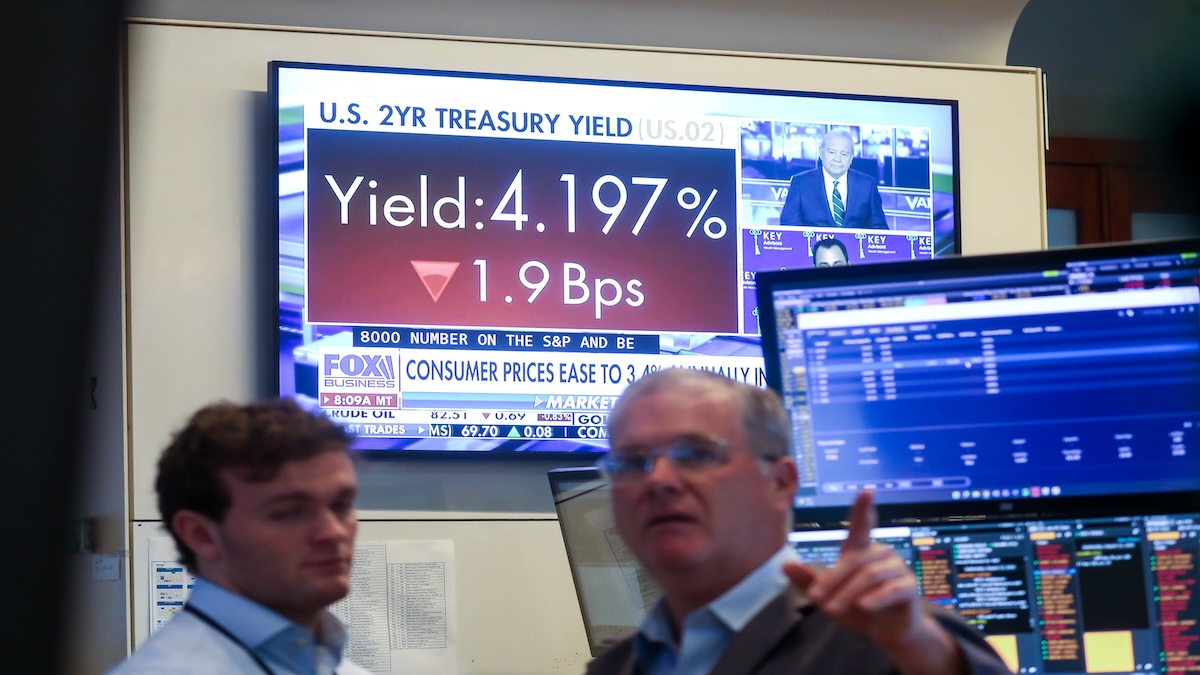
US Treasuries rallied after data showed employers unexpectedly cut jobs in July, suggesting labor market challenges that could impact the Federal Reserve’s willingness to raise interest rates.
Given America’s political environment, you would be forgiven for thinking the country has slipped into a dark age of energy recidivism; burning oil, gas and coal left and right; and tossing wind and solar farms on the scrap heap.
The S&P 500 was flat in July 2026 as semiconductors fell 29%, energy gained nearly 13% on higher oil, and long-term Treasury yields reached their highest levels since 2007.
Investors remain cautious despite bullish positioning, as rotations curb speculation while record margin debt and high equity allocations raise longer-term risks.
Given the current state of inflation and interest rates, it’s probable that many advisors and investors are considering alternative ways of fostering income within their portfolios.
Reflecting on the first half of 2026 provides a clear roadmap to strategize for the remainder of the year. Before that can occur, however, it’s imperative to check the pulse on the current state of the market and posit what may happen next.
While the outcome of the July FOMC meeting itself was in line with expectations, the aftermath has proven to be far more challenging for the money and bond markets, especially for longer-dated maturities, a.k.a. duration. Investors, as well as Fed Chairman Warsh, have quickly discovered something we have been highlighting about over the last few months: a lack of forward guidance can have unintended consequences.
On Wednesday afternoon the Federal Reserve held interest rates steady for a fifth consecutive meeting, and stocks buckled: the Dow fell 1,153 points, its worst day since April of last year.
By repeatedly describing standard inflation gauges as “imperfect measures of underlying inflation,” Federal Reserve Chair Kevin Warsh has pushed a long-running technical debate into the center of the policy conversation: What is the best way to measure underlying inflation?
This year has offered a vivid reminder of how quickly market conditions can shift—from policy uncertainty, to a sharp geopolitical shock, to a focus on an AI-driven rally. As the themes of the day changed, the case for an overlay persisted.
When we talk about inflation, we usually focus on the Consumer Price Index (CPI). However, the Federal Reserve’s “preferred” inflation measure is the Personal Consumption Expenditure (PCE) index. What’s the difference and why does the Fed prefer the PCE?
July 2026 was a flattish month for markets. The S&P 500 index was down slightly. Value did well, while momentum did poorly. Smallcaps, midcaps, and emerging markets, all of which have been the year’s best performers, had a bad month. Commodities, driven largely by oil prices, led the pack, as the fragile ceasefire in Iran failed to hold.
The numbers are in, and the story of ETF adoption goes on undeterred. In July, ETFs saw their third month this year of asset inflows exceeding $190 billion. If 2025 was a record-breaking year for ETF asset creation, 2026 is promising to upstage it.