Advisor Perspectives welcomes guest contributions. The views presented here do not necessarily represent those of Advisor Perspectives.
Key Takeaways
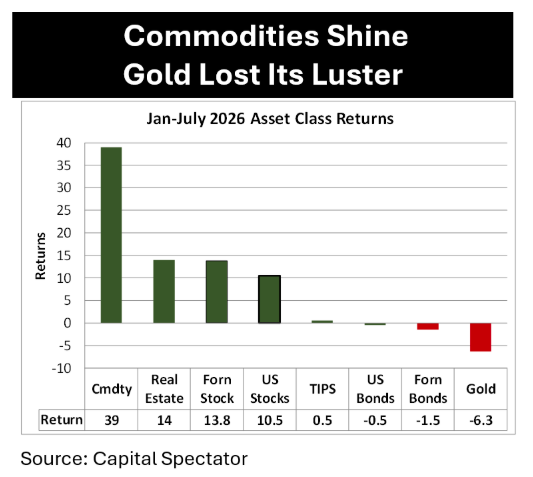
- Commodities have led asset class returns this year with a 39% gain through July, driven by an 87% surge in crude oil prices year to date.
- An important commodity is the worst performing: Gold is down 6%, primarily due to a 4% strengthening of the U.S. dollar.
- U.S. stocks, previously dominant, now deliver mid-tier performance at 10%, highlighting the value of broader diversification.
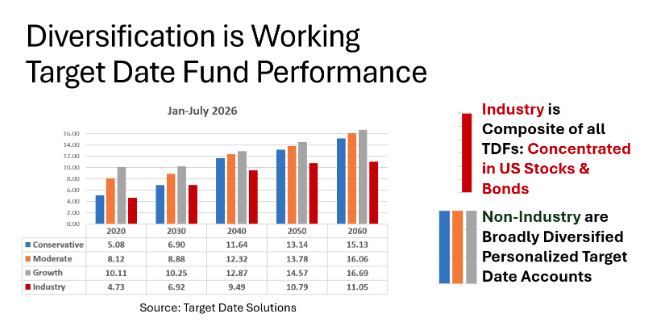
- Portfolios diversified beyond U.S. stocks and bonds, especially with alternatives like commodities and real estate, have outperformed concentrated portfolios.
Asset Classes
Commodities have dominated this year so far, with a 39% return, led by crude oil prices that increased by 87% as a result of the blockage of the Strait of Hormuz. On the low end of commodity prices and asset class results, gold is down 6.3% due in large part to a strengthening U.S. dollar that has increased by 4%.
Unlike the previous 17 years, during which U.S. stocks were the best-performing asset class, they are in the middle of the results with a 10.5% return. Consequently, diversification beyond U.S. stocks and bonds has added value this year, as evidenced in portfolio performance.
Portfolios
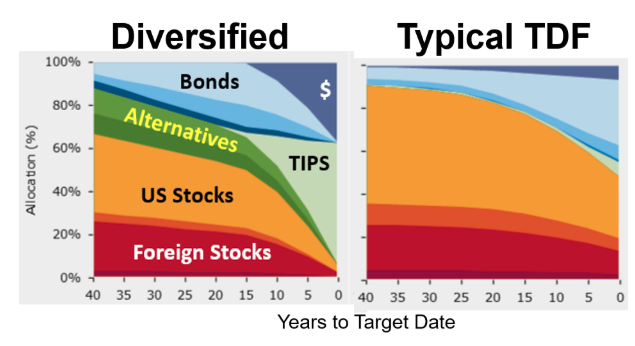
Holding more in your portfolio beyond U.S. securities has benefited performance. Most target date funds (TDFs) are concentrated in U.S. stocks and bonds that comprise more than 90% of underlying assets. By contrast, the non-industry accounts in the exhibit are broadly diversified into alternatives like commodities and real estate.
How Did You Do?
How has your portfolio performed? Use the Portfolio results above to answer this question. Choose your horizon (target date), risk preference, and diversification (concentrated in U.S. stocks or diversified) — that’s your benchmark. How did you do?
My Perspective Looking Forward
U.S. stocks are currently very expensive on a variety of bases — like the Buffett barometer — buoyed up by AI. Corrections have followed previous occurrences of expensiveness. Some investors — like Jeremy Grantham — expect the next correction to be the worst. I think they’ll be right.
So, what will protect portfolios when U.S. stocks tank, especially when inflation is also a concern? I think real assets like commodities and real estate (especially farmland) will hold up, as will Treasury Inflation Protected Securities (TIPS).
Real estate has long served as a reliable hedge against inflation — especially farmland, given the natural demand for food. TIPS safeguard purchasing power, as their price is adjusted to increase with inflation.
Conclusion
The U.S. stock market has gone up every year since 2008, with the exception of 2022. That’s 17 years — the longest bull market ever recorded. Stein’s Law says this will end: “If something cannot go on forever, it will stop.” Is the correction going to happen soon? No one knows, but being prepared is a good idea.
More articles by Ron Surz:
Ron Surz is president of Target Date Solutions, developer of the patented Safe Landing Glide Path and Soteria personalized target date accounts. He is also co-host of the Baby Boomer Investing Show. Surz’s passion is helping his fellow baby boomers at this critical time in their lives when they are relying on their lifetime savings to support a retirement with dignity, so he wrote a book, “Baby Boomer Investing in the Perilous 2020s,” and he provides a financial educational curriculum.
For anyone who relies on TDFs — or advises those who do — Surz’s new book is a must-read guide to understanding the risks, solutions, and future of a secure retirement.
A message from Advisor Perspectives and VettaFi: Discover something new! Click here to register for our upcoming webcasts.
Read more articles by Ron Surz
 Advisor Perspectives welcomes guest contributions. The views presented here do not necessarily represent those of Advisor Perspectives.