Advisor Perspectives welcomes guest contributions. The views presented here do not necessarily represent those of Advisor Perspectives.
- Baby boomers in target date funds (TDFs) face a 40% chance of loss in the next five years.
- Sequence of Return Risk peaks in the Risk Zone spanning the five years before and after retirement. The majority of baby boomers are currently in the Risk Zone.
- Most TDFs are at high risk at their target dates, but a few, like the $1 trillion Federal Thrift Savings Plan, offer about half the risk.
- With stock markets at historically high valuations, the probability of a correction is elevated, making reliance on luck a poor strategy.
In the 1971 hit movie “Dirty Harry,” Clint Eastwood aims his .44 Magnum — considered by some at the time to be the most powerful handgun in the world — at the bad guy and says: “You have to ask yourself one question: Do I feel lucky?” In this article, I explain why baby boomers in target date funds (TDFs) should not feel lucky today or in the near future.
The odds are not good that baby boomers in TDFs will complete this decade without experiencing an investment loss. The next five years are critical, because that’s when Sequence of Return Risk peaks. However, most baby boomers are not worried because they don’t fully understand the risk — they feel lucky today. But 60% of the 70 million baby boomers in the U.S. are currently in the Retirement Risk Zone that spans the five years before and after retirement.
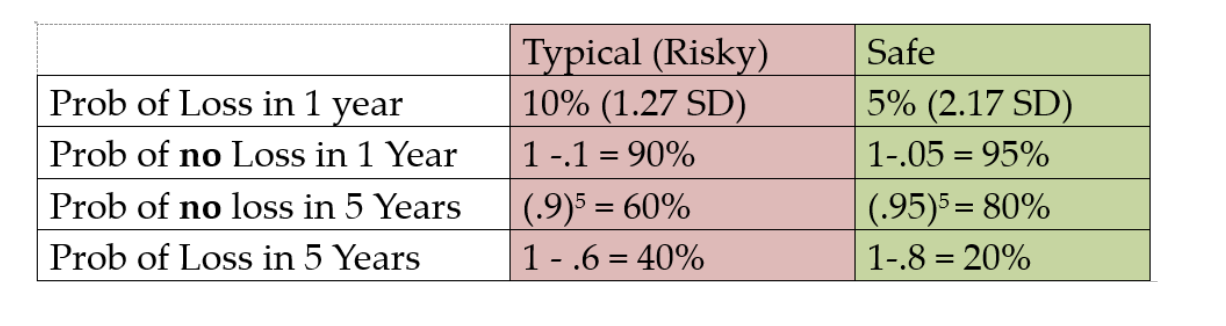
The detailed table in the next section explains why baby boomers shouldn’t feel so lucky. There’s a 40% chance that the typical TDF will have at least one losing year during the next five years.
Statistics don’t tell us how bad that loss might be, but Jeremy Grantham and others believe it will be shocking. These are bad odds, especially since retirement with dignity is at stake.
But not all TDFs are “typical.” A few that are much safer have only a 20% chance of losing money in this decade — about half the risk of typical TDFs. Below, I provide the math that estimates the probability of loss in TDFs for these two types — safe and risky (with the latter being typical). The risky group has won the performance horse race over the past 18 years, but that will change as stock prices reach unprecedented levels and luck runs out.
Two Groups of TDFs — Risky and Safe
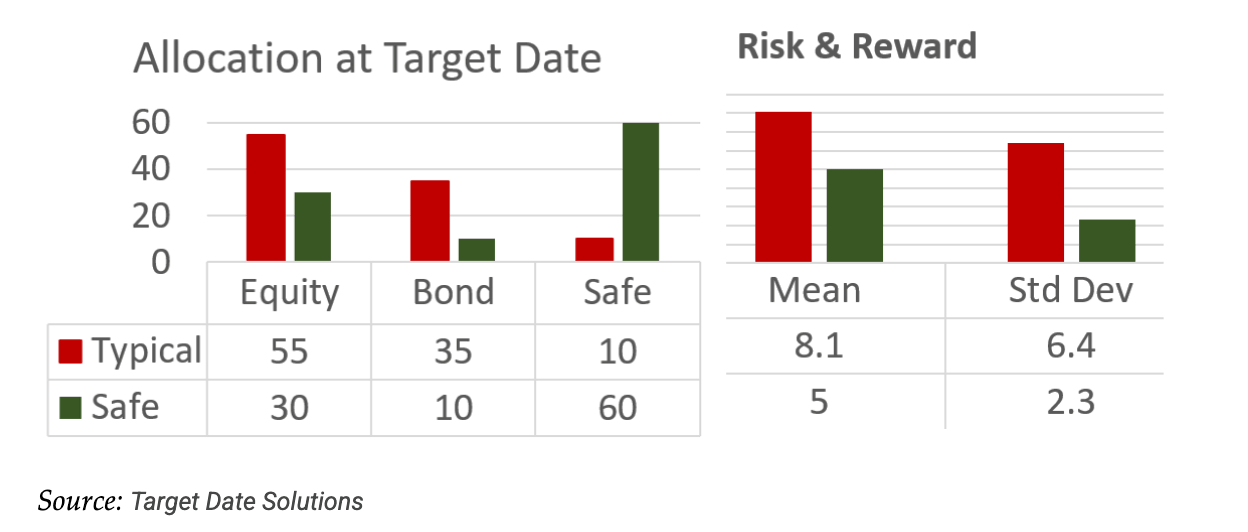
Most TDFs are the same — high risk at their respective target dates. But a few are very safe, and most notable among them is the $1 trillion Federal Thrift Savings Plan, the largest savings plan in the world. The graph below illustrates some of the differences between the two types.
A return below zero is 1.27 standard deviations — 10% probability — below the mean for the typical TDF, and 2.17 standard deviations — 5% probability — for the safe group. If we expand these annual probabilities out to the five years that end this decade, there is a 40% chance of losing money in the typical TDF, but only 20% in the safe group.
The table below illustrates the the probability of loss in one year and in five years.
Due for a Correction
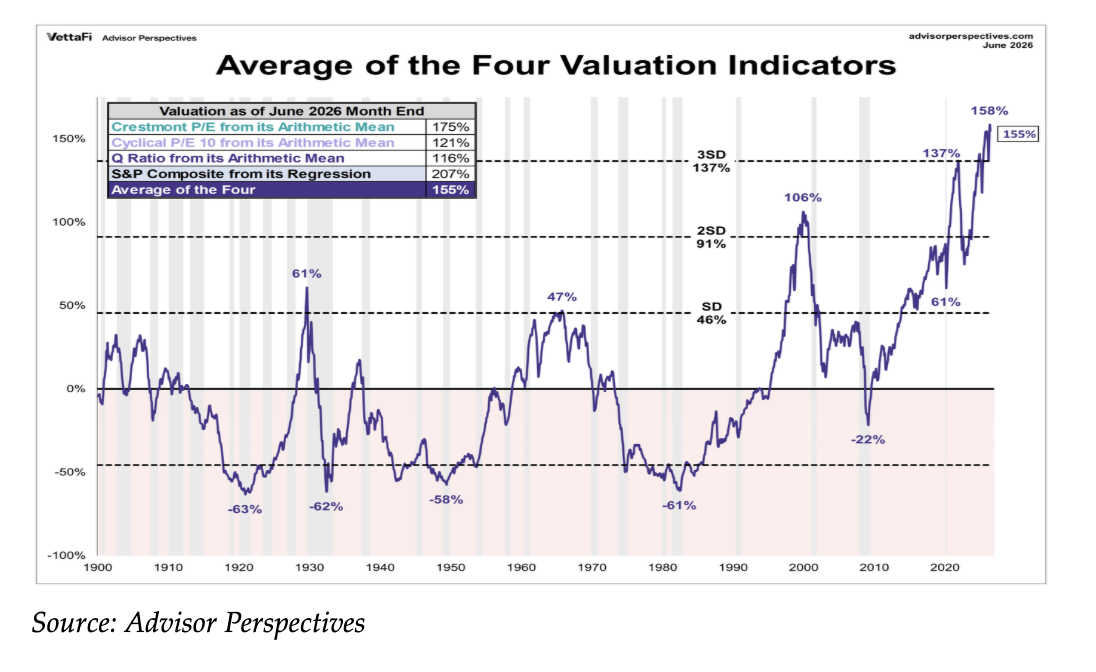
The conditional probability of loss is even higher because the U.S. stock market is currently very expensive — more than 3 standard deviations above the mean — and due for a correction. In the past, stock markets have crashed when they became expensive, and greed and fear are powerful motivators. Given current inflation and geopolitical fears, investors should not feel lucky going forward. Will (can) AI continue to buoy up the stock market?
Conclusion
The past 18 years have seen the longest bull market ever! Stocks and bonds have gone up every year, except 2022. Stein’s Law says: “If something cannot go on forever, it will stop.”
For the remainder of the 2020s, 40 million baby boomers will be in the Retirement Risk Zone, during which losses can ruin the rest of their lives. There’s a 40% chance that the typical TDF will lose money in at least one year remaining in this decade. That’s a very risky gamble to take.
There are safer TDFs with about half the risk of losing money near retirement, but they are not popular — yet. These safer TDFs, beyond the Federal Thrift Savings Plan, include the Dimensional Fund Advisors Target Date Retirement Income funds, the low-risk flexPATH target date funds, and strategy represented by the SMART target date fund index on Morningstar Direct.
More articles by Ron Surz:
Ron Surz is president of Target Date Solutions, developer of the patented Safe Landing Glide Path and Soteria personalized target date accounts. He is also co-host of the Baby Boomer Investing Show. Surz’s passion is helping his fellow baby boomers at this critical time in their lives when they are relying on their lifetime savings to support a retirement with dignity, so he wrote a book, “Baby Boomer Investing in the Perilous 2020s,” and he provides a financial educational curriculum.
For anyone who relies on TDFs — or advises those who do — Surz’s new book is a must-read guide to understanding the risks, solutions, and future of a secure retirement.
A message from Advisor Perspectives and VettaFi: Discover something new! Click here to register for our upcoming webcasts.
Read more articles by Ron Surz
 Advisor Perspectives welcomes guest contributions. The views presented here do not necessarily represent those of Advisor Perspectives.