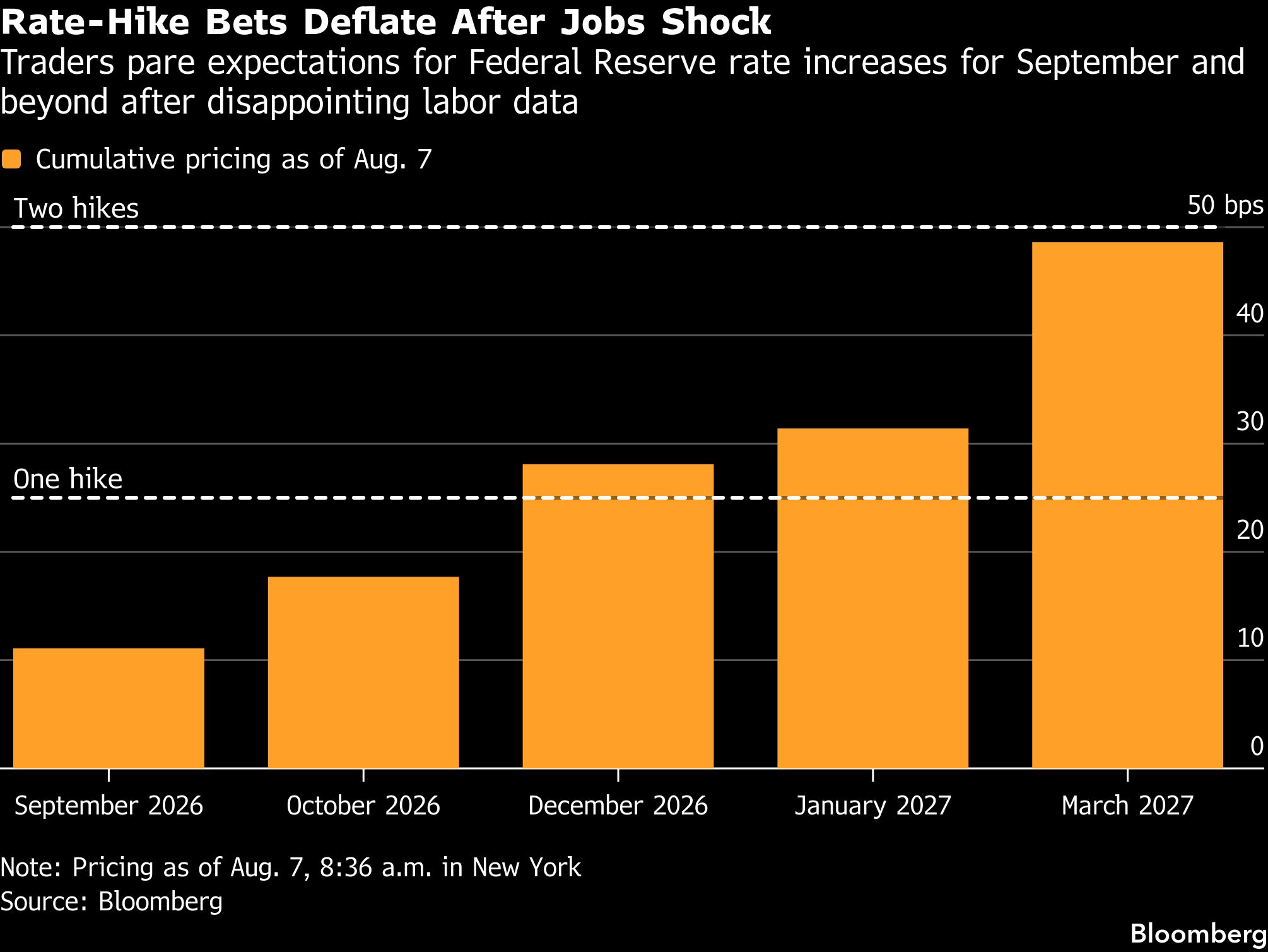
US Treasuries rallied after data showed employers unexpectedly cut jobs in July, suggesting labor market challenges that could impact the Federal Reserve’s willingness to raise interest rates.
The yield on two-year US Treasuries, which are sensitive to near-term moves in Fed monetary policy, fell eight basis points on Friday to 4.16% as traders cut bets on interest-rate hikes in the coming months. The 10-year rate was down six basis points at 4.62%.
Nonfarm payrolls decreased 23,000 last month following substantial downward revisions to the prior two months, Bureau of Labor Statistics data showed Friday. The unemployment rate fell to 4.1% as labor force participation continued to slide.
“The headline number being negative is a total shock,” said Tom di Galoma, managing director at Mischler Financial Group. “I guess the Fed will not be tightening in September.”
The data suggested the labor market may be facing challenges after surprising strength earlier this year, which had fueled investor bets on Fed hikes. Traders are now pricing about a roughly 40% chance of such a move at the next scheduled decision in September, according to interest-rate swaps, compared to closer to 60% before the data.
Jeffrey Rosenberg, senior portfolio manager at BlackRock, told Bloomberg Television that he “would be hesitant to write this report off as the revisions in the headline number are pointing to weakness. The market is not ignoring it, with a big hike probability coming out with the front-end rally.”
To be sure, investors are still fully pricing a hike by year-end. Fed Chairman Kevin Warsh’s refusal to provide forward guidance further complicates the market’s response. Last week, the Fed held its key interest-rate tool unchanged, though three officials dissented in favor of a hike.
In an interview with Punchbowl News posted on Friday, President Donald Trump reiterated his preference for lower interest rates while also acknowledging that Warsh is part of a board that votes on rate moves. Trump struck a softer tone than the sharp criticisms he threw at Warsh’s predecessor, Jerome Powell.
The next major data will come with US consumer prices figures due on Wednesday. The surge in energy prices stemming from the US’s war with Iran has reignited worries regarding inflation, though a weaker-than-expected CPI print published last month helped ease some of those concerns.
“If data looks somewhat softer in the next couple of months, especially when it comes to the inflation side, they are probably not going to want to hike,” Stephanie Roth, chief economist at Wolfe Research, said on Bloomberg TV. “They are going to want to see how the data progresses.”