A high-yield municipal-bond fund run by Capital Group saw the biggest inflow of any US-based exchange-traded fund on Friday, with an infusion of $1.54 billion.
In this article, I will discuss the automatic Social Security bridge strategy built into the AFP models and look at several hypothetical client situations to quantify how much a Social Security bridge strategy (SSBS) may actually enhance your retired client’s retirement security.
Imagine having the ability to withdraw funds during retirement without worrying about the tax bill that typically accompanies your withdrawals. With in-plan Roth conversions, you gain this advantage and enjoy the satisfaction of knowing your investment will grow tax-free.
A portfolio of longish-term bonds held to a shortish-term horizon did appear to benefit from a drop and suffer harm from a jump in interest rates. This article’s purpose is to sharpen that observation and remove the ambiguity.
Morgan Stanley had an unusual message when it approached four of the world’s biggest asset managers in July: they had progressed to the final round of one of the most sought-after private credit deals to date. But if they wanted to get to the finish line, they would need to pair up.
Lauded for their yield, credit quality, and of course, their federal tax-free income, municipal bond benefits are also extending into the containment of tariff contagion.
Recently, due to deals President Trump is making, some are saying the United States has embarked on a version of Chinese-style “state capitalism” – directly entangling markets and government.
Investment assets – things such as stocks, bonds, companies, and buildings – have a value, which is sometimes referred to as their “intrinsic value”: what the asset is “worth” at a point in time. This value is subjective. It can’t definitively be found anywhere – not even by AI, as far as I know – and opinions will differ as to what it is.
Elevated yields and conservative balance sheets are helping high yield stay resilient amid trade uncertainty.
Since the last update of our three ‘Tactical Rules’ on June 17th, both domestic and international equity markets have rallied, increasing roughly 6.9% and 3.7%, respectively.
July inflation data emphasized that tariff-related price pressures are still with us, in addition to some heat in the services sector—making the road to Fed cuts a bit bumpier.
Markets entered the second half of 2025 with renewed optimism, though not without turbulence earlier this year.
Chief Economist Eugenio J. Alemán discusses current economic conditions.
In the grand banking hall of Cipriani 42nd Street in Manhattan last week, crypto advocates gathered beneath marble columns and chandeliers to declare the arrival of a new financial era — one that goes way beyond Bitcoin.
Despite triple the amount of tariff income, the July budget deficit surged to $294.14 billion, 19 percent higher than a year ago, according to the Monthly Treasury Statement.
The latest wholesale inflation numbers in the U.S. took some of the wind out of Wall Street’s sails this week, but they haven’t dulled investor enthusiasm for gold.
Foreign investors are flooding into South Africa’s government bond market to take advantage of one of the best emerging-market trades of recent years.
There is a seasonality in asset class investment performance that is revealed in the history of calendar month returns. Based on history, investors should be “all in” U.S. stocks this August but “mostly out” in September.
My takeaway from the GPT-5 launch has been that while AI companies can tout overall performance on various benchmarks, these are becoming increasingly less relevant.
At the heart of why consumers in China save so much and spend so little, and why Xi Jinping and Donald Trump will struggle to change that behavior even if they want to, lies the country’s stock market.
Advanced Credit Solutions is a tiny finance firm based in Luxembourg that was founded by a Belgian and works with insurers. Despite its outwardly bland appearance, the business it does is anything but.
To benefit from a corporate buyback, an individual must sell their shares to the company. Conversely, those holding on to their shares are not compensated.
U.S. economic growth slowed decisively in the first half of the year amid concern about rising tariffs, although corporate fundamentals have remained strong.
High yield bonds have historically delivered attractive long-term returns, and since the Great Financial Crisis they have also become higher quality, as weaker borrowers have departed the sector for the private credit and leveraged loan markets.
The U.S. economy is like a finely tuned sports car—powerful, tough, and built for speed. It has managed to climb steep inclines in recent years, competently maneuvering past multiple roadblocks.
The day of reckoning is here. Earlier in the summer, the Trump Administration set a global trade deal negotiation deadline of August 1.
For the second quarter of 2025, most energy infrastructure companies maintained their payouts, with MLPs largely providing sequential growth.
As the universe of investors seeking to increase their exposure to private markets grows, and now includes wealth advisors and family offices, investors need to consider not just what they own but how they own it.
High yield ETFs, particularly short high yield, have been a significant contributor to portfolio performance, providing relatively reliable fixed income return with relatively little volatility.
In this video, Chuck Carnevale, co-founder of FAST Graphs, aka Mr. Valuation discusses Growth at a Reasonable Price (GARP) and presents five small- to mid-cap growth stocks at a reasonable price he believes are worth researching.
Advent is working on an offer to acquire U-blox Holding AG in a deal that could value the Swiss maker of positioning chips at more than 1 billion Swiss francs ($1.2 billion), according to people familiar with the matter.
July’s Consumer Price Index (CPI) report showed headline year-over-year inflation remained steady at 2.7%, below the anticipated level of 2.8%.
A checklist comprising above-average income, attractive valuations, and positive correlations to possible interest rate cuts may sound daunting
Apollo Global Management Inc. is aiming to invest in artificial intelligence, defense and infrastructure in Europe, where trillions in spending is needed, its co-head of European credit Tristram Leach said in a Bloomberg TV interview.
Despite headline noise from U.S. tariffs and mixed earnings, India’s structural growth pillars—credit expansion, services exports and infrastructure delivery—remain firmly intact in 2025.
For many investors, land ownership is part of the American Dream. But what happens when the land you own sits idle?
Main Capital, a Dutch buyout firm focused on software deals, is pushing to more than double its assets under management to €15 billion ($17.5 billion) in the next three years, betting on rising demand from US investors for European assets.
Investors seeking a Goldilocks option to balance yield and rate risk may want to consider intermediate bonds.
With 90% of S&P 500 companies having reported second quarter results, corporate America has handily topped expectations, displaying resilience in the face of a challenging policy environment.
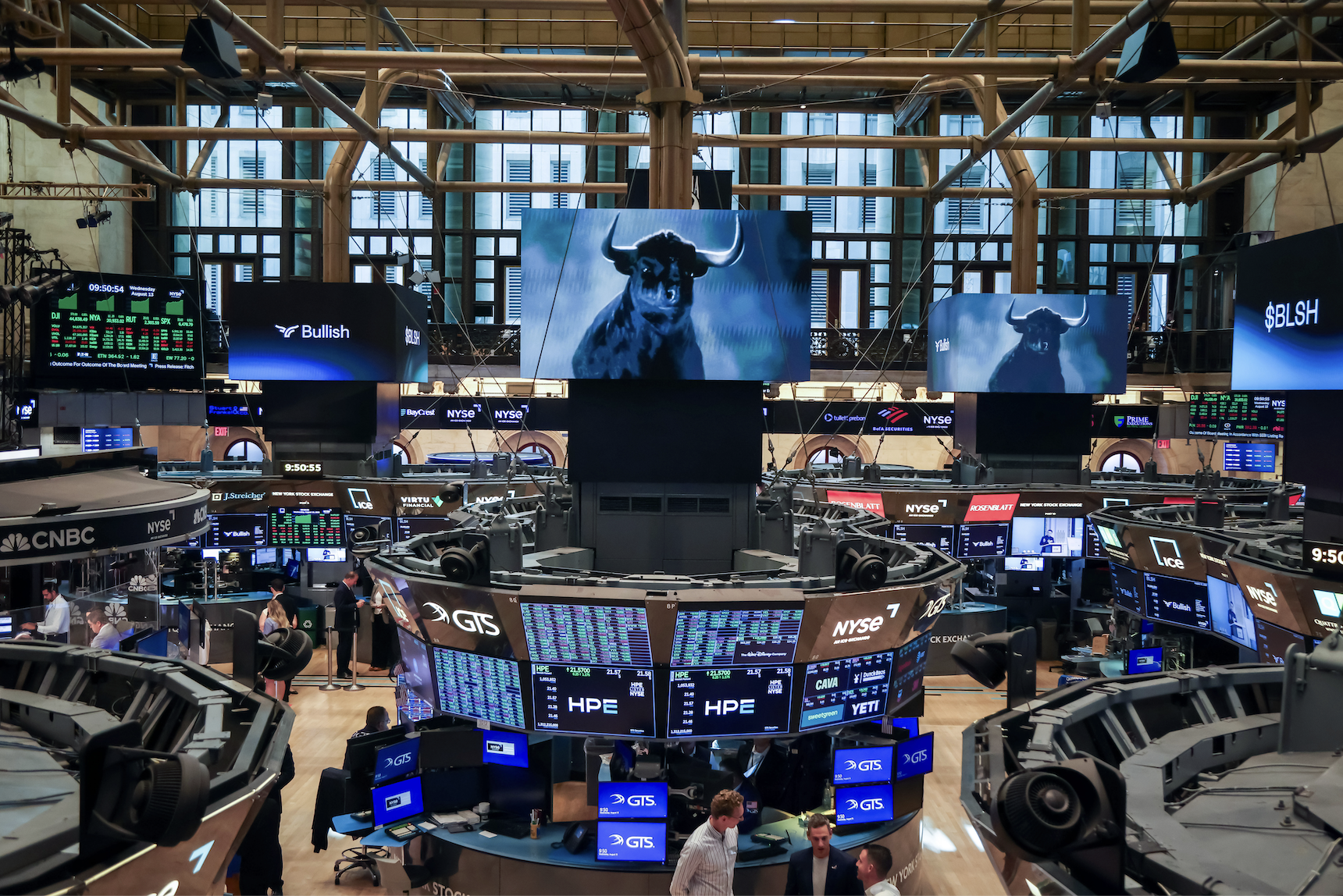
Bullish shares jumped 84% from the IPO price after the digital-asset exchange operator and owner of media outlet CoinDesk raised $1.1 billion in an initial public offering.
The word “bubble” gets tossed around quite a bit. Usually, it comes in the form of verbal arguments about whether prices have advanced to a point that’s “too high” in some sense. We can do much better than that. A bubble is a mathematical object.
A pair of new bond exchange-traded funds is making it easier than ever for investors to avoid taxes on coupon payments.
UnitedHealth Group Inc. shares jumped after funds piled into the company, which has been hampered by a federal probe into its business practices and weakening results.
The One Big Beautiful Bill Act, signed into law on July 4, 2025, introduces significant changes to the federal student loan system. The legislation aims to simplify repayment options, adjust borrowing limits and modify the structure of educational financing.
Economic resilience allowed the Fed to remain in wait-and-see mode in July, but July’s non-farm payroll report may cloud the horizon.
Wall Street banks are starting to cover firms that are not publicly traded. JPMorgan Chase & Co. kicked off the trend with a report on OpenAI Inc. Citigroup Inc. followed suit a week later with a list of roughly 100 large private companies it will focus on, predominantly in the tech sector.
Portfolio Manager Dan Lyons and Research Analyst Luyi Guo explain recent developments in proposed pharmaceutical tariffs and “most favored nation” drug pricing and what both could mean for the biopharma industry.
The U.S. economy grew at a surprisingly strong annualized rate of 3.0% in the second quarter of 2025, which far outpaced the post-2000 average of 2.3% and easily beat expectations.
As investors re-evaluate their allocations to US assets, we think they should consider euro-denominated bonds.
Income diversification is necessary considering that rate cuts could be ahead. One area that could help bridge the gap — private credit.