As the universe of investors seeking to increase their exposure to private markets grows, and now includes wealth advisors and family offices, investors need to consider not just what they own but how they own it.
Over the past 25 years, the private investment market has expanded rapidly, not just in terms of size but also in the variety of investment strategies. As general partners have evolved to meet the changing needs of investors and take advantage of new investment sectors, the number of buyout, infrastructure, private credit, impact and other specialized types of GPs has grown. This has led to a broadening landscape that includes specialist fund managers differentiated by stage of investment, use of proceeds, security type, sector, size and geography, among other attributes.
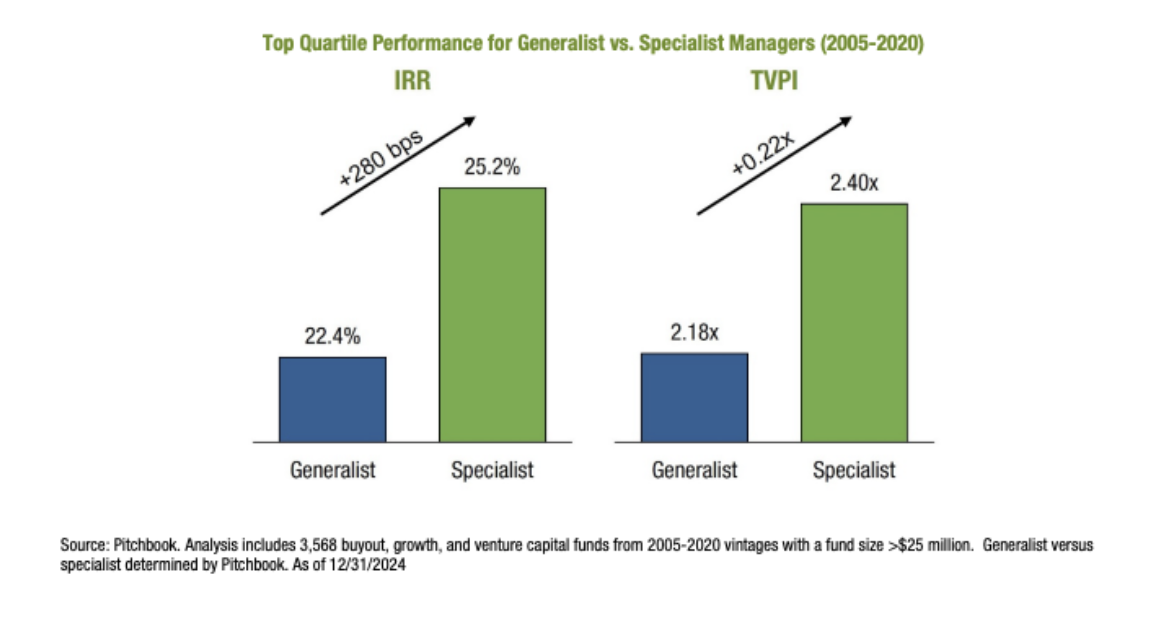
Those specialist funds are carving out a distinct edge relative to generalists. In fact, top-performing sector-specific managers have outperformed generalists by up to 280 basis points over the long-term, PitchBook data shows.

How are they achieving those superior returns? Specialist managers provide advantages that go beyond what broader, multi-strategy managers can offer. Here are basic ways they stand out:
A Focus on Fundamentals and Value-Add
In many cases, specialist funds tend to focus on undervalued, smaller companies with less competition, allowing for selective and patient deal-making. Their due diligence also tends to prioritize business fundamentals, driving the income statement over financial engineering via balance sheet optimization. This analysis enables specialist GPs to align post-investment priorities with management teams, increasing the likelihood of successfully executing value creation plans and delivering strong financial outcomes.
Industry Relationships that Drive Proprietary Deal Flow
Specialist funds thrive in unique spaces, leveraging deep, trust-based relationships with key industry players—including founders, executives, advisors, and other fund managers—to source exclusive, often off-market deals.
In our case, North Sky is a pioneer in the impact investing landscape with an expansive network of GPs, LPs, brokers, bankers and other advisors, having cultivated an enviable number of relationships over its 20+ years as an impact specialist. In addition, our early entry into the impact market allowed us to build a robust network of entrepreneurs, coinvestors and other stakeholders, which is a critical asset in the world of private equity and venture capital.
These types of strategic relationships, built on years of cultivated trust and completed transactions, enable access to high-value opportunities whereby specialist funds avoid crowded auctions, experience smoother deal execution, craft bespoke terms and in some cases enjoy longer deal review periods which enables more in-depth analysis. Such factors increase their probability of achieving outsized returns.
Niche Focus with Limited Competition
Less competition in any market segment improves a buyer’s pricing power. This is true for specialty managers who focus on specific niches and may even create proprietary investment opportunities where they are essentially the only bidder for the asset. A good example of that can be found in the impact secondaries market, which is still nascent and primed for growth.
If you compared all secondaries capital raised from 2013-2024 (which amounts to $0.6 trillion) to all capital raised for buyout, venture, infrastructure, secondaries and other private markets capital (about $14.9 trillion), you get a ratio of about 4%. In other words, traditional secondaries funds represent about 4% of the total private market.
If you do the same calculation for the private market impact sector, impact secondaries capital raised in that period represents only 0.1% of the roughly $1.1 trillion total of all impact capital raised from 2013-2024. That means there is a 40:1 ratio compared to the broader secondaries marketplace, demonstrating the tremendous growth potential for impact secondaries.
The opportunity set is even larger, considering that niche markets often have smaller average deal sizes, which may fly under the radar of generalist managers. For example, deals under $25 million garner less attention, as large generalist funds target bigger portfolios to justify their allocation of internal resources (i.e., time), due diligence costs and investment minimums.
Conclusion
In today’s complex private market landscape, sector-specialist funds deliver a powerful edge for investors. Specialist funds bring a wealth of experience and a refined skill set to the table, honed through years of industry sector focus. This isn’t just general financial know-how, but a granular understanding of the nuances, trends and pitfalls within their chosen domain. Investors benefit from this mastery because it translates into sharper insights, better risk assessment and the ability to spot opportunities that broader, less specialized funds might overlook.
Scott Barrington is Co-CEO of North Sky Capital, an innovator in the impact investing arena for two decades. North Sky launched the first impact fund of funds in North America (2005); the first sustainable infrastructure fund focused on the triple bottom line of attractive returns, renewable energy and jobs creation in the U.S. (2010); and the world’s first impact secondaries fund (2013).
A message from Advisor Perspectives and VettaFi: To learn more about this and other topics, check out some of our webcasts.
© North Sky Capital
Read more commentaries by North Sky Capital