Funds will begin paying out their 2023 distributions this month which could lead to a tax bill for your clients. While capital gains distributions will likely be lower this year than in recent years, interest income is expected to be higher.
Stephen Dover, Head of Franklin Templeton Institute, recently sat down with Franklin Templeton Fixed Income Portfolio Manager Josh Lohmeier and Western Asset Portfolio Manager Mark Lindbloom to discuss the fixed income landscape—and why they believe 2024 will be a good year for fixed income investors.
It’s possible that a 2024 recession could be avoided, but we see recessions risks as remaining elevated in most developed markets. We believe there is limited upside for equities amid expensive valuations and recession concerns. Government bond valuations, however, look attractive in the U.S., UK, Canada, Germany and Australia.
When it comes to commercial real estate, a lot of attention is obviously paid to offices. But it's not the only sector facing strains.
Stock markets will suffer in the first quarter of 2024 as a rally in bonds would signal sputtering economic growth, according to Bank of America Corp.’s Michael Hartnett.
Bond traders who powered a ferocious rally in the $26 trillion US Treasury market are about to find out if they’ve gotten ahead of themselves.
The capital markets are already pricing in rate cuts ahead of 2024, causing yields to fall. One way to continue supplementing income amid a potential drop in yields is to diversify income using a pair of active exchange-traded funds.
Although some volatility may continue, we believe interest rates have peaked. We expect lower Treasury yields and positive returns for investors in 2024.
In early October, gold was valued at around $1,820 according to Kitco. That is fairly close to its low for the calendar year. Its previous low came in late February, at $1,811.
The sizzling global bond rally stalled on Thursday ahead of a key US jobs report, with a slump in Japanese debt adding to the nerves of Treasury traders already fretting that yields had dropped too far.
The Treasuries market took another leg higher on Wednesday, as a slowdown in private-sector job creation further encouraged traders to bet on US interest-rate cuts ahead of broad labor-market data due Friday.
The recent rate pause by the Federal Reserve is bringing optimism to the capital markets that interest rates may finally head lower. In turn, it’s pushing yields down. Conversely, bond prices rallied in November, which should help bring investors back to the market.
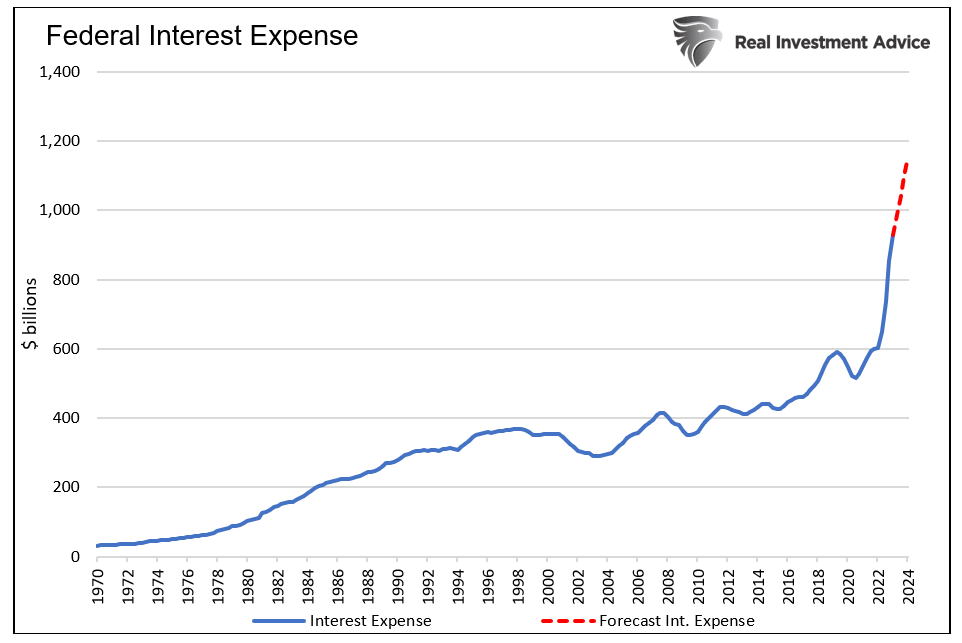
The federal deficit is already high at 6% of GDP. But if a recession hits – as Jeffrey Gundlach fears will happen next year – unemployment will rise, and the deficit and the interest the government pays on it will cripple the economy.
MetLife Inc., the biggest US life insurer, downplayed concerns about the faltering commercial real estate market amid signs that occupancy is starting to recover.
Treasury yields resumed their downward slide — with the benchmark 10-year note’s falling to the lowest level since Sept. 1 — after the latest sign of labor-market cooling bolstered bets that a Federal Reserve shift to policy easing isn’t far off.
The message coming from Wall Street is that investor optimism is running dangerously high.
Taiwan’s economic and financial decoupling from China has deepened with the near-collapse of what was once the world’s largest Chinese bond exchange-traded fund market.
Valuations for municipal bonds are very attractive right now. And as yields remain strong, so do their fundamentals.
Money markets paid nothing. The dividend yield for the S&P 500 Index was 2%, and the 10-Year Treasury yield was stuck between 2%-3%.
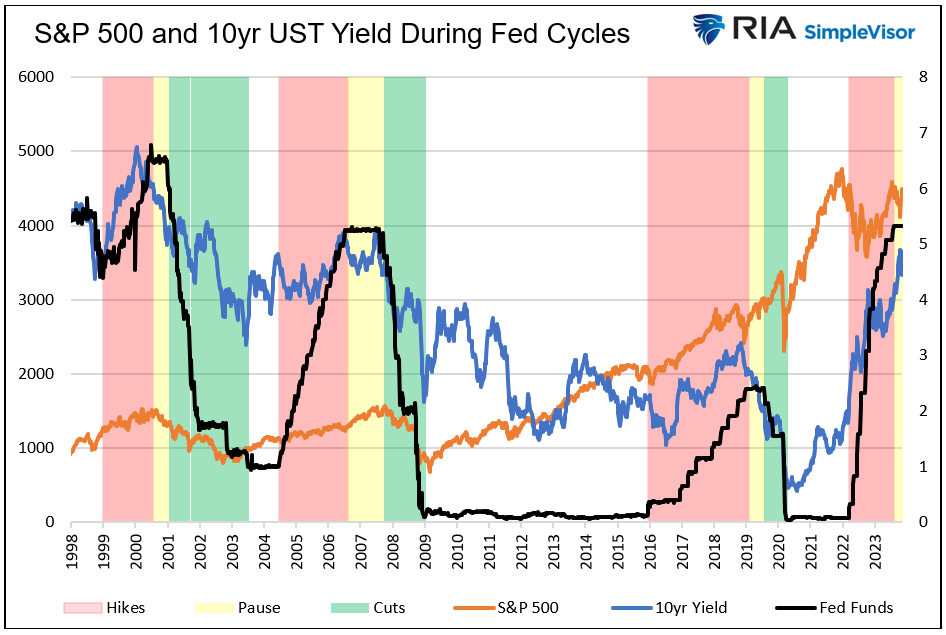
How might stocks and bonds perform during the pause and eventually when the Fed cuts rates?
Our outlook for 2024 is for a gradual U-shaped recovery composed of seemingly chaotic movements in economic data with turning points in policy rates and earnings growth.
India is once again leading flows into US exchange-traded funds tracking emerging markets, boosting one of the most popular trades in 2023 as declining US yields and a weakening dollar turn investors toward assets in the developing world.
Recency bias is too ingrained within us as human beings to ever go away regardless of the evidence. As advisors, we must learn to manage it.
December’s whipsaw opening shows investors may be concerned November’s epic rallies went too far, too fast in anticipating a near-perfect soft landing for the economy.
For much of 2023, the market has tried to anticipate a Fed pivot – only to be wrongfooted several times. However, sharply higher interest rates, cooling inflation pressures and moderating wages have the market convinced that the Fed’s current tightening cycle is over.
The dearth of homes for sale has underpinned the housing market’s surprising resilience and may further lift home prices despite reduced affordability.
Trench warfare in the early 20th century has been described as long periods of boredom punctuated by moments of terror.
I previously discussed a slate of recessionary indicators with high correlations to recessionary onsets. However, as we head into 2024, many Wall Street economists predict a “soft landing” or “no recession” outcome for the economy.
In November, Treasury rates dropped, and risk assets rallied. The market expects continuing drops in inflation and slower, but not disastrous, growth. The data support the market's sanguine assessment.
Across Wall Street, analysts and investors had cheered 2023 as the year of emerging markets, only to be burned by a relentless climb in US Treasury yields. Now, as the Federal Reserve looks set to end its most aggressive monetary tightening campaign in a generation, they’re at it again.
US stocks are headed for a rocky end to the year after rallying in November as bond yields fluctuate, according to Morgan Stanley’s Michael Wilson.
A torrid bond market rally shows traders are convinced the Federal Reserve’s rate-rising cycle is over. The debate now turns to when central bankers start cutting, and by how much.
The life story of Charlie Munger, who passed away on Tuesday at age 99, serves as a shining example of the enduring American Dream, especially now at a time when many people doubt whether the promise of a better life is still intact.
In a turnaround from last year, there is renewed interest in the fixed income asset class as yields have risen. Ed Perks, CIO of Franklin Income Investors, shares his analysis of recent macro developments and where he sees opportunities for income.
In a year in which little has gone right in the US bond market, November turned out to be a month for the record books.
Federal Reserve Chair Jerome Powell pushed back against Wall Street’s growing expectations of interest-rate cuts in the first half of 2024, saying the committee will move cautiously with borrowing costs at a 22-year high but retain the option to hike further.
Decades-high interest rates are poised to revive interest in a little-used corner of the municipal-bond market: variable rate deals.
November will be etched in the memories of investors as a remarkable month.
In the wake of recent underperformance, healthcare is entering the new year with compressed valuations just as innovation picks up and a post-COVID reset winds down. That should make for a positive outlook, says Janus Henderson Portfolio Managers Andy Acker and Dan Lyons.
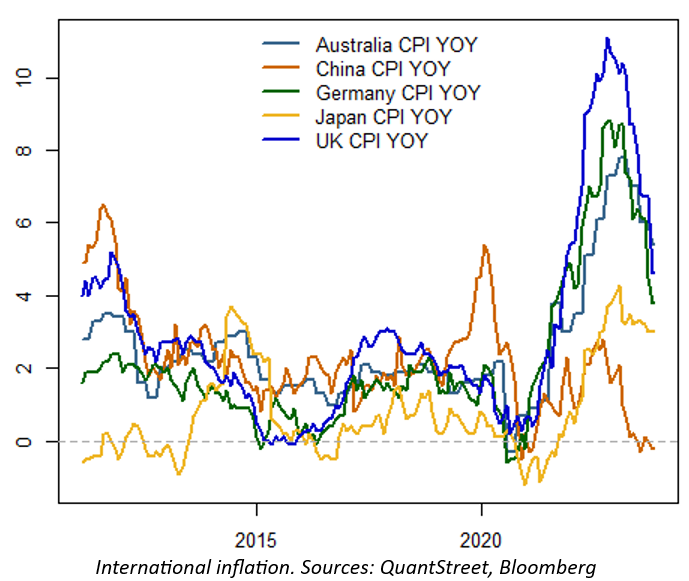
Economic conditions now are quite different from the 1970’s and still disinflationary.
Risk premiums on US investment-grade corporate bonds have narrowed to the tightest level in nearly two years on expectations that the Federal Reserve has reached the peak of its monetary-tightening cycle.
Equities have an important role to play in a diversified allocation today, to help hedge against inflation and to navigate a lower-growth environment.
The last time the municipal bond market rallied so much, it was Paul Volcker — and not Jerome Powell — who was winning a war on inflation.
Real estate headlines seem to only focus on bad news right now, from remote work’s impact on offices to struggles for city center retail.
Drew O'Neil discusses fixed income market conditions and offers insight for bond investors.
On November 28, 2023, VettaFi hosted an Alternatives Symposium with an excellent turnout of nearly 750 advisors and investors registered for the event.
The article explores the current state of the bull market, offering insights from Pring Turner Capital. The author discusses indicators supporting optimism for a second leg of the bull market, citing economic, monetary, and technical factors.
The unhappiness of American consumers despite rapid job and economic growth in the past few years is a hotly debated topic. Is it inflation? High borrowing costs for homes and automobiles? Crowded airports and packed airplanes?
Now that inflation is finally decelerating, regulators are increasingly turning their focus to financial stability.
The problem is not a deficit or a debt-issuance problem. It's an interest rate problem.