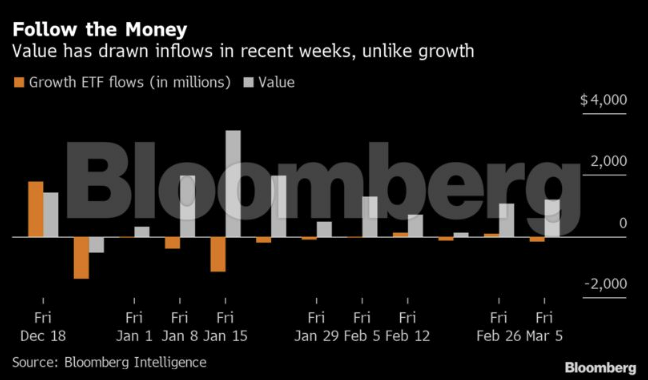
The left-for-dead value trade has roared back to life to wipe out all its pandemic losses, with its revival reshaping the $2 trillion world of factor investing.
“Bull markets are born on pessimism, grow on skepticism, mature on optimism and die on euphoria.” -Investor and mutual fund manager Sir John Templeton
Every year. Every day. I teach clients that they must choose one of two paths to complete their Medicare coverage.
New research shows that higher employee satisfaction leads to higher equity returns. That reinforces previous research showing that ESG principles should be an important aspect of advisors’ due diligence in fund selection.
There may be some incredible opportunities for investors in companies that produce the metals, minerals and other raw materials that will be needed with an increase in spending.
One year since the inception of one of the most severe recessions in modern history, women’s engagement in the labor force is crucial to the economic recovery.
Sweden’s Investor AB was founded in 1916 by the Wallenberg family with the aim of making long-term investments in high-quality global companies, a business philosophy it has maintained through booms, depressions, recessions, and global trends.
Our Fixed Income CIO Sonal Desai has been ahead of the curve in flagging the risks of inflation and rising rates that have now entered the mainstream debate.
There is hope that economies will see a more sustainable and robust recovery this year, given unprecedented levels of monetary and fiscal stimulus and as more individuals are vaccinated against COVID-19. But one question for investors is what happens next—will inflation and higher interest rates be a consequence?
How long will the effects of COVID be felt in potential growth, the tourism sector and bankruptcy filings?
What normalcy will it be? I don’t expect to simply go back to the way things were. The economy as it was structured in December 2019 is gone forever. The world is different now. The economy will be different, too.
Opponents of Harvard College’s affirmative action policies asked the Supreme Court to bar colleges from using race as an admissions factor, setting up what could be a defining showdown for higher education and the court’s conservative majority.
Things are looking up for the US economy. Later this week we'll get an update on real GDP growth for the 4th quarter of 2020. We estimate that'll be revised up to a 4.3% annual rate of growth from a prior estimate of 4.0%.
The details of the January Producer Price Index showed a further surge in prices of raw materials. Breakeven inflation rates (the yield spread between inflation-adjusted Treasuries and fixed-rate Treasuries) have continued to move higher.
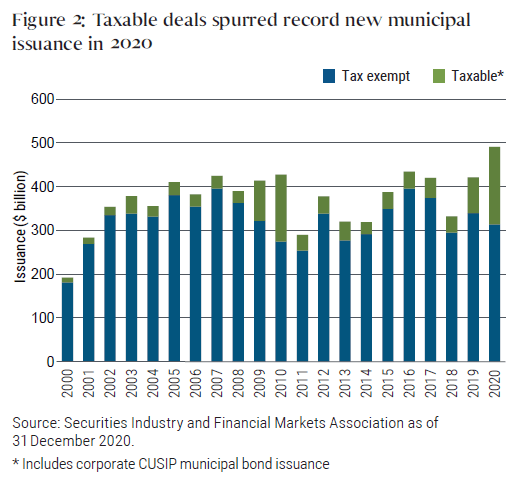
Political change, continued fiscal support will drive municipal markets in 2021, although outcomes are likely to vary.
Liquidity is valuable to investors. Therefore, they should demand higher expected return (a risk premium) for less liquid stocks. But new research shows they have not earned that extra return in public equity markets.
Rather than going deep into one theme, this week we will do a “Random Thoughts” from the Frontline. Today we will cover several topics in shorter form: valuations, infrastructure, the debacle in Texas, and a lot more.
Millions of Texans were without power this week when the state was hit with a record setting winter storm. An overhaul of its aging infrastructure would require massive amounts of metals and other materials, which would be positive for miners and producers.
BlackRock Global Allocation Fund portfolio manager Russ Koesterich explains why he expects volatility to drop -- and cyclicals outperform.
For a variety of reasons, many investors are worried about higher inflation. While we may see reflation (a pickup in prices that were restrained due to the pandemic), a significant increase in underlying inflation appears unlikely.
U.S. Treasury yields rose to the highest since February 2020 and are at risk of climbing further, as investors start to factor in the full economic impact of a stimulus plan totaling as much as $1.9 trillion.
Ever since the stock market bottomed in 2009 during the financial crisis, people have been coming up with reasons why the bull market was about to end. We heard every reason – Brexit, the end of Quantitative Easing, too much debt, COVID, etc. – and while we understood each may be a cause for consternation, we focused on valuations, which suggested the bull market would continue. Over time, math wins.
Emerging-market investors seem to have a lot going for them right now -- and the renewed weakness in the U.S. dollar is adding to the bullish mood.
Short-term interest rates are approaching zero percent and will likely be negative shortly. The culprit is an unusual circumstance at the U.S. Treasury.
Factor-based models are often criticized for data mining. One way to address that charge is with “out-of-sample” testing over longer time frames. But that takes time. New research provides an alternative out-of-sample test – using emerging-market bonds.
Rob Arnott: “There hasn’t been a better time to be a value investor at any other time in my career. I look back at the tech bubble and I never thought I would see valuations stretched the way they were then. We're back to that, and then some." We invite you to revisit “Reports of Value’s Death Have Been Greatly Exaggerated” now published in the Financial Analysts Journal.
By buying or overweighting characteristics-based factor exposure and selling or underweighting beta-based factor exposure, investors can position their portfolios to reap the rewards of factor investing while bearing less risk.
Our Fixed Income CIO Sonal Desai shares her investment views and strategies for the post-pandemic recovery. She explains why inflation looks likely to gain steam, and how the balance of fundamentals and valuations become especially crucial today when looking for attractive returns in fixed income.
When companies take positive ESG steps, they attract asset flows from fund managers, according to new research. But the price spikes from those flows may not result in outperformance for long-term investors.
The U.S. economy lost 2.77 million jobs in the initial estimate for January, which is on par with what we saw a year ago (-2.79 million). Seasonally adjusted, this was recorded as a 49,000 gain (with private-sector payrolls up just 6,000).
It’s hoped that an extra $1,400 in the pockets of everyday Americans may help support lagging U.S. consumption. We believe the stimulus, along with improved vaccine roll out, may also help support commercial air travel.
Knowing if you’re ready to launch your own RIA is a big decision. For me, these four factors guided me to realize I was ready to break out on my own.
In a blow to the Reddit crowd taking on the Wall Street elite, the broader hedge fund industry lives to fight another day for now following a week of stock drama.
Collateralized loan obligations are the largest source of demand in the loan market. Cheryl Stober breaks down some key drivers of CLO manager behavior.
Massive growth in central bank balance sheets via quantitative easing, debt monetization, and firing of “big bazooka” stimulus packages brings renewed focus to potential shocks in the business cycle. An awareness of the macroeconomic “shocks” and their impact on asset prices should be incorporated in investors’ tactical asset-allocation decisions.
When investors talk about “the stock market” they are most often referring to an index that tracks stocks only in their home country. This “home bias” is evident when it comes to the make-up of investors’ stock portfolios. Investors around the world tend to hold mostly domestic stocks.
February begins with a stack of important economic scorecards. Among them are the last of the fourth-quarter corporate earnings reports, last week’s assessment of the 2020 gross domestic product (GDP), unemployment figures, consumer spending, as well as all the other regular reports that give us a snapshot of our recent economic history.
Nothing so animates a speculative herd as a parabolic price advance in an asset detached from any standard of value. I am convinced that future generations will use the present moment to define the concept of a reckless speculative extreme, in the same way our generation uses “1929” and “2000.”
The explosive rally in GameStop, pitting retail investors against hedge funds, has renewed calls to ban short selling. But new research shows how valuable short sellers are to the efficient functioning of markets.
Those of you with kids and grandkids may at some point have stepped inside a GameStop. If so, you might be familiar with the video game retailer’s tagline: “Power to the players.”
I’m often asked if I foresee inflation or deflation. Both are possible in their own ways, and frankly I feel a little funny telling people I think we will see both. I would just like to have a growing economy and dependable money that holds its value.
As a review of the year that was, today’s report analyzes and dissects the nature of the K-shaped recovery in both the economy and stock market.
Many financial firms have one rainmaker, meaning they rely solely on one person to bring in new business.
Calls for fiscal stimulus measures to target infrastructure are growing. But new research shows that infrastructure investments have offered few benefits to investors.
The decade-long onslaught inflicted by growth stocks on value investors is due to end, according to Gerard O’Reilly. But the data is too “noisy” for him to say when that will happen.
The competition to find superior models is what advances our understanding not only of the markets but also about which factors to focus on when selecting the most appropriate investment vehicles and developing portfolios.
Faster vaccination and bigger stimulus can pave the way to a better year, and agriculture subsidies upset trade relationships.
The Loomis Sayles Municipal Sector Team discusses key themes that may impact the municipal market in 2021.
What goes up must come down... but does what goes down have to come up? According to the laws of gravity, no. As for commodity markets, however, history tells us it is true.
Wall Street and Main Street are two different zip codes. In 2020, one neighborhood struggled with rising economic uncertainty, while the other posted strong gains underscored by a loose fiscal and monetary environment. In 2021, we expect the neighborhood's economic fortunes to converge.