Indexed ETFs can provide an easy, cost-effective alternative for fixed income exposure that draws from myriad sources. However, investors could be missing out on the advantages associated with active management. Given the current macro environment, it’s almost a necessity.
Inflation is the number-one public concern in Japan. But one section of the economy is proving to be invulnerable to rising prices: pop idols, YouTubers and cartoon characters.
November ended with modest index gains masking a deeper rotation beneath the surface, as markets wrestled with December Fed cut odds, AI fatigue, and how to position portfolios into year end.
As we put the finishing touches on Outlook 2026, here are several other key factors that will drive markets in 2026 that investors will want to keep in mind.
While US investors focus on growth, international markets may remain the best places to find value opportunities in 2026, says Franklin Mutual Series.
The reopening of the US government and the release of delayed economic data did little to calm markets. The long-awaited September jobs report finally arrived last week, showing job gains of 119,000, surpassing expectations but accompanied by downward revisions to previous months and a rise in the unemployment rate.
Here’s how Michael Saylor’s Bitcoin treasury company Strategy Inc. is supposed to work: The firm raises funds to buy Bitcoin; that buying drives up the price of Bitcoin; the share price of Strategy follows suit. Rinse and repeat
If there’s one thing Democrats and Republicans have agreed on in recent years, it’s to ignore the rapidly deteriorating finances of Social Security and keep its unsustainable benefits intact. The longer they dither, the worse the problem will get.
In the ten years prior to the onset of COVID, the consumer prices index rose at an average annual rate of 1.7%. Since the onset of COVID the overall CPI has risen at a 4.2% annual rate. Inflation peaked at about 9.0% back in 2022 but is still hovering between 2.5 and 3.0%, which is above the Federal Reserve’s official target of 2.0%.
US Federal Reserve officials would rather “stick to their knitting” than confront the complex forces that are reshaping the economy. Unless the next Fed chair shakes the institution out of its complacency, continued policy-induced volatility and intensifying political attacks are all but guaranteed.
The recent Thanksgiving week provided a crucial snapshot of the changing economy, highlighted by a shift in holiday shopping to early online sales and a significant drop in the 10-year Treasury yield below 4%.
Yields on the bond market have incrementally adjusted to introduce a new variable: a fiscal premium. Yet, this is not a new form of risk; it represents a new form of information. Investors still believe they will get repaid; they just believe they are entitled to a higher return to facilitate it.
No matter how long you delay taking Social Security, it likely won’t cover all your living expenses. But that doesn't mean you should take it early.
In the ranks of the world’s 20 best-performing stock markets this year, every second index is European.
This has been a bumpy year for the US economy. Although there was a massive boom in AI-related investments in 2025, policy-induced uncertainties and disruptions to official data releases clouded the picture.
This article argues that the Federal Reserve's decade of ultra-loose monetary policy following the 2008 crisis, including nearly ten years of near-zero rates, has warped the perception of a "normal" interest rate environment.
Despite the "America First" focus of the current administration, international markets, particularly emerging markets (EM), have outperformed domestic financial markets. This surprising trend is highlighted by the strong performance of EM debt and equities, driven primarily by U.S. dollar weakness and corresponding monetary easing by EM central banks.
At Vanguard, we are always working to make our target-date funds (TDFs) better. That means regularly reviewing our glide-path design and diving into specific asset allocation topics to ensure that our strategies evolve with the market and continue to meet our clients' needs.
Corporate America delivered another exceptional earnings season, with third-quarter S&P 500 earnings growth tracking over 13% and achieving one of the highest beat rates ever recorded. Companies successfully adjusted to shifting macroeconomic pressures, including tariffs, as expectations continued to rise. The impressive results were bolstered by robust revenue growth and significant investment from mega-cap technology firms.
Although most economists have issued dire warnings about the damage tariffs and other ill-advised policies would cause, the US economy’s aggregate indicators have remained quite robust. Some of the costs may simply have been postponed, but rapid advances in AI could well offset them when they fall due.
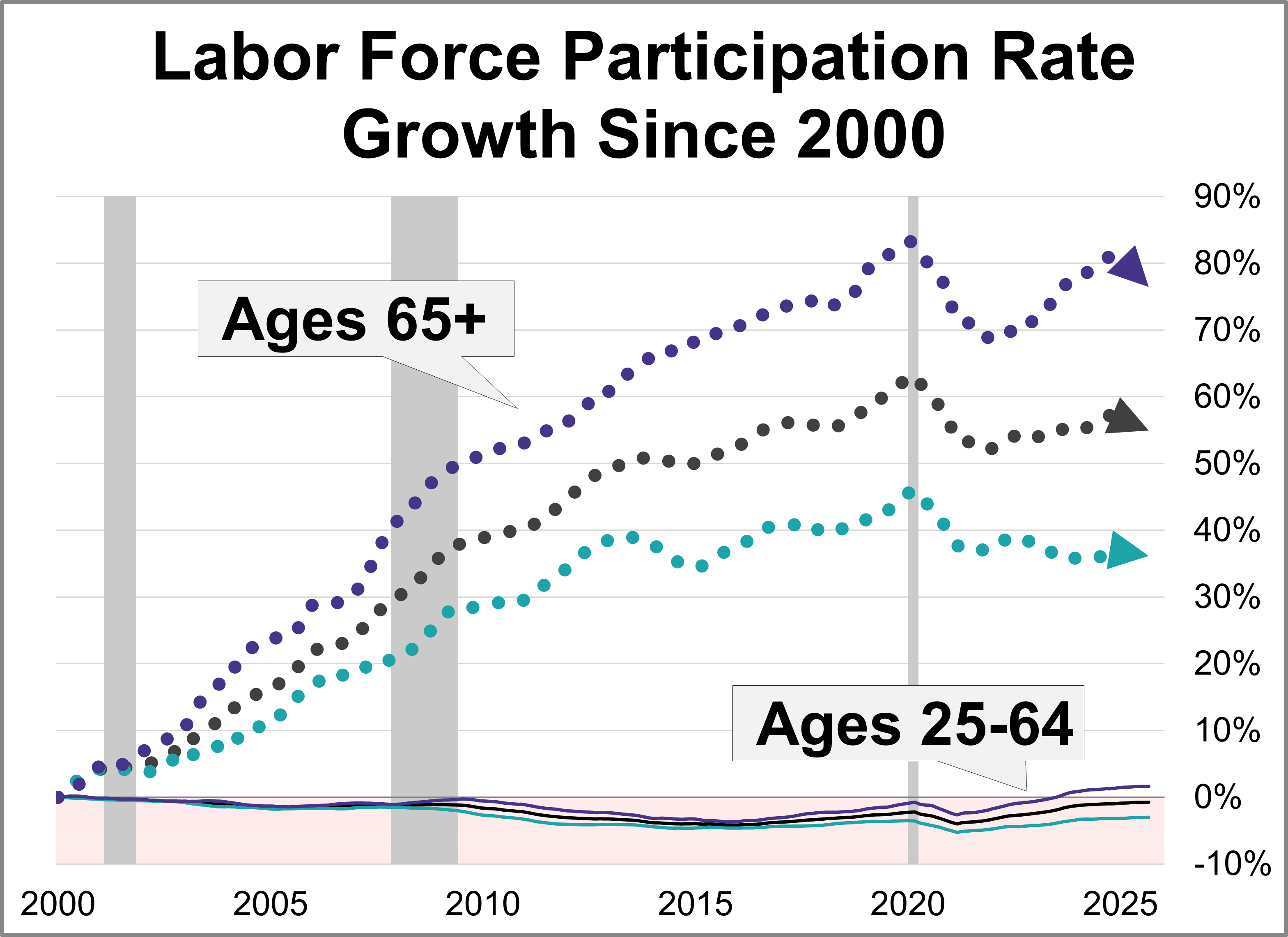
The labor force participation rate (LFPR) is a simple computation: You take the civilian labor force (people aged 16 and over employed or seeking employment) and divide it by the civilian non-institutional population (those 16 and over not in the military and or committed to an institution). As of September, the labor force participation rate is at 62.4%, up from 62.3% the previous month.
Investor certainty about a Federal Reserve interest rate cut in December has surged to approximately 80%, driven by signals from Fed officials and recent mixed economic data, especially regarding the labor market.
As investors shift away from volatile artificial intelligence stocks, the health-care sector has emerged as the clear winner this month, with the S&P 500 Health Care Index up 10%. This rotation, fueled by aggressive buying from hedge funds and mutual funds, reflects investor interest in defensive value amid concerns over an AI stock bubble.
Jeff Schulze, Head of Economic and Market Strategy at ClearBridge Investments, discusses key spending, employment and other policy factors he is following as we look forward to 2026.
Like ducks on a pond, markets often appear calm on the surface while churning furiously underneath. For financial markets, above the surface, attention has focused on equity market valuations and record-tight levels of credit spreads, but a deeper look reveals even more extreme dynamics below.
In a recent episode of the Money Metals podcast, host Mike Maharrey sits down with Jordan Roy-Byrne, CMT, MFTA, editor and publisher of The Daily Gold, to unpack where gold and silver are in the current cycle.
Yes, we may be in the second market bubble of this century. Alternatively, the market may be pricing in a shift as fundamental as the transition to either electricity or the internet. Either way, investors must think clearly, act deliberately, and avoid the kind of blind speculation that turned past booms into bloodbaths.
This article reviews historical and contemporary attempts by world leaders—from Nixon's price controls to European energy subsidies—to contain costs, ultimately illustrating the limits of policy intervention in combating inflation. While some measures provided temporary relief, the persistent challenge of high prices remains a central political concern.
This article explores gold's role as a distinct, independent alternative asset class, discussing its diversification benefits, and practical ways for investors to gain exposure.
Retail earnings ahead of Black Friday show a clear split: value-focused discounters like TJX and Walmart are thriving, while Target and home improvement stores struggle with consumer pullback on discretionary items. This shift reflects broader economic pressure, as consumers trade down due to high prices, weakening income sentiment, and increased reliance on credit.
Treasury yields edged lower, with the 10-year nearing 4%, as data affirming labor-market weakness and remarks from Federal Reserve Governor Stephen Miran bolstered expectations for an interest-rate cut next month.
Nvidia CEO Jensen Huang turned heads earlier this month when he told the Financial Times he believes China will win the artificial intelligence (AI) arms race due to the country’s expanding power capacity and lack of regulatory bottlenecks that slow things down here in the U.S.
Amid concerns that the traditional 60/40 investment mix no longer works, financial experts are recommending a 20 percent allocation to gold as a necessary portfolio adjustment. This shift is driven by the fact that gold is increasingly viewed as the most reliable hedge against inflation and government spending, unlike bonds which have lost their safe-haven status. Consequently, investors are initiating a "quiet revolution" by moving billions into gold ETFs.
Returns from emerging market bonds hinge on five factors, our economic research suggests. And for the first time in two decades, four of these are now favourable, heralding a new phase of outperformance for the asset class.
Although the September employment report surprised to the upside, the overall stance of the US labor market remains weak, something that was underscored by the third consecutive increase in the rate of unemployment, from 4.1% in June to 4.4% in September.
Many of you may have recently seen a chart circulating on the internet suggesting a nationwide collapse in home prices is on the way, that we are in the “biggest bubble in history,” the collapse is “inevitable and nothing can stop it.”
Federal Reserve Governor Christopher Waller said he’s advocating an interest-rate cut in December, though the US central bank can probably take more of a meeting-by-meeting approach starting in January once it receives a flood of economic data.
This article explores the growing changes and challenges facing the Federal Reserve. It argues that due to political pressure and fiscal irresponsibility from Congress, the Fed is losing its policy effectiveness and its long-held tradition of consensus voting is breaking down, leading to an era of unpredictable decisions.
AI looks like a classic investment bubble to us, with very high valuations and signs of rampant speculation. But we recognize that while many investors harbor fears that AI might be a bubble, they are far from sure of that fact and tend to assume the market is appropriately priced as a fairly strong prior.
Answers to questions investors are currently asking about Treasury bonds, tax policy, credit quality and other issues currently affecting fixed income investments.
We enter 2026 after a year of robust global stock gains on AI optimism, falling interest rates and a resilient world economy. Beneath this stability, however, lies a more fragile environment.
Last week's economic landscape was defined by conflicting signals from key indicators, suggesting a growing divergence between investor behavior and underlying consumer health.
This month’s Muni Monthly covers performance, supply and demand technicals, fundamentals and valuations for the month ending October 2025.
In times of uncertainty — whether in sport or in markets — the ability to separate fact from feeling — or ideology — is critical. This principle applies across leadership, investing and even today’s AI-driven economy.
The interview features Cynthia Murphy and John Davi, Founder, CEO, and CIO of Astoria Portfolio Advisors, discussing their firm's investment philosophy and the current market environment. Davi explains Astoria's three verticals: managing risk-based ETF portfolios, running quantitative stock selection models, and offering their own equity, fixed income, and alternative/real asset ETFs. The conversation highlights key market concerns like high inflation and the dominance of the "Mag Seven" stocks, with Davi recommending diversification into international stocks, mid-cap stocks, financials, industrials, and inflation-fighting strategies like gold and Bitcoin, especially for traditional 60/40 portfolios.
Alternative investments have already gained plenty of traction in 2025, and things may very well be the same for 2026. However, it’s crucial to evaluate which kind of alternative investments could provide a more potent use case than others.
The continued slump in the housing market is now being compounded by a weakening U.S. labor market and a surge in mass layoffs. This labor uncertainty is making potential buyers reluctant to commit to purchases, even as affordability improves and mortgage rates stabilize. This dynamic is leading homebuilders to reduce construction and staffing, further worsening the job market.
Every market needs speculation, but when it spreads into nearly every asset class, investors face a different kind of challenge. Sometimes the smartest move is the least exciting one.
With the federal government shutdown now over, until the end of January at a minimum, the money and bond markets have turned their attention back to the Fed. Specifically, the conjecture is centered on whether another rate cut will be forthcoming at the December 10 FOMC meeting.
In this Money Metals podcast episode, host Mike Maharrey talks with money manager Michael Pento of Pento Portfolio Strategies about what he sees as a dangerously distorted financial system.