For more than four decades, PIMCO’s Secular Forum has provided a disciplined framework for stepping back from short-term market noise to assess the structural forces that will shape the global economy and markets over the next five years. Yet rarely has this exercise been more consequential than it has recently.
After more than three years of underperformance, our prognosis for global health care stocks remains positive. The sector now offers a broader set of high-quality companies at valuations that appear increasingly disconnected from fair value.
All major U.S. stock indices fell last week, ending a remarkable run of nine straight weekly gains for the S&P 500. But the headline numbers hide an unusually lopsided story.
Begin with the print itself, because the headline flatters the internals only slightly. The bulk of May's gains came from leisure and hospitality, which added 70,000 jobs, nearly half of them in food services and drinking places; local government contributed 55,000, health care 35,000, and manufacturing a modest 7,000, while financial activities actually shed positions.
With the latest CPI report showing that inflation is likely here to stay, it could be time to pivot towards ETFs with downside protection.
Sentiment in the US stock market has shifted quickly from fear of missing out to fear of getting wiped out.
LPL Research analyzes bond markets as yields rise, exploring Fed policy expectations, inflation trends, and whether bad news is already priced into Treasuries.
Equity markets should remain supported by strong earnings and capital investment trends through 2026, but market concentration and macro risks leave less room for error.
The takeaway for both HY and EM corporates is straightforward. Once oil prices are above breakeven, further moves in oil tend to matter less for credit performance.
In Part 1, we explored why Dollar Dominance Remains Alive and Well. Today, we will explore the stronger-dollar trade, the one macro trade that nobody is sized for.
While job growth has reaccelerated, supporting consumption, the underlying income picture is less encouraging.
Investors have enjoyed a favorable run. If the year ended today, it would mark the seventh time in the last nine years that stock portfolios generated double-digit returns. Housing prices remain near historic highs, while bond investors have benefited from elevated yields over the past three years.
Building resilient portfolios in markets delivering mixed messages can be a challenging affair. In our ongoing engagement with the retail and advisor community at VettaFi, we hear first-hand just how investors are tackling that challenge this year.
Several articles enjoyed strong performance during the month of May, though there does not seem to have been a unifying theme, unless it is pointing out mistaken beliefs or unexamined conventions.
In his new book, “Risk & Reward: How to handle market volatility and build long-term wealth,” Ben Carlson relies on history to defend investing in U.S. stocks. Carlson calls the U.S. stock market “the greatest wealth-building machine ever created,” and nudges his readers into thinking its success will continue.
Interest rates remain one of the primary concerns for investors as Kevin Warsh has officially assumed leadership at the U.S. Federal Reserve (Fed). While we believe the possibility of a rate cut has diminished considerably, we are not yet expecting additional rate hikes.
Probably the most popular insight to make its way from finance theory into everyday usage is that "diversification is the only free lunch" in investing. The idea dates back to Harry Markowitz in 1952. He, and those building on his work, demonstrated that in an efficient market, investors shouldn't earn extra return for bearing company-specific risks that can be diversified away.
The rise in US yields has extended across the entire Treasury curve, creating a charged backdrop for Fed policymakers and their new chairman, Kevin Warsh, who helms his first meeting and press conference next week.
There is an old adage that the stock market climbs a wall of worry, which describes its ability to keep rising even amid negative economic news or events. This defies logic, yet I have watched it prove true time after time.
The job market was surprisingly strong in May with non-farm payrolls growing 172,000, beating even the strongest forecasts for the month. As a result, the futures market is now pricing in a quarter-point rate hike later this year and more likely than not another quarter point rate hike sometime in 2027.
It’s no secret that investors are on the lookout for opportunities in their fixed income portfolios. This is especially true in today’s shifting landscape. Equities are hot, perhaps too hot, and many investors want strong performances out of their bonds in order to keep up.
Fertilizers sit at the center of this transmission mechanism. As much as a third of the global supply of these commodities passes through the Strait of Hormuz, which has largely been closed for three months. This has triggered shortages and a price spike.
In case you’ve been living under a rock for the past few months, three of the world’s largest and most consequential private companies—SpaceX, Anthropic and OpenAI—are preparing to go public in the same year. Together, they could add nearly $4 trillion in market cap to public markets.
Labor market fundamentals have improved meaningfully from last year’s near standstill while inflation has moved higher, driven in part by the Iran conflict and the resulting increase in petroleum and gasoline prices. As a result, Federal Reserve (Fed) officials are likely becoming more concerned about the risk of broader inflation pressures, a theme highlighted in this week’s ISM Manufacturing and Services PMI releases.
Metals Focus has released its Gold Focus 2026 report. It includes comprehensive historical supply and demand data for 2017-25 and its 2026 forecast.
Chris Galipeau and Taylor Topoussis discuss high-conviction insights that go beyond media headlines.
We are halfway through 2026, and the planning priorities that have defined our client work this year are in focus. Some of what we are doing is recurring: fixing compliance errors, correcting quarterly estimate miscalculations, and keeping tax positions aligned with economic reality.
2026 is heading toward a four-peat of double-digit returns on U.S. stocks, but it will require P/Es to remain high — investors need to remain optimistic. In the past, when P/Es were high, investor fear kicked in and P/Es declined, causing stock market losses. Time will tell, but diversification is a reasonable strategy no matter the outcome.
US stocks bounced back on Monday from the worst rout this year, as a selloff in technology stocks eased and traders assessed flaring tensions in the Middle East, which supported oil prices and energy shares.
The bar for a Federal Reserve rate hike is falling as the job market remains robust in the face of stubborn price pressures, according to Collin Martin at the Schwab Center for Financial Research.
Our broad message for the second half of 2026 is this: Income still matters, but investors should be selective. Despite the recent rise in Treasury yields, we suggest investors favor a below-benchmark average duration with their bond holdings, favoring short- and intermediate-term maturities.
An increasing number of our neighbors are now retired. As they have made that transition, their sensitivity to the costs of living has increased, as has their skepticism over the way that inflation is measured. A common refrain: “I don’t care what the numbers say…things are REALLY expensive these days!”
With tech stocks pushing to new highs on enthusiasm around transformational technologies, the real question isn’t just momentum. It’s whether markets are becoming frothy, even bubble‑like, reminiscent of the dot‑com era. We don’t think so.
Trade policy returned to the spotlight this week as the United States announced new tariffs on 60 countries, with rates of either 10% or 12.5% depending on the trading partner.
The U.S. labor market took center stage last week as three major labor market indicators outperformed forecasts. Robust payroll additions in both the public and private sectors, paired with a massive surge in job openings, point to a workforce on solid footing.
For years, the retirement industry has framed the challenge the same way: Participants aren’t engaged enough. Employers need better communication. Advisors need to educate more.
In this episode of the Money Metals Midweek Memo, host Mike Maharrey argues that reports of inflation's demise have been greatly exaggerated. Drawing on both recent economic data and historical parallels, he contends that the United States may be entering a second wave of a broader long-term inflationary cycle reminiscent of the inflationary era of the 1960s and 1970s.
The latest Emerging Markets Insights discusses companies across various sectors that have expressed cautious optimism for the second half of 2026 despite ongoing geopolitical pressures and higher input costs. Templeton Global Investments highlight what they observed at a recently attended summit.
Currencies in the developing world sank after a blowout US jobs report provided the clearest sign yet that the labor market is breaking out of a prolonged period of lackluster hiring, undercutting the case for rate cuts from the Federal Reserve.
On June 4, Vanguard launched the Vanguard U.S. High-Yield Corporate Bond Index ETF (VCHY) on the Cboe BZX. VCHY provides ultra-low-cost exposure to higher-yield U.S. corporate bonds. It comes with an expense ratio of just five basis points.
Bond ETFs secured a record $64 billion in monthly inflows, driving total fixed-income ETF assets above $2.5 trillion.
There are short duration bonds and corresponding ETFs. For advisors and fixed income investors who really want to minimize interest rate risk, there are ultra-short alternatives. Those products are worth considering this year.
The U.S. economy appears resilient, judging from key economic measures. AI-driven capex continues to power investment, support equity markets, and sustain a wealth effect that has propped up consumption. Real GDP growth remains positive. Private sector balance sheets are in generally good condition and many higher income and wealthy households have benefited from equity markets gains.
Climate change has become a defining force in geopolitics. As governments respond to record heat waves, floods, wildfires and droughts, their policies and economic posturing are reshaping manufacturing, trade and energy security across the capital markets.
The rise in U.S. Treasury (UST) yields, specifically the ten-year note, since late February has captured the attention of global investors in a very visible fashion. Just a couple of weeks ago, headlines were blaring that the UST 10-year yield had reached its highest level since the beginning of 2025, leaving market participants to wonder: What comes next?
We are expecting inflation in energy prices and a decline in interest rates when the poop hits the AI mania fan. For these reasons, we are overweight in oil stocks and home builders. These industries prospered in the 1970s, once the stock market mania broke in late 1972!
While insurance coverage has broadly kept pace with rising catastrophe exposure, the protection gap — in absolute terms — has gone up as the value of exposed assets has grown, the Swiss Re Institute said on Wednesday.
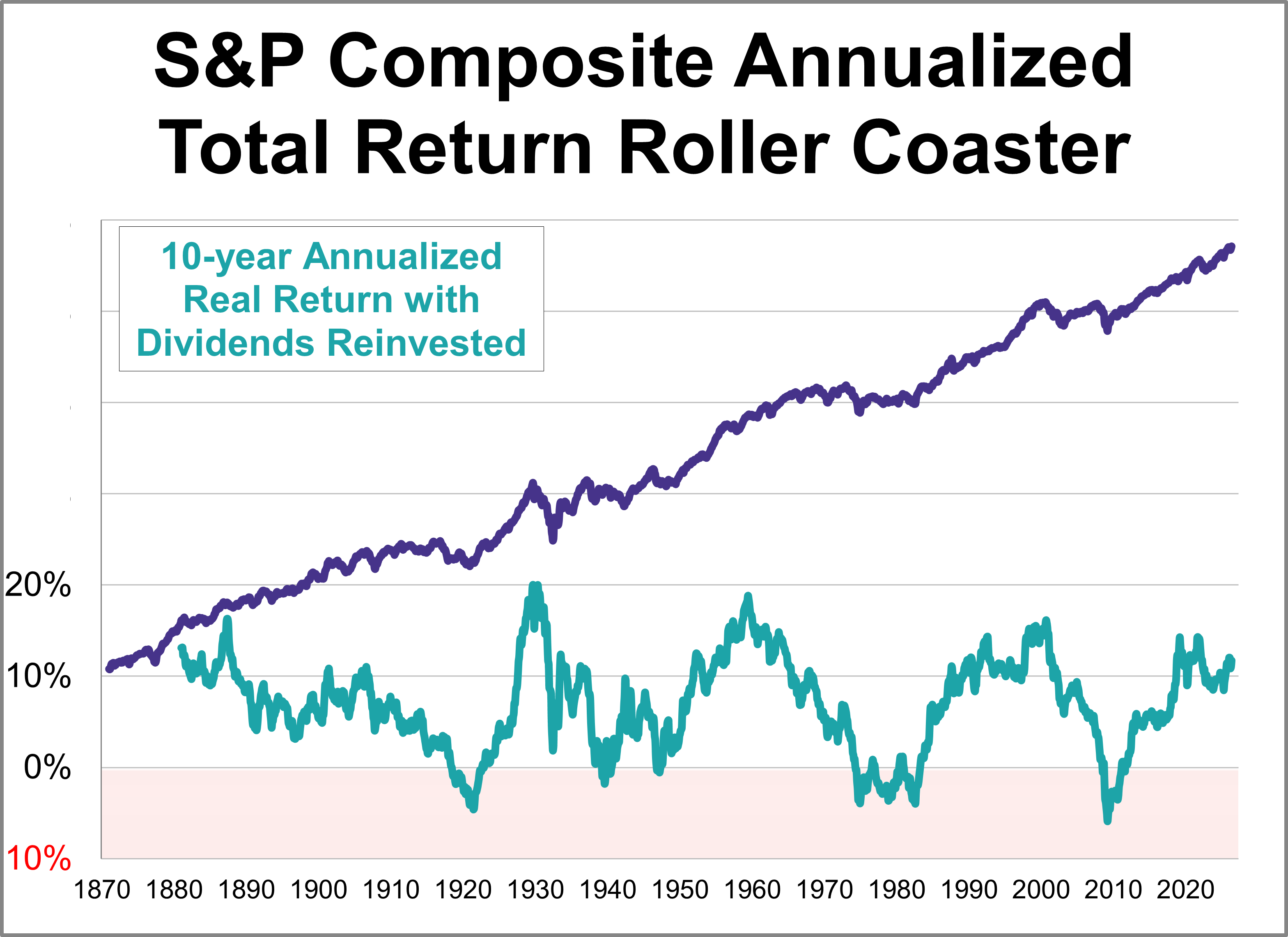
Here's an interesting set of charts that will especially resonate with those of us who follow economic and market cycles. Imagine that five years ago you invested $10,000 in the S&P 500. How much would it be worth today, with dividends reinvested but adjusted for inflation?
Despite rising global yields and renewed inflation concerns, equities moved higher in May on the back of a strong US earnings season and continued momentum in AI-related stocks. The tech-heavy Nasdaq Composite gained 8.4% for the month, while the S&P 500 rose 5.3% and the Dow Jones Industrial Average was up 2.9%.
Stocks extended their advance for a ninth consecutive week, with the S&P 500 rising more than 5 percent in May on the heels of April’s 10 percent rally. This nine-week run coincides with the market’s March 30 bottom, when early signs of a potential off-ramp or ceasefire in the Middle East began to emerge.