At least for now, the US government has avoided a shutdown. Stephen Dover, Head of Franklin Templeton Institute, opines on what may come next after this temporary resolution, and the impacts on the markets.
At a pivotal time for monetary policy around the world, Capital Group fixed income portfolio manager Tom Reithinger offers his outlook for inflation and the impact it’s having on global interest rates.
More than two years and over 500 basis points later, the Federal Reserve (the “Fed”) has executed one of its most aggressive monetary policy moves in decades, bringing the Federal Funds rate (the rate that banks charge each other to borrow or lend excess reserves overnight) to a current target range of 5.25%-5.5%.
There are compelling arguments that interest rates will remain low rather than rise.
The Federal Reserve may be putting its hoped-for soft landing of the economy at risk by tacitly accepting a run-up in long-term interest rates to the highest levels since 2007.
While government shutdowns impact the economy directly and indirectly, the magnitude of the impact is determined by the length and scope of the shutdown. Some operations can continue in a “partial shutdown” scenario, and thus impact the economy differently.
India will need to think beyond physical assets to continue its growth.
Good news for bond investors: yields are likely to stay higher for longer. We share strategies for making the most of this environment.
News of a liquidity crisis at China's largest property developer, Country Garden, has rekindled fears about the scale of the country's real estate problems and potential ripple effects. And Country Garden is not alone.
Plenty of ink has been spilled about how much money has gone into active ETFs in 2023, and from a pure top-line flows perspective, it’s true.
If you go to a financial adviser to chat about investments, here’s how your first meeting will probably go: They will ask you about your attitude to risk. How much money are you prepared to lose?
The queue of soothsayers warning of impending doom is lengthening; growing concern about US domestic politics as well as the global economic backdrop risks sparking a full-blown market rout.
Stock bulls reeling from the worst month of 2023 have at least one reason for optimism: Corporate profits are set to rebound sharply in the fourth quarter.
Rising rates in the second half of the year have brought year-to-date returns for the US Aggregate (“Agg”) benchmark index negative.
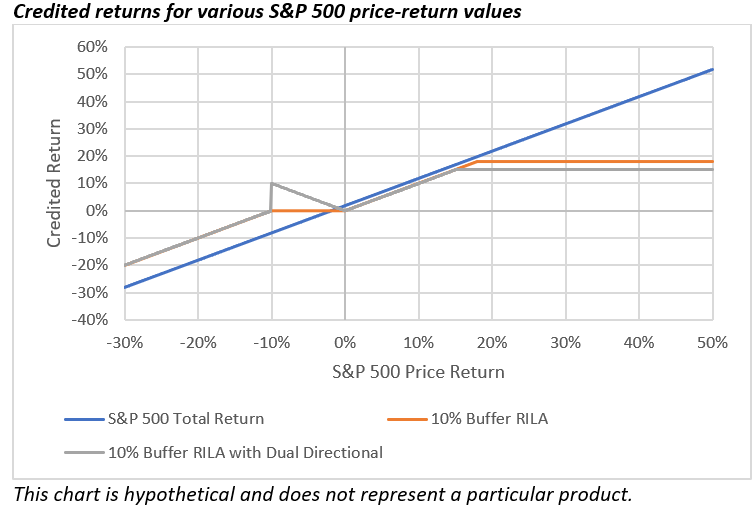
I explore the efficacy of traditional RILAs and those that offer dual-directional crediting. I use a total-portfolio context with a portfolio-optimization approach based on utility theory.
VettaFi’s Tom Hendrickson and Jane Edmonson discuss the firm’s recent acquisition of EQM Indexes and offer several predictions on the future of thematic investing. F/m Investments’ Alex Morris explains why the firm is pursuing a mutual fund share class of their single treasury bond ETFs. Vanguard’s Rich Powers highlights their private equity offering and its potential benefits to investors.
Many Americans believe that Gen Z is financially illiterate and uninformed. But the story is not that simple.
SECURE 2.0 contained a provision that gave favorable treatment to partial annuitization. The reason you haven’t heard about this is because those transactions cannot increase commissionable income.
Money-management firms launched new exchange-traded funds at a rapid pace last month, shaking off fears that the $7 trillion industry is already overrun with low-cost investment vehicles.
Certificates of deposit (CDs) and Treasuries both can offer steady, predictable investment income—but how to decide between them? Here are five factors to help you choose.
From inflationary tailwinds for earnings growth to corporate reforms that unlock shareholder value, multiple regime shifts are underway to restore the appeal of the Japanese equity market, according to the Templeton Global Equity Group team.
Public credit markets offer high quality investments with attractive yields and downside resilience, while we see growing longer-term opportunities in private markets.
Downside equity market volatility can be unsettling, but it is important to put the pullback in perspective and identify the drivers of the negative market reaction. First and foremost, the equity market was due for a modest pullback.
With negligible incremental risk, a RAFI Global Index hypothetically outperformed a Cap-Weighted Global Index by 40 bps per annum and a Cap-Weighted Global Value Index by 2.2% from 2007 to 2022—a 16-year period covering the long value rout and its aftermath.
Common aphorisms and assumed truths about stock returns often imply the disappearance of risk over long horizons. Is that accurate?
The third quarter was a story of dashed hopes in emerging markets, with the unraveling of some of the most profitable trades in the asset class.
The degree of success of muni impact bonds often stems from showing issuers how they’ll be graded.
The S&P 500 has fallen almost 3% within the past month, highlighting the volatility that typically hits at the end of the summer. For volatility through the end of 2023, investors may want to consider two active ETFs from American Century.
The commercial real estate sector’s continued challenges could potentially impact US banks. Franklin Templeton Fixed Income’s Shawn Lyons discusses the ongoing commercial real estate crisis and how US banks are safeguarding themselves against these issues.
Preferred stocks are what’s known as hybrid securities, meaning the asset class displays both equity and fixed income characteristics.
Certain asset classes thrive or lag as economies move through one cycle to the next. Franklin Templeton Institute’s Tony Davidow shares how to analyze different economic indicators and how asset classes perform through economic regime changes.
The Chinese yuan has lost nearly 6% of its value against the U.S. dollar this year, while Shanghai-listed stocks are off about 8% from their 2023 high, set back in May.
The prevailing narrative about the U.S. economy is that it’s ‘resilient’: despite rapid rate hikes, economic growth has held up and may even be accelerating.
We believe a mild U.S. recession is more likely than not in 2024, although a soft-landing scenario cannot be ruled out. A recession is also likely in the UK and eurozone, but appears less likely in Australia.
It was the week that bond markets finally seemed to grasp what central bankers have been warning all year: higher interest rates are here to stay.
Rising real interest rates invariably trigger recessions. The residual impact of pandemic related behaviors delayed the impact in this cycle.
Avocado toast, hard seltzers, and Instagrammable vacations are not the reasons millennials and our Gen Z compatriots have failed to scrimp, save and budget our way into home ownership.
Since 2012, Puerto Rico has offered investors — primarily mainland Americans — one of the most attractive deals in the world: move to the commonwealth and pay no taxes on interest, dividends or capital gains, all while living on a balmy and culturally vibrant Caribbean island without having to surrender US citizenship.
The Bank of Japan met last night to cap off a week of central bank activity.
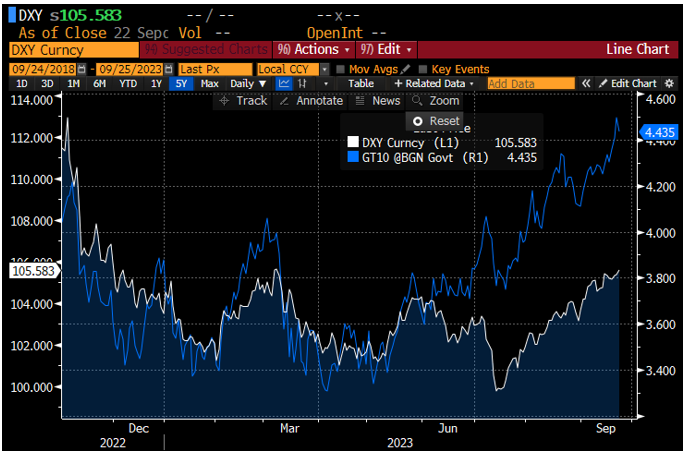
Despite the Fed’s aggressive monetary tightening and the regional banking crisis earlier this year, the U.S. economy has been surprisingly resilient. Bond yields continue to rise, with long-term Treasuries at their highest level since October 2007.
Gilt prices have been struggling this past year due to surging inflation and interest-rate increases. David Zahn, Franklin Templeton Fixed Income’s Head of European Fixed Income, shares his outlook for the UK economy and why he thinks now is a good time to consider investing in gilts.
Intermission is over. Today we resume my series on the global cycle theories that, probably not by coincidence, all point to major change unfolding in the next few years. Finishing it may take some time since I keep finding new material.
Anyone who even casually pays attention to the financial media has likely become familiar with the current state of inflation as well as how high interest rates have risen over the past ~2 years.
Like any recovering reporter, I like to keep tabs on my old beats, and the marijuana ETF space never disappoints. Or, perhaps more accurately, it never stops disappointing.
The Federal Reserve’s preferred measure of underlying inflation rose at the slowest monthly pace since late 2020, helping to lay the groundwork for policymakers to forgo an interest-rate hike at their next meeting.
The JPMorgan Asset Management money manager at the helm of the largest active exchange-traded fund in the $7.2 trillion industry is coming to market with another equity strategy geared toward investors bracing for a period of uncertainty.
Quarterly commentary giving an overview of the markets and the importance of having and implementing a strategy when investing in the markets.
The post-Covid era seems ripe for a Yogi-ism since economists and policymakers have been so wrong about the path of the economy and inflation. Yes, inflation is finally on a downward trend, but it has proven far stickier than the Federal Reserve and most economists predicted and remains above the Fed’s 2% target.
Monetary tightening still continues in the form of quantitative tightening, bringing potential volatility, earnings pressures, and lackluster performance to stock markets.
In our latest Quarterly Letter, Ben Inker and John Pease discuss the new economic regime, how investors can prepare for a recession, and the merits of combining high quality and cheap assets in today’s environment.