If you really want to reduce the federal debt, you don’t have to convince Congress of anything. You can just write a check. The Treasury Department gladly accepts gifts from anyone so inclined.
If today were the last day of 2023, Bitcoin would have returned almost 155%, marking the best year since 2020, when it rose a phenomenal 305%.
Mutual Series sees an increasing number of investment opportunities in real assets.
While inflation isn’t yet at the 2% range that the Federal Reserve has been targeting, it’s getting there. At least, it’s getting close enough for it to ease up on the gas on raising interest rates. In fact, the Fed could pump the brakes next year.
With stocks racing to record highs, diminishing expectations of a recession, and hopes that the Federal Reserve could potentially reduce interest rates multiple times next year, risk appetite is being reborn.
China stocks have been a source of frustration for investors this year. But there are expectations that situation will improve in 2024. The key is selectivity. That means market participants shouldn’t wager on uniformly stellar returns by China equities next year.
John Baldi, Portfolio Manager at ClearBridge Investments, examines the evolving US equity income landscape and shares his strategies for generating income and growth, while also aiming to manage risk in uncertain economic and market conditions.
It’s been the year of active equity ETFs, the year of covered call ETFs, and a year when growth and quality has mattered most in the equity market. All of this is now clear from the year-to-date net inflows and fund performance records.
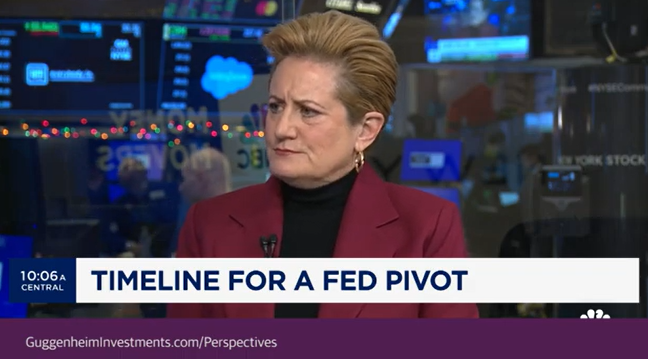
Anne Walsh, Chief Investment Officer for Guggenheim Partners Investment Management, joins CNBC to discuss Federal Reserve policy and its effect on credit markets heading into 2024.
BlackRock Inc. bond chief Rick Rieder is expanding his footprint in the $7.8 trillion ETF industry with the launch of his second fund.
With the lagging effect of elevated interest rates potentially cooling the appetite of the economic growth engine that is the U.S. consumer, Global Head of Multi-Asset Adam Hetts at Janus Henderson Investors explains why he believes investors should take a defensive stance by prioritizing quality companies and cross-asset diversification.
In the past five years, US ETF market assets have more than doubled, over 1,000 new funds launched, and annual trading volumes jumped by around $11 trillion.
The decision to hold the federal funds rate steady was in line with expectations, but the accompanying statement and projections indicate a shift toward easing in 2024.
In this video, Chuck Carnevale, Co-Founder of FAST Graphs, a.k.a. Mr. Valuation will take a look at Utility Stocks in the Utility Sector. Chuck will discuss the characteristics of companies in this sector and what to expect from them.
Macroeconomic uncertainty remains elevated. We believe a recession in 2024 is more likely than not. Non-profit hospital systems have faced significant operational pressures, and may continue to experience challenges in the near-term.
In the latest episode of our Alternative Allocations podcast, Franklin Templeton Institute’s Tony Davidow discusses asset allocation and portfolio construction with Aaron Filbeck, Managing Director of the Chartered Alternative Investment Analyst Association.
The VettaFi Market Outlook Symposium brought together industry thought leaders and experts to help investors position for 2024.
Biodiversity is an emerging, and increasingly important, issue for managers to consider in investment management.
To date, we have found that due to limited data, tools and knowledge, the integration of biodiversity factors in investment research remains limited. Within the investment community, calls are growing to measure the impact and dependencies on biodiversity in portfolios. Market participants appear to be recognizing the importance and magnitude of potential risks and opportunities at play.
US stock and bond prices will see modest gains as the Federal Reserve pivots to cutting interest rates next year, though the easing may not be as aggressive as markets are now expecting.
After clashing in recent years, Wall Street traders and the Federal Reserve are – for once – broadly in sync: The great monetary pivot is near as central bankers engineer a once-unthinkable soft landing in the world’s largest economy.
A secure lifetime income solution can seamlessly continue the “do it for me” structure that has helped DC plan participants save in their working years.
Doug Drabik discusses fixed income market conditions and offers insight for bond investors.
As GMO launches its first ETF, it seemed like a good time to share my thoughts on the market inefficiency that the strategy seeks to exploit – the quality anomaly.
Learn how financial advisors turn to outsourcing to strengthen client relationships, grow total assets, increase personal income, and improve work-life balance.
Figuring out how to pay for college can be one of your biggest financial challenges, whether you’re a student or a parent who’s preparing to send one of your kids to school.
Municipal bonds posted historic total returns of 5.90% in November. Rallying interest rates led the way, while strong demand aided outperformance versus Treasuries.
To argue that the U.S. consumer has remained resilient has become a cliché and at the same time an understatement. After a very strong increase in real incomes during the pandemic, real income growth started to slow considerably.
Value stocks are poised to deliver solid returns in what may prove to be a more unsettled year ahead, according to Mutual Series CIO Christian Correa.
With Americans living longer and deferring retirement for lots of reasons, the retirement planning landscape is changing. Employers are not offering pensions, and the age to maximize Social Security benefits is increasing. All these factors make planning for retirement income crucial. We’ll explore this in depth with my guest, Matt DiGangi.
As an advisor specializing in retirement planning, I frequently work with professionals who want to explore early retirement.
Domestic aggregate bond strategies are on pace for decent showings this year. And there is mounting speculation that the Federal Reserve will lower interest rates next year, perhaps multiple times.
Investors are beginning to price in a 'soft landing' as the base case over the next 12 months. This is evident across a number of indicators.
It’s the time of year when you look back at all that’s been accomplished. VettaFi’s covered strong net inflows into fixed income ETFs, covered call funds, and many, many, many new product launches. But VettaFi also accomplished a lot as a firm.
The change in tone from the Fed Chairman regarding inflation suggests that rates may have peaked. This month, we're highlighting the positive performance of the markets, with the S&P 500 approaching levels last seen in July. We're also experiencing an improvement in consumer confidence as things remain relatively healthy despite housing costs.
Passive investing means buy and hold, and that’s not what I do for my own portfolio or recommend to clients. Here are eight ways I’m an active investor.
The chief risk for your clients who are in retirement or approaching that phase of life is the solvency of Social Security.
Last year was a record one for personal income taxes in the US and close to a record for taxes overall.
You’re young. You’ve got a little money to put away every month. You aren’t madly engaged with markets. But you want to invest for the long term in a low-cost, properly diversified manner. What do you do? Ask almost anyone and you will get the same answer.
A review of recent US inflation data, the Recession Risk Dashboard, and thoughts on if we’ve reached the peak in the fed funds rate. Join us for this conversation with Jeff Schulze of ClearBridge Investments.
Following a tumultuous 2022, this year has been better, though not entirely sanguine for fixed income investors. 2024 is right around the corner, and expectations of rate cuts by the Federal Reserve are rising. Now is the ideal time for advisors to evaluate opportunities in the bond market.
It’s been a very good year for U.S. high yield. In fact, BondBloxx Investment Management has noted that riskier fixed income assets have outperformed U.S. Treasuries.
We see potential opportunity in municipal bonds in 2024, although there may be more volatility.
One thing you learn when writing about the debt problem, as I have been in recent weeks, is that many people think it’s not a problem at all.
Airline consolidation is not only relatively common but necessary for growth and competitiveness, and the recent announcement of Alaska Airlines’ planned acquisition of Hawaiian Airlines is a prime example of this trend.
The Franklin Templeton Fixed Income team believes that sustainable investing will be a dominant investment trend in the coming years, with structural tailwinds that could help improve financial returns.
The Market Outlook Symposium is coming on December 14. The latest symposium from VettaFi will offer investors a deep and incisive look at how to position for 2024 and beyond. In today’s unusual market environment, this is a critical topic.
Funds will begin paying out their 2023 distributions this month which could lead to a tax bill for your clients. While capital gains distributions will likely be lower this year than in recent years, interest income is expected to be higher.
The financial markets, investor opinions, and world events have been all over the place – so bear with me this morning as I am going all over the place with a variety of year-to-date observations and comments.
Stephen Dover, Head of Franklin Templeton Institute, recently sat down with Franklin Templeton Fixed Income Portfolio Manager Josh Lohmeier and Western Asset Portfolio Manager Mark Lindbloom to discuss the fixed income landscape—and why they believe 2024 will be a good year for fixed income investors.
It’s possible that a 2024 recession could be avoided, but we see recessions risks as remaining elevated in most developed markets. We believe there is limited upside for equities amid expensive valuations and recession concerns. Government bond valuations, however, look attractive in the U.S., UK, Canada, Germany and Australia.