Political risk is global in 2024: Franklin Templeton Institute’s Kim Catechis highlights key elections to watch across the world in the coming year.
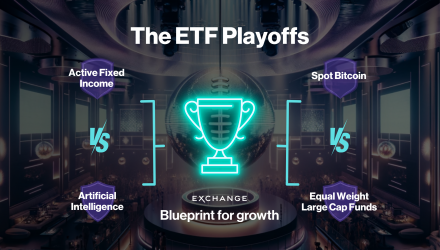
The ETF Playoffs have reached the final round. This weekend, spot bitcoin ETFs will square off against artificial intelligence to see who gets to be the champion of 2024! The winners were determined by vote on Exchange’s LinkedIn page. With the championship nigh, voting for the winner will open soon.
The basic tenets of building wealth, like having a well-diversified portfolio with long time horizons, are not difficult concepts that are relatively easy to implement. So, why don’t people follow them? In our latest insight, we analyze several risk/return charts across multiple time horizons and reveal the results that investors tend to find surprising.
The residential real estate market will continue to be at the mercy of interest rate policy throughout 2024, but there are other corners of the real estate market to consider. One active exchange traded fund, in particular, takes a different approach to real estate.
As expected, the Fed held rates steady in January, but importantly downplayed the likelihood that rate cuts will start as soon as March.
In this article, Russ Koesterich discusses why a different approach to portfolio construction within equities is warranted in 2024.
For Tesla Inc., being the tenth most valuable company with the greatest market capitalization and fastest growing profitability of any maker of cars and trucks, is seemingly atrocious.
US gross domestic product surprised to the upside in the fourth quarter of 2023, primarily led by US consumers and the government. Franklin Fixed Income Economist Nikhil Mohan sees the growth mix remaining largely the same in 2024.
For many investors, fixed income investments have a primary objective of preserving wealth. The known characteristics of owning individual bonds are a major reason for this: known income, known cash flow, known redemption date, known redemption value.
A renewed sense of optimism emerged during the fourth quarter, sparking an increase in U.S. equity trading volumes and a rally in risk-on fixed income assets.
As the calendar closed on 2023, investors were once again treated to magnificent returns in their stock and bond portfolio.
Income investors have an overwhelming number of investment options today. The menu ranges from traditional fixed income to equity investments like REITs to innovative covered call ETFs to more exotic vehicles.
History shows that monetary policy drives investment performance. When the Federal Reserve (Fed) hikes or cuts the fed funds target rate in response to economic conditions—or stays on hold while it assesses the data—performance will differ by sector.
The first round of the ETF Playoffs has concluded! Exchange, a conference for financial services professionals, is happening in Miami, February 11-14. Since Exchange is hosting a party for the big game at Miami’s hottest club, LIV, we’re hosting an ETF championship bracket.
If artificial intelligence is going to live up to the hype, Goldman Sachs analysts said recently, the excitement stage of AI needs to shift drastically this year into a period of meaningful deployment.
Economic growth in the US is off to a better start than expected this year, thanks largely to a long-awaited pickup in consumers buying “stuff” again after they shifted spending to experiences in 2022.
Trading in bonds these days means having to put up with more frequent market gyrations — and that’s just fine with big investors like Pimco and BlackRock Inc.
Regulatory conflation between financial advice and investment advice detrimentally impacts how financial services are delivered to our citizens.
Market expectations have established a high bar for central banks' rate cuts. Any disappointment like stronger inflation or economic growth could spark market volatility.
Prior to 2022, many retail investors likely eschewed buying individual Treasury bonds from the U.S. government. That’s because they didn’t offer much in the way of income.
Andy Rothman reviews data points that offer insights into the coming quarters.
To celebrate the pending Exchange conference, VettaFi and some key industry partners were at the Nasdaq MarketSite to help ring the opening bell last week. Exchange will be the industry’s largest ETF-, and most valuable advisor-focused, conference.
This week, follow Exchange on LinkedIn and vote for your favorite ETF trends of 2024.
A comfortable retirement is supposed to be the culmination of the American dream, yet far too many actual Americans are falling short of achieving it. In the spirit of fan fiction, I'd like to set up a better ending.
The latest economic data for the US are better than most dared hope a year ago. Inflation has fallen much faster than the Federal Reserve expected, and so far without the abrupt economic slowdown and higher unemployment that many economists thought likely.
Last July, I issued an open letter to the annuity industry requesting the introduction of a product to meet the needs of independent advisors who adhere to a safety-first, goals-based investing philosophy. That call has been answered.
Can inflation continue to decline, and what will drive it down?
Emerging markets debt proved sturdy in 2023. And more of the same could be on the way this year. That’s because fixed income investors are looking outside of the U.S. for elevated levels of income.
More institutional investors are exploring infrastructure for diversification, income and stable return potential as well as inflation protection. Investors are looking at both the traditional segments and newer digital sectors along with renewables.
In the middle of 2023 we argued that, according to our forecast for GDP at the time for the whole of 2023, employment was growing too fast and that it would have to slow considerably during the second half of the year.
A traditional 60/40 stock/bond portfolio has been a tried and tested strategy among financial planners. But income seekers can specifically reap the benefits of both assets with exposure to one active exchange-traded fund: the NEOS Enhanced Income Aggregate Bond ETF (BNDI).
The European Central Bank left interest rates unchanged, without conveying any urgency to start cutting rates in the next few months. David Zahn, Franklin Templeton Fixed Income’s Head of European Fixed Income, weighs in on the implications for investors—and why lengthening duration may make sense.
Advisor Perspectives recently asked its community they are recommending the new spot bitcoin ETFs. Many made incorrect statements in their efforts to justify their opposition.
Much discussion of economics since the publication of Thomas Piketty’s book has indeed been influenced by his data and analytic framework.
The number of studies showing the success of universal basic income programs continues to mount. The latest comes from the Federal Reserve Bank of Minneapolis, which recently released its initial report on a pilot project designed to test the feasibility of so-called UBI.
Bond traders looking for something to jolt the $27 trillion Treasury market out of its recent rut will probably still be left waiting for answers, even after a busy week packed with a Federal Reserve meeting, the government’s quarterly debt-sale plans and a slew of economic data.
A recent report from the International Monetary Fund (IMF) has projected that AI will affect almost two out of every five jobs done by humans around the world. AI of course will impact work that is already somewhat or totally automated.
Interest rates in most parts of the world appear to be stabilizing, as inflation trends continue to decline from the high levels seen in the summer of 2022. Learn more about the implications for hedge fund strategies from K2 Advisors.
This dividend aristocrat has increased their dividend for 67 consecutive years. How’s that for reliability? But the best part is it’s finally in the cheap buy range for value investors.
Many investors buy individual bonds as a means to preserve their wealth. They can serve as a method to balance growth assets (such as stocks).
While 2023 was the year of Fed rate hikes, the fixed income market is expecting 2024 to be the year of rate cuts. At the December 2023 meeting, the Federal Reserve’s own guidance was for three 25 basis point reductions in 2024.
The Federal Reserve’s preferred gauge of underlying inflation rose at the slowest annual pace in nearly three years while consumers spent at a robust rate, keeping the debate alive as to whether officials will soon cut borrowing costs.
Credit quality in the muni market likely has peaked, but we believe states' strong rainy-day funds and other attributes will lend stability in the near term.
The expectation of higher corporate earnings in 2024 could help prop up the actively managed NEOS S&P 500 High Income ETF (SPYI). Of course, capital markets are brimming with optimism, with the expectation of rate cuts to come.
Registered investment advisors have long leaned on the 60% equities/40% fixed income portfolio structure. While it’s not perfect, it has served clients well, broadly speaking.
Defensive equity strategies that limit downside losses but lag too much in up-markets may be missing the mark. Is there another way to reduce volatility?
Amid expectations that the worst case scenario for interest rates this year is that the Federal Reserve will halt its tightening cycle, some fixed income investors may be inclined to take their eyes of floating rate notes (FRNs).
The anticipation of rate cuts to come this year is making for a busy bond month to start 2024. Now, regional banks are adding to corporate bond sales, according to data from Bank of America.
When markets are volatile, it's tempting to move into cash. But those high yields on short-term cash instruments aren't as attractive once taxes and inflation are factored in.
According to my guest today, the lagging effects of central bank tightening will lead to a further deceleration in growth, a mild U.S. recession, anemic growth in Europe, but more resilience in emerging markets. Past episodes of high U.S. inflation suggest it will take about two years to bring core inflation down by half from its peak level. Equity valuations are stretched, particularly in big tech. Monetary authorities have decreased their support. And governments have probably already reached the limits of the fiscal stimulus they can provide.
Given those challenges, you will learn about the opportunities for investors across a range of asset classes. There are quality U.S. and international stocks that trade at reasonable valuations and stand to benefit from important technology and secular trends. The expectation of lower interest rates in the future is creating opportunities in fixed income markets. That is in longer duration and in niche parts of the market like cat bonds and agencies.