These days, high-yield US bonds yield just 378 basis points over Treasuries, more than 2 percentage points below the 2022 high and close to the narrowest gap since the Federal Reserve started raising interest rates last year.
Can the Federal Reserve engineer a soft landing, in which it defeats excessive inflation without tipping the US economy into recession? This week, Fed officials will offer important clues as to whether that’s achievable.
Fifty cents on the dollar is a very low price in the world of bonds. In most cases, it signals that investors believe the seller of the debt is in such financial distress that it could default.
Have you ever wondered why your closing ratio on seminar attendees rarely exceeds 40%?
US stocks continued their slog through the end of summer, but the S&P 500 Index just notched a resiliency milestone not seen in five years.
When markets are in a rising tide, all boats (aka stocks) can benefit. When the waters are choppier, active equity selection aims to identify the sounder vessels. Tony DeSpirito reviews five reasons why he believes the new environment is setting up to favor an active approach.
The FOMC will make some close calls and tough decisions.
Confidence is returning to the bond markets and one sign is corporations’ willingness to start taking on debt again with new issuance.
Markets are convinced that the Federal Reserve (Fed) is going to pause its interest rate campaign after it finalizes its Federal Open Market Committee (FOMC) meeting on Wednesday, September 20.
Despite substantial growth and huge advancements in public policy support, clean energy has had an abysmal stretch in the stock market the last two and a half years.
The University of Colorado Buffaloes are undefeated and suck up a lot of oxygen in the college football world.
VettaFi’s Dave Nadig covers the launch of the first ETF holding 0DTE options, along with IPOs in ETFs, flows, and stories to watch moving forward. Astoria’s John Davi spotlights their recently launched U.S. Quality Kings ETF (ROE) and discusses current model portfolio positioning. Fort Washington Investment Advisors’ Laura Mayfield explains the management process behind two Touchstone ETFs, including their Securitized Income ETF (TSEC).
Managing volatility is a high priority for advisors. The right investments can stabilize a portfolio and dampen volatility, while keeping goals on track. Increasing bond allocations used to be the standard way to reduce volatility, but with bonds more correlated to equities, their diversification value has decreased. With high inflation, bonds also aren’t providing enough real income for many investors.
Demand for private credit has increased because of its low correlation to traditional equities and bonds, and enhanced income potential. As an asset class, private credit has a history of resiliency throughout economic downturns. That was true during the pandemic, and last year when these types of loans largely held up, in contrast to the bond market which had historically bad performance.
My guest today will discuss how advisors can reduce volatility, increase income and diversify equity and bond allocations through private credit and other alternatives.
Here’s how I apply behavioral finance to help clients to think differently about their investing.
Economists are playing a game of “can-you-top-this this,” seeing who can ramp up their US economic growth forecasts the most.
Okay, I took a little poetic license, but the point is that while we try, predictions of the future are difficult at best and impossible at worst.
Amid signs the bond market has bought into the Federal Reserve keeping interest rates higher for longer, a cohort of investors is placing bets on the economy hitting a wall — and a sharp policy reversal in short order.
Stock-market strategists who were largely wrong about this year’s rally are finally starting to come to face their mistake, raising year-end targets for the S&P 500 Index.
Federal Reserve policymakers’ updated forecasts for their benchmark interest rate, due Wednesday, are looming as a key potential decider for a US Treasuries market at risk of a third straight year of losses.
Forced deleveraging to be chaotic, causing a new Fed and banking panic.
In a significant turnaround for its aviation sector, Mexico’s air safety rating was upgraded from Category 2 back to Category 1 by the Federal Aviation Administration (FAA). The upgrade could be a game-changer, offering opportunities for both Mexican airlines and their U.S. joint venture partners.
Competing narratives have emerged to describe the state of the U.S. economy.
Soft consumer confidence and property-market woes are playing a large role in the slowdown of China’s economy.
The Northern Trust Economics team shares its outlook for U.S. growth, employment, interest rates and inflation.
Now, is it an oversimplification to say that the upgrade to GDP growth is just down to Taylor Swift and Beyoncé? It is, to a degree, no matter how popular they are—and they are very popular indeed.
Bearish China traders have had the upper hand for most of the year. Still, easing deflation could give bulls a glimmer of hope.
The Energizer Bunny! That’s the term that best describes the U.S. economy.
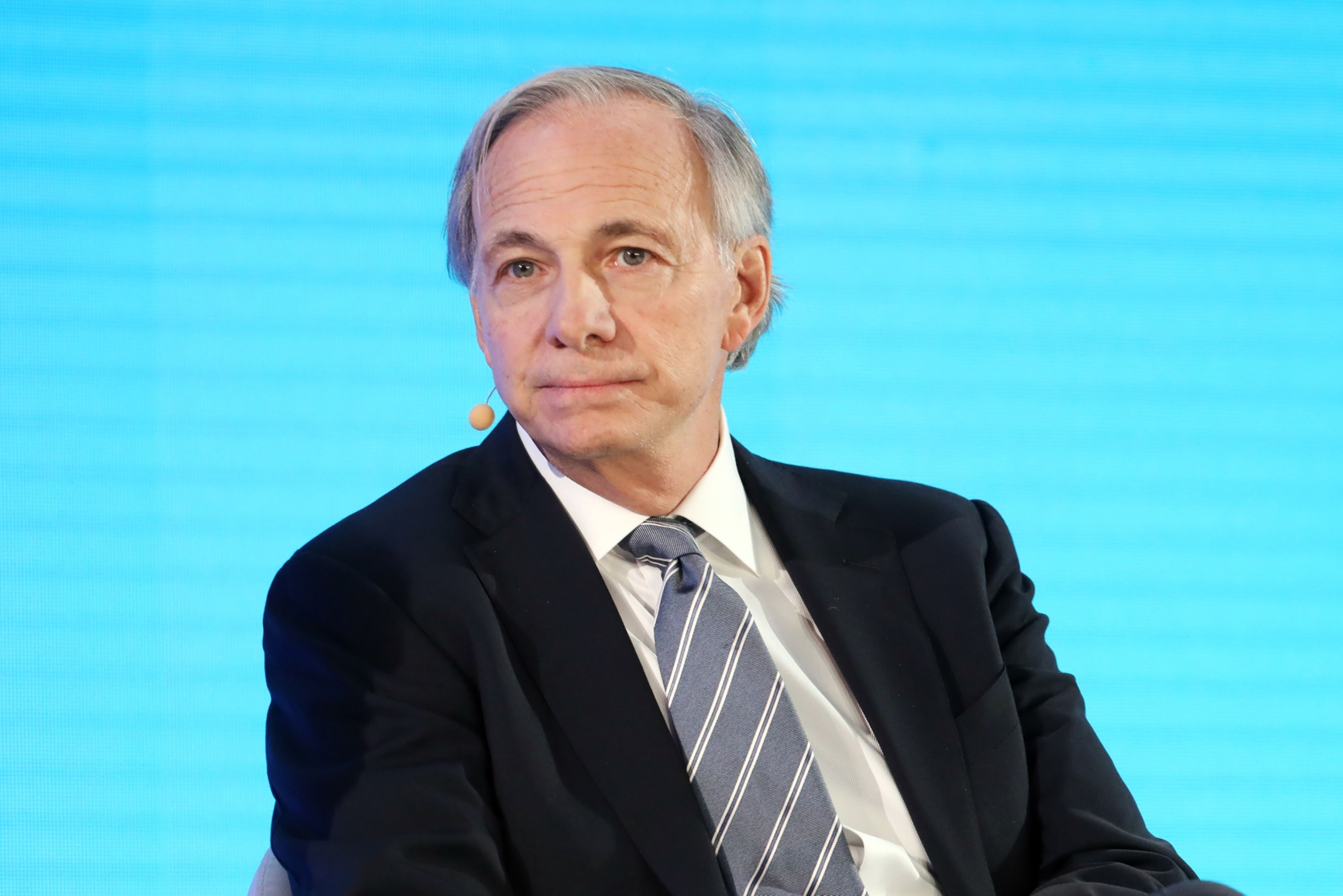
Bridgewater Associates LP founder Ray Dalio said he doesn’t want to own bonds and prefers cash, highlighting difficulties investors face as global central banks try to manage inflation.
Equity funds saw the biggest weekly inflow in 18 months amid growing investor confidence the US economy is headed for a soft landing, according to Bank of America Corp.
Hear from Jeff Schulze, Head of Economic and Market Strategy at ClearBridge Investments, about the state of the US economy. Get his perspective on the Federal Reserve’s next potential moves.
Although US bond yields are well above their lows of the past decade, it’s always a good idea to think globally.
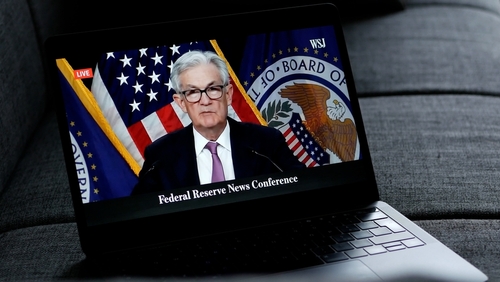
Federal Reserve Chairman Jerome Powell and his colleagues are likely to shy away from signaling that they’re done raising interest rates when they meet next week.
The consensus is wrong, and the Fed has not engineered a “soft landing.” A recession is all but certain in the first half of next year, according to Jeffrey Gundlach.
Americans are downbeat about the economy, even as inflation rates rapidly decline back toward more normal levels, the unemployment rate has held below 4% for the longest stretch since the late 1960s and economists race to raise their growth forecasts.
A resilient US economy will prompt the Federal Reserve to pencil in one more interest-rate hike this year and stay at the peak level next year for longer than previously expected, according to economists surveyed by Bloomberg News.
All week, stock traders have shrugged off everything from hot inflation data in the US to another recession-threatening hike in interest rates over in Europe.
Inflation averaged 1.8% in the ten years pre-COVID. Don’t expect inflation to average that low in the decade ahead. Not until the US finds a way to repeat the 1980s policy mix.
The 10-year Treasury yield has climbed steadily over the past two years. But we believe fixed-income investors should be prepared for lower yields ahead.
Measuring, anticipating and controlling the cost of healthcare are all difficult.
How long will the Federal Reserve continue quantitative tightening (QT)? How large will its balance sheet be when QT ends? These important questions impact financial market liquidity, the anchor of asset values. We assess the likely path of QT in the years ahead.
That’s a bold prediction in the title. I believe it will come true.
A recent paper analyzing the correlation between stock and bond returns going back to 1875 suggests the relationship of the past quarter century is shifting in an uncertain inflationary environment. The results might stimulate some investors to rethink their portfolio allocations.
Expectations of central-bank interventions are helping to steady emerging-market currencies, even as traders adjust to a higher-for-longer regime for developed market interest rates.
The US bond market hasn’t flashed recession warnings so consistently for so long in at least six decades.
In this first episode, Franklin Templeton Institute’s Tony Davidow discusses the democratization of alternative investments and related topics with CAIA’s John Bowman.
Inflation Update featuring Sam Rines, Managing Director, Corbu LLC
VettaFi’s vice chairman Tom Lydon discussed the iShares MSCI USA Quality Factor ETF (QUAL) on this week’s “ETF of the Week” podcast with Chuck Jaffe of “Money Life.”
Many advisors aren’t familiar with financial phobias. They are common and can be debilitating.
Normalizing economic activity and the slow but steadily growing lag effect will result in a recession.
Since the beginning of the year, economic data has continued to defy the recession calls of 2022.