Noble Prize winners and “Modern Portfolio Theory” pioneers Harry Markowitz and William Sharpe developed what we know today as the 60-40 portfolio. This strategy consisted of a hypothetical 60 percent allocation to equities and a 40 percent allocation to fixed income.
Actively managed ETFs continue to gain traction. After a strong 2023, active ETFs gathered 34% of the net inflows in the first two months of 2024. Impressive for an asset category that still represents 6% of overall industry assets.
Concerns that Nvidia Corp.’s stratospheric gains might be unsustainable have spread to ESG investment managers who beat the market last year by betting big on the stock.
In this paper, GMO proposes a novel approach to financing emerging countries’ transitions toward cleaner energy production. Indeed, we believe a significant opportunity exists across two dimensions: greenhouse gas (GHG) emissions reduction and investment returns.
We get granular as the environment for risk-taking is supportive for now. That’s why we like euro area high yield credit, emerging market debt and U.S. stocks.
The average expected return on asset (EROA) assumption for the largest U.S.-listed pension plan sponsors increased to 6.70% in 2023—the first time a year-over-year increase has been observed in 19 years of records.
After Covid-19 arrived in 2020, a lot of wealthy people fled locked-down California. Elon Musk, the world’s second-richest human, moved to Texas, griping that the Golden State had become “a little complacent, a little entitled.”
The Fed is talking about cutting rates and reducing QT. The only rationale for it in such an environment is a concern with liquidity problems.
Treasuries held modest gains ahead of remarks from Federal Reserve Chair Jerome Powell and key labor-market data, which are set to test bond investors’ conviction about interest-rate cuts in the US.
Rodney Comegys, Global Head of Vanguard Equity Index Group, offers actionable insights to investors on how to select active strategies that can help them achieve investment success.
Investor sentiment and stock market valuations are getting increasingly stretched as indexes trek higher, but solid underlying breadth has been a positive offset for now.
This PIMCO Perspectives assesses how the term premium’s 40-year downturn could start to reverse.
The economy continues to hum along (Atlanta Fed 1Q24 GDP estimate: +3.0%), albeit shifting down a notch from the pace seen in the final quarters of last year.
The shift from a regime of secular stagnation to one of reflation is contributing to both a broadening of global earnings growth and significantly higher dispersion in company results and performance.
Amid a 2023 market rally, exchange-traded fund (ETF) inflows had a banner year, putting the mutual fund industry further on notice that ETF popularity continues to grow exponentially. Furthermore, the move toward ETFs should increase investor exposure to active funds that focus on bonds.
Despite what headlines say, expensive M&A isn’t the only way to grow a firm.
Washington DC continues to spend much more than it gets in revenue. In the Calendar Year of 2023, the federal government spent $6.3 trillion but only collected $4.5 trillion in taxes.
US households are now paying roughly as much interest on other kinds of debt, from credit cards to student loans, as they are on their mortgages, according to the latest numbers from the Bureau of Economic Analysis.
European nations still have a long energy transition ahead.
22%. That is the average increase in potential retirement spending that individual savers in defined contribution plans can achieve when they embed guaranteed retirement income solutions into a target date fund. For lower-income workers, it’s a 25% increase.
Real Estate Investment Trusts (REITs) have long been thought of as a great source for income investors seeking higher than average income as well as good growth and income.
Personal income increased more than expected in January, up 1.0% (or $233.7 billion). The increase in January closely matches what happened in January of 2023 when it increased by 0.95% (or $213 billion).
Many fixed income investors have started venturing out in duration in portfolios. When interest rates are cut, high-quality duration could serve as an important hedge for a bond portfolio.
How much of your income should you spend on rent or a house payment?
Why are we prone to irrational behavior as investors? Why do we too often sell when we should buy and buy when we should sell? Market history is replete with examples of this behavioral dynamic.
This lessening of government involvement, and the change in the corporate culture, together with a new or reinterpreted economic philosophy all combined to produce an unraveling of the United States that had for some time been incredibly materially productive for the benefit of all.
There’s been a lot of excitement and reporting about a new ETF: the Alpha Architect 1-3 Month Box ETF (ticker BOXX), designed to give investors the return of short-term US Treasury Bills with the tax character of long-term capital gains.
The apparent disconnect between the state of the US economy and voters’ perceptions of it has puzzled economists for months. Unemployment is low, inflation has come way down and real wages are no longer lagging behind.
Traders surprised by this year’s painful rise in bond yields are still looking to snap up US debt given their ongoing assumption the US economy will eventually slow in 2024.
Nvidia Corp.’s rise is captivating the stock market and driving the S&P 500 Index to new highs. But it also raises cautionary reminders of another investor darling that soared on dreams of a technological transformation, only to tumble back to earth when those hopes turned to disappointment.
OPEC+ strategies and geopolitical tensions could roil markets.
Ed Perks, Chief Investment Officer of Franklin Income Investors, explores the impact of these changes on the fixed income and equity markets and offers insights regarding opportunities in different asset classes.
Equity investors didn't mind the extra day this February as both domestic large-cap stocks and small-to-mid-cap stocks saw steady gains through the month, bringing both groups into positive territory year-to-date, though the latter continues to lag.
Not all investment returns are the same. Some are taxed at a higher rate than others. The Form 1099-DIV can help you analyze the Investment Tax Health of your clients. By looking at how much the investor received in different investment returns, you can calculate how much federal tax they will need to pay.
Investors continue to turn to low-cost core taxable bond ETFs in 2024. The Vanguard Total Bond Market ETF (BND) and the iShares Core Aggregate Bond ETF (AGG) gathered $2.5 billion and $2.1 billion, respectively, as of late February.
Today, we have a different kind of letter. I’ve been in California for some rather innovative and hopefully life/health span-extending medical treatment.
An investment program with dedicated but limited internal resources can extend its staff through a strategic partnership with an external investment solutions provider.
Multi-asset income strategies are becoming more popular, but some may bake in more risk than expected. The key is designing complementary exposures.
One of the hottest products for retail investors the last couple of years is the single-stock option-income exchange-traded fund. While the basic idea is similar to the old and respectable covered-call writing strategy, the modern versions grabbing attention and dollars are supercharged, promising income yields of 100% or more.
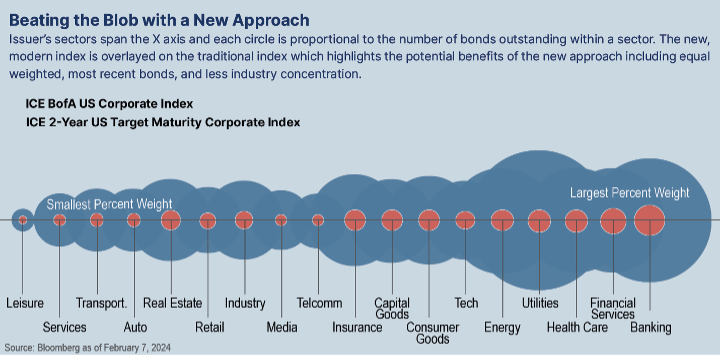
Why the traditional methodology for bond index construction needed a new, investor-focused approach.
Rob Tayloe discusses fixed income market conditions and offers insight for bond investors.
The 2024 survey found US workers are prioritizing higher compensation and the ability to save more for retirement. At the same time, employers’ perceptions of what workers are seeking has diverged. In this piece, our Jacque Reardon shares findings from the survey and potential implications for employers.
Thanks to artificial intelligence (AI) and investors still holding out hope that rate cuts will happen at some point, global equities are marching higher. That rally could eventually spill over into other assets like international bonds.
We hope you enjoy the latest Newsletter from Harold Evensky.
Like travel agents, real estate agents will need to offer more value and be more available to those willing to pay. They can also be my friend, so long as they don’t charge too high a commission.
Colm Kelleher whipped up a storm at the end of last year when the UBS Group AG chairman warned of a dangerous bubble in private credit.
Adding real assets to a stock and bond portfolio can help boost returns and smooth volatility when inflation runs above 2%.
In this FAST Graphs stock analysis, Chuck Carnevale, Co-Founder of FAST Graphs, a.k.a. Mr. Valuation will cover eBay. eBay’s momentum seems to be changing – is now the time to be taking a position in eBay for both growth and income?
Dina Ting, Head of Global Index Portfolio Management for Franklin Templeton Exchange-Traded Funds, delves into these positive developments and sheds light on Japan’s expanding economic prospects.
In this article, Russ Koesterich discusses the reason behind the recent resiliency of stocks, despite rising rates.