The direction of interest rates was the biggest factor moving markets in the third quarter. Sentiment on technology stocks appeared to shift. Money market assets reach historic high, but returns lag stock market.
Geopolitical factors and higher-for-longer interest rates have taken the steam out of 2023’s equities rally the past few months. But the recent rate pause could clear the path for gains in the S&P 500 for the remainder of the year.
In this period of higher interest rates, the quest to capture alpha and mitigate risk in corporate credit requires a more refined approach.
Federal Reserve Chair Jerome Powell said the central bank must be willing to think beyond the complex mathematical simulations it traditionally uses to forecast the economy.
Given the likelihood that economists are again myopic in their inflation forecasts and bond traders are betting on such projections, I see a day soon when a disinflationary or deflationary reality hits the bond market and bond yields plummet.
Alarm bells sounded Friday when we learned that the US unemployment rate rose to 3.9% for October, well above the 50-year low of 3.4% that it hit earlier in the year. The latest reading is still very low, so what’s with the doomsayers telling us a recession has arrived?
Here are six key trends for HNW donors to consider during your giving season conversations.
Hoisington Investment Management Co. was pummeled by its bullish stance on US bonds in recent years, driving its Treasury fund to some of the industry’s biggest losses as the Federal Reserve’s rate hikes sent prices tumbling.
Following a strong first half of 2023, third-quarter returns were more challenged across almost all asset classes. One outlier was high-yield debt, which often serves as a way to de-risk equity exposures when stocks are under pressure.
After the October/November meeting, it seems that Fed officials have an added objective, as Fed Chair Jerome Powell said during the press conference that they needed to see interest rates “persistently high.”
Policy changes at the Bank of Japan could potentially reverse capital flows, shift global yields higher, contribute to a stronger yen, and increase the value of Japanese stocks.
With the race to year-end now upon us, I share my thoughts on why, despite the recent reset and higher rates, I still see several reasons for market optimism for the remainder of the year.
Billionaire Stan Druckenmiller isn’t letting up on his criticism of US Treasury Secretary Janet Yellen. Druckenmiller says Yellen committed an epic mistake by failing to meaningfully term out America’s debt when rates were ultra-low — a missed opportunity he’s characterized as “the biggest blunder in the history of the Treasury.”
For years, Dutch payments fintech Adyen NV’s founders and management ran things their own way, thanks to some blowout growth.
The S&P 500 Index’s best week in a year has brought the broad equities benchmark to a decisive point where stocks can make a significant break higher or find their gains capped.
A record flood of cash has poured into opposite ends of the US Treasury yield curve this year, seeking either to seize on the highest short-term interest payments in over two decades or profit from a long-bond rally once rates finally peaked.
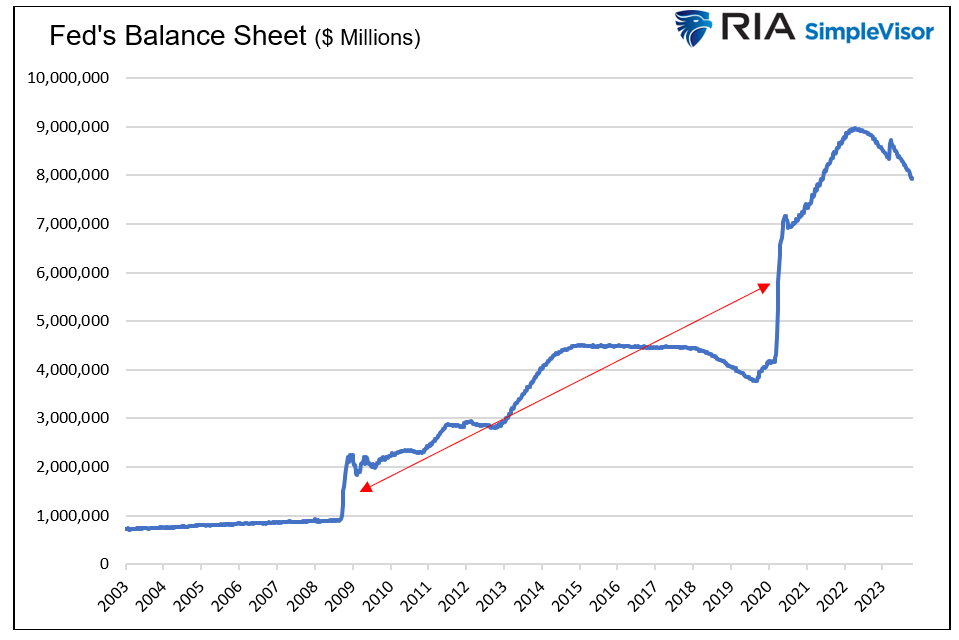
The Federal Reserve (Fed) elected to not raise the federal funds rate at the October/November 2023 Federal Open Market Committee (FOMC) meeting.
Financial markets have changed dramatically since balanced portfolios were introduced to investors decades ago. As markets evolve and grow more complex, active management plays a greater role in the success of these strategies, which offer a mix of 60% equities and 40% fixed income.
Two weeks ago, the yield on the 10-year Treasury Note was hovering around 5%, and the S&P 500 was in contraction territory, down over 10%.
Many commentators are struck by the disconnect between the US economy’s impressive performance of late and the dismal popular view of the very same economy.
What’s the most important price in the global economy? The price of oil? The price of semiconductors? The price of a Big Mac? More important than any of these is the price of money. For more than three decades it was falling.
A prospect that might have seemed unthinkable just a couple short weeks ago is coming into view for bond traders: The potential for US Treasuries to post an annual gain for the first time since 2020.
Advisors face a number of challenges in current markets, given risks and stock and bond correlations. They must grapple with how to invest smartly as well as keeping their clients invested in the traditional 60/40 portfolio.
While 3Q23 growth showed the economy expanded at a 4.9% annualized rate, it is important to remember that the GDP report is backward-looking.
While bond prices are generally down, the income they provide is up, providing potential opportunities for fixed income investors.
In Q3, the strongest performance among factors was seen in developed ex-U.S. large cap and small cap and U.S. small cap, where Value outperformed by 4.9%, 3.3% and 3.3%, respectively. The weakest performance among factors was in U.S. small cap, where the Size factor underperformed by -2.4%.
Tighter financial conditions prompted Federal Reserve officials to take a step back from data dependence, and suggest a higher bar for future hikes.
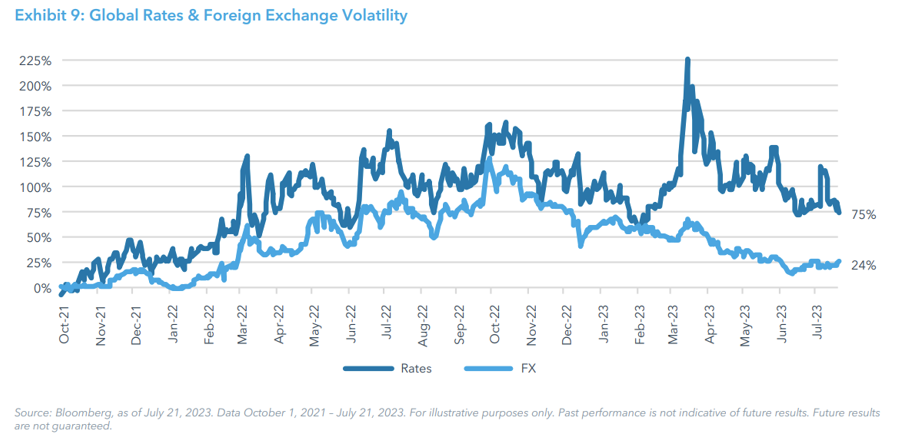
Higher macro and market volatility, along with greater dispersion, creates a favorable environment for active trading, according to K2 Advisors. Get the team’s latest hedge-fund strategy outlook.
US job growth slowed in October by more than expected and the unemployment rate rose to an almost two-year high of 3.9%, indicating that employers’ strong demand for workers is beginning to cool.
Identifying problems is great. Identifying solutions is even better, especially when the politicians who are supposed to be solving our big problems don’t even try.
Cathie Wood says she would unambiguously wager on Bitcoin — rather than gold or cash — to safeguard against the possibility of deflation in the coming decade.
The return of inflation has altered the investing landscape in a way last seen more than half a century ago.
Recent economic data, we believe, suggests sticky inflation with positive GDP growth is more likely in 2024 than a soft landing. We expect that interest rates will stay higher for longer on the back of increased Treasury supply and hawkish Federal Reserve rhetoric.
Investment taxes can have a real impact on a portfolio. Investors should be aware of four key tax realities they currently face. Without a plan to manage these taxes, investors may find their ability to retire comfortably could be compromised.
With unanimity, the Fed opted to keep the fed funds rate unchanged but remains attentive to the idea that inflation risk should still be paid attention to.
Yields on 10-year Treasury notes plummeted 20 basis points on Wednesday, the most since the banking crisis in March. For all the macroeconomic news of the day, it was hard to pinpoint exactly what changed so meaningfully from one trading session to the next.
Companies with healthy balance sheets are some of the best performing stocks this year, and their shares could keep rising, according to Piper Sandler & Co. strategists led by Michael Kantrowitz.
The Fed kept rates unchanged at today’s meeting, but whether they are done with rate hikes or simply at a pause is yet to be determined.
The US economy just enjoyed its strongest quarterly growth outside of the pandemic era since 2014, expanding at a 4.9% annualized rate in the three months ended Sept. 30.
It’s been a great year for alternative income strategies as inflation, interest rate, and recession risk fears dominated markets. Garrett Paolella of NEOS and Christian Magoon of Amplify ETFs joined VettaFi’s Tom Lydon to discuss alternative income opportunities at the Income Strategy Symposium hosted by VettaFi on October 27.
Less than a third of Gen Z feels financially secure while just more than half feels “very or extremely worried about not having enough money,” according to a recent study by consulting firm EY. “Welcome, the water’s warm!” says every American millennial.
The US Federal Reserve thinks it can take a break. As Fed officials see it, they need only sit back and wait while the monetary tightening they’ve already done gradually takes hold, slowing the economy and pushing inflation back down to the central bank’s 2% target.
Washington seems determined to ignore the country’s rapidly worsening fiscal picture, but sooner or later policymakers will be forced to pay attention. When they do, they’ll find that changes to Social Security are unavoidable.
MicroStrategy Inc. Chairman Michael Saylor’s strategy of buying Bitcoin may be coming into question as the advent of exchange-traded funds holding the largest cryptocurrency appears imminent.
Advisors plan to allocate more to fixed income ETFs as 2024 approaches. In a poll conducted by VettaFi, attendees were asked what bond changes they were considering heading into year-end. And 60% of respondents said they plan to add to fixed income ETF exposure using proceeds from cash and/or equities.
Recently, I was asked by a client what my return expectations are for the next three years.
Economists no longer expect a recession. Such was according to a recent WSJ survey of Wall Street economists.
Contrary to many analysts’ expectations, emerging markets have not spiraled into a debt crisis. This can be partly attributed to central banks’ decision to reject populist policy proposals in favor of a modern iteration of macroeconomic orthodoxy.
The US Treasury increased its planned sales of longer-term securities by slightly less than most major dealers expected in its quarterly debt-issuance plan, in a move that signals officials may be concerned about the surge in yields over the past several months.
Inflation has been coming down since its peak in the summer of 2022. Because the U.S. has so far avoided a recession, soft-landing hopes have risen along with the decline in inflation.